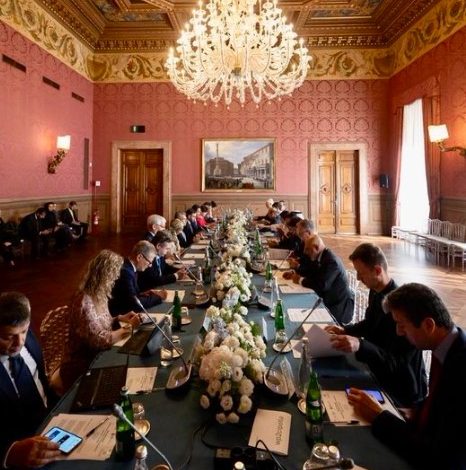
Saudi Arabia has stressed the need for new approaches to security and stability as the region is undergoing a profound strategic reshaping.
The Kingdom’s statement came during the Gulf-Mediterranean Summit, organized by the Istituto Affari Internazionali (IAI) in Rome, putting strong emphasis on the Palestinian cause’s centrality to any serious vision for regional security.
Gulf-Med Dialogue
Under the title “A Strategic Dialogue for Stability and Economic Cooperation,” the Gulf-Mediterranean Summit convened advisers, negotiators and experts from Saudi Arabia, Kuwait, Lebanon, Palestine, Qatar and Türkiye, along with representatives of the Italian Ministry of Foreign Affairs and International Cooperation, the European Union, and UNHCR.
The closed-door sessions focused heavily on navigating regional stability in the wake of recent geopolitical shifts, including the signing of the Islamabad Memorandum of Understanding (MoU) between the US and Iran and the ensuing technical talks aimed at reaching a final agreement.
The meeting addressed primary crises impacting the Middle East, including Gaza, Lebanon, Iran and the Strait of Hormuz, as well as the prospects for ongoing diplomatic negotiations.
In light of these challenges, the talks explored potential paths for mediation and the expanding influence of the Gulf States, whose growing diplomatic, economic, and strategic weight positions them well to help forge new regional frameworks in close coordination with Mediterranean partners.
The discussions also expanded to cover strategic sectors such as finance, energy and defense, in order to address the issue of economic development and regional infrastructure, paying special attention to the interconnection between security, economic growth and connectivity.
Throughout the sessions, participants stressed the importance of improving coordination frameworks to better connect diplomatic initiatives with infrastructure and development strategies.
Inclusive Approach
The Saudi Minister Plenipotentiary at the Ministry of Foreign Affairs, Dr. Manal Radwan, took part in the Gulf-Mediterranean Summit, alongside officials, diplomats, and experts from the Gulf, the Middle East, and Europe, according to the Saudi Press Agency (SPA).
Yesterday, we hosted the Med-Gulf Summit, organised with the support of @CSP_live–Fondazione CSF, bringing together senior representatives from Saudi Arabia, Iraq, Kuwait, Lebanon, Palestine, Qatar and Türkiye, with officials from @ItalyMFA, the EU, UNHCR and regional think tanks pic.twitter.com/FqCTjlD6KJ
— Istituto Affari Internazionali – IAI (@IAIonline) June 25, 2026
In her speech, Radwan highlighted the deep strategic restructuring unfolding in the region, emphasizing the urgent need for new inclusive approaches to security and stability.
She noted that policies grounded in hegemony or a total reliance on military force are incapable of delivering long-term security, stressing that the region requires more comprehensive frameworks for dialogue, cooperation, and collective security.
Advocating Palestinian Rights
Radwan reaffirmed Saudi Arabia’s position on the Palestinian cause, emphasizing its centrality to any viable vision for regional security. She warned that the persistent humanitarian deterioration in the Gaza Strip, settlement expansion and annexation in the West Bank, and the erosion of final status issues – chief among them Al-Quds Al-Sharif (Jerusalem) – undermine the prospects for both regional and international stability.
Furthermore, the Saudi representative said that the legitimate national rights of the Palestinian people, chief of which is their right to self-determination and the establishment of an independent state, must constitute the basis of any future political track.
She also noted that ending the occupation and holding Israel accountable for its violations are fundamental prerequisites for achieving a just peace and sustainable regional security.
Gulf-Europe Partnership
Radwan highlighted the importance of respecting state sovereignty, adhering to the principle of non-interference in internal affairs, and halting all efforts aimed at weakening or undermining state institutions.
Additionally, she emphasized the need to preserve freedom of navigation, the security of maritime corridors, and global supply chains, while reaffirming the vital need to advance the Gulf-European partnership to effectively address mutual challenges across energy, the digital economy, and strategic infrastructure.
Concluding her speech, Radwan said that achieving real progress requires coordinated collective action and a cohesive regional and international partnership capable of addressing the root causes of crises and promoting security, stability, and development in the region.