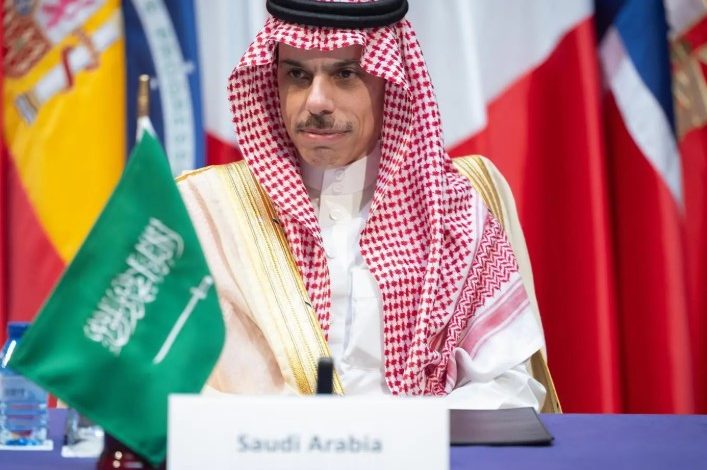
Saudi Arabia’s Foreign Minister Prince Faisal bin Farhan highlighted the significance of the newly announced US-Iran deal as a crucial step toward resolving long-standing disputes, but stressed that the upcoming negotiations must address broader regional concerns.
Speaking at the annual meeting of the European Council on Foreign Relations (ECFR) in Vienna on Wednesday, Prince Faisal pointed to the need for a robust, long-term verification regime for any agreement to be sustainable.
The Saudi Foreign Minister’s remarks came hours after the US and Iran officially signed a preliminary deal that halted the fighting, reopened the Strait of Hormuz and kicked off a 60-day negotiation period to discuss disputed issues, most notably Tehran’s nuclear program.
Pivotal Step
In his remarks, Prince Faisal welcomed the US-Iran preliminary deal as “incredibly important” and a significant step that will end the conflict and open the pathway toward resolving many of the outstanding disputes, chief among them being the nuclear issue.
He also expressed optimism regarding the US and Iran’s commitment to diplomacy to settle their disputes. “I am optimistic that there is real intent on both sides to give diplomacy a chance,” he noted.
Verification Safeguards
The Saudi Foreign Minister said that while the deal includes clear commitments to resolve the nuclear issue, the durability of any future agreement will depend heavily on establishing robust verification mechanisms.
“The detail will matter. It will be most important to see the verification mechanisms that are in place,” he said. “How we will have a long-term sustainable verification regime is what will matter the most,” he added, noting that this is what will restore the confidence of regional countries and the wider international community.
Moreover, he pointed to the importance of ensuring that Iran has a civilian nuclear program that imposes no risk to its neighbors.
“I’m certainly going to be very vocal in advocating for ensuring that whatever agreement is reached is a solid agreement that has the necessary safeguards and the necessary verification mechanisms,” he said.
Regional Security Framework
Prince Faisal noted that the US-Iran talks need to address other issues of concern, including freedom of navigation in the Strait of Hormuz and the broader regional security concerns.
Consequently, he argued that regional countries and Iran need to launch a security dialogue to address these issues and build a regional framework that respects the sovereignty and national security interests of all parties.
Saudi Arabia's Foreign Minister Prince Faisal bin Farhan's message at #ACM2026 was clear: the Iran-US MOU is a significant opportunity to put an end to this conflict and open the pathway towards resolving many of the outstanding issues. The primary among them is the nuclear… pic.twitter.com/wz0Ibenn0d
— ECFR (@ecfr) June 18, 2026
The Saudi Foreign Minister warned of the risks posed by leaving many regional issues unresolved, citing the 2015 Iran nuclear deal, widely known as the JCPOA.
“One of the lessons that we learned from the JCPOA, which also ignored the regional context completely, is that if we don’t address the issues that concern the region, the risk is always that any agreement on the nuclear issue becomes less secure and becomes a source of contention,” Prince Faisal said.
“I firmly believe that there is a need to address all of the issues that concern the region,” he added, noting that this will build a level of confidence that could help in resolving other areas, such as sanctions relief.
With regard to the Strait of Hormuz, Prince Faisal said that the waterway must return to its pre-war status, rejecting suggestions of tolls or service fees. “Our position is very clear. The situation must return to the status quo before the war. There is no other option from our perspective,” he stated.
Saudi Arabia’s Approach
Speaking about the US-Iran negotiations, Prince Faisal said that Saudi Arabia played a “supportive role,” encouraging both parties to focus on the diplomatic track to bridge the gaps. He noted that the Kingdom will continue these efforts to address regional issues and avoid potential areas of conflict in the future.
Prince Faisal highlighted Saudi Arabia’s approach to regional stability, emphasizing that the Kingdom adopts a dual track that involves diplomacy and deterrence.
“The reality is you can’t have effective diplomacy without a strong deterrent and a strong resilience to be able to deal with potential threats and challenges. So we are going to have a dual track approach for this,” he noted.
He explained that this approach focuses on building defense capabilities to be able to confront various threats while strengthening resilience from a logistics and economic perspective.
Economic Cooperation
When asked about the prospects for economic cooperation, Prince Faisal said that Iran’s attacks against Saudi Arabia and Gulf countries have created a “significant loss of trust,” undermining the progress achieved by the Beijing understanding.
“There’s going to have to be a rebuilding of trust and a rebuilding of relationships and then maybe there is in eventually in the future some pathway to greater economic cooperation and investment between Iran and the Kingdom and the GCC,” he noted.
Commenting on reports of a proposed $300 billion reconstruction or investment fund for Iran, the Saudi Minister said he had no information about this fund. “First of all, I have no details on this fund. I have no information or insight into the concept behind it, so I can’t comment on it specifically,” he said.
Gaza Crisis
Addressing the ceasefire in Gaza, Prince Faisal stressed that both Hamas and Israel must commit to their commitments and move to the second phase of the agreement. “There is a need for both sides to live up to their commitments. Right now, both sides are not living up to the commitments,” he noted.
Furthermore, he said that the biggest challenge is “Israel’s unwillingness so far to embrace the political track” for the Palestinians.
In this context, Prince Faisal argued that the US involvement will be pivotal in pushing both sides toward a political horizon that resolves several issues in a way that benefits the Palestinians, the Israelis and the entire region.
Concluding his remarks, Prince Faisal highlighted Europe’s role in regional diplomacy, particularly in areas such as sanctions policy, maritime security and the nuclear issue.