Makkah Defense Pact: Saudi Arabia, Türkiye, Pakistan Draft the Roadmap Forward
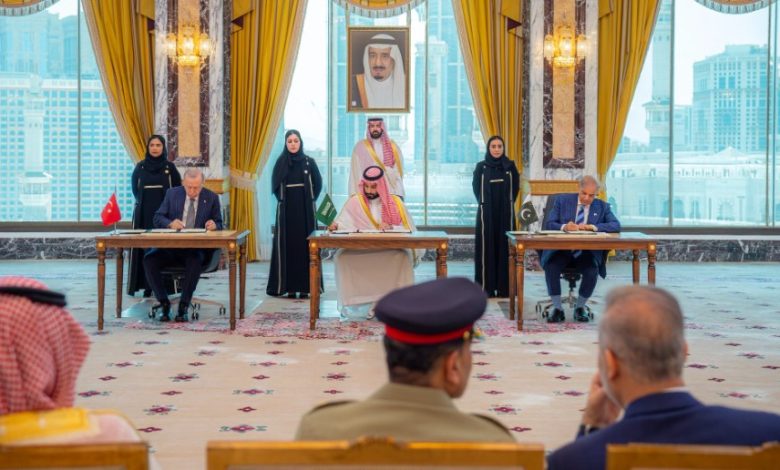
The landmark Makkah Joint Defense Agreement is starting to take shape as Saudi Arabia, Türkiye, and Pakistan are laying out the political and military mechanisms for trilateral coordination.
The agreement transforms bilateral defense and security ties into a unified, self-reliant defense architecture grounded in collective deterrence, establishing a long-term framework for defense partnership and integration in order to bolster regional stability. By laying out the architecture, the pact has shifted from ceremonial signing to practical steps towards operationalization.
From Signing to Execution
Driving the News: The Turkish Defense Ministry said that the three parties to the Makkah Joint Defense Agreement, Saudi Arabia, Türkiye, and Pakistan, will establish the political and military mechanisms, Reuters reported.
The Backstory: Following a trilateral summit in Makkah on August 7, 2026, Saudi Arabia, Türkiye, and Pakistan signed a joint defense pact stipulating that “any armed attack against any one of the three states shall be regarded as an attack against them all.”
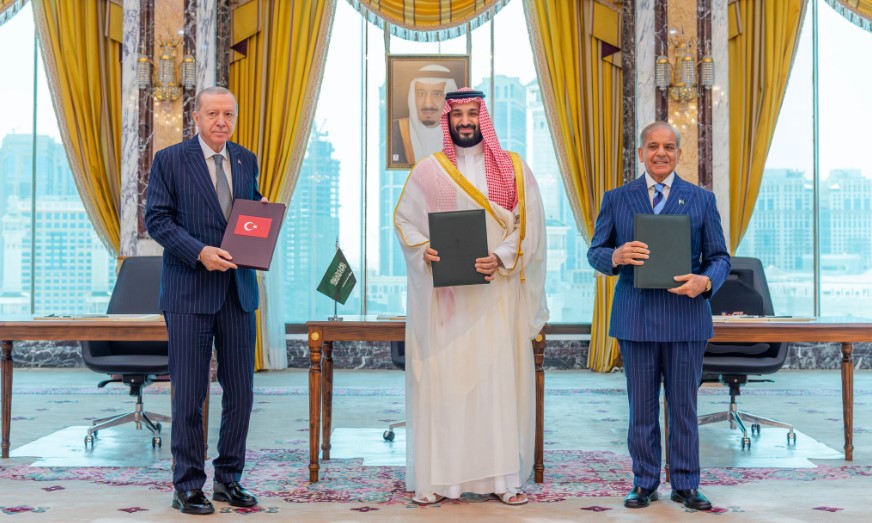
What It Said: “Under the accord, strategic political and military mechanisms plan to be established involving the Defence Ministers, Foreign Ministers, and Chiefs of General Staff/Armed Forces Commanders, and that coordination among the three countries will be conducted at the highest level.” – The Turkish Defense Ministry stated during a weekly briefing in Ankara.
Trilateral Coordination Architecture
State of Play: According to the Turkish Defense Ministry, the ultimate objective of the agreement is to ensure defense and military ties are placed on a “more institutional and sustainable” footing.
Areas of Cooperation:
- Joint military exercises: Land, naval, and air
- Joint development and production: Air defense and unmanned autonomous systems
- Technology cooperation: Electronic warfare and AI capabilities
- Sustainable maintenance
- Logistics support
Three Powers Integrated
Between the Lines: The operational mechanisms will leverage the distinct advantages of each member state:
Saudi Arabia
In addition to its economic weight and political influence, Riyadh possesses advanced military capabilities. Its defense expenditure amounted to roughly $33.23 billion (SAR 124.6 billion) in the first half of 2026, driven by ongoing efforts to localize defense industries, according to Al-Arabiya. The Kingdom also ranks #25 globally in overall military strength, per Global Firepower.
Türkiye
Türkiye, NATO’s second-largest military, boasts a rapidly growing defense industry, particularly in drones, naval shipbuilding, electronic warfare, and armored systems. Its defense and aerospace exports reached $1.12 billion (approximately SAR 4.2 billion) in July. It ranks #9 globally in overall military strength, per Global Firepower.
Pakistan
As the only nuclear-armed Muslim nation, Pakistan possesses a highly professional military, advanced missile capabilities, and a vast experience in counterterrorism. It ranks #14 globally in overall military strength, per Global Firepower.
An Open Defense Framework
The Context: While stressing the defensive nature of the partnership, Riyadh, Ankara, and Islamabad have signaled that the defense pact is open for all brotherly countries that aim for the peace, prosperity, and stability of the region.
In His Words: “This agreement is open to all sisterly nations that desire peace and stability.” – Recep Tayyip Erdogan, President of Türkiye.
What to Watch: Turkish Foreign Minister Hakan Fidan suggested that Egypt could join the Mecca Joint Defense Agreement. He noted that Türkiye eyes an expanded initiative beyond the three countries, adding that several other countries have also expressed interest in joining the framework.
Zoom In: Egypt is a member of the Regional Four (R-4) group, alongside Saudi Arabia, Türkiye, and Pakistan. As a quadrilateral consultative framework, the R-4 aims to boost joint coordination and unify positions to address the rapidly evolving developments and dangerous military escalation in the Middle East.
The Bottom Line: Saudi Arabia, Türkiye, and Pakistan are moving fast to operationalize the Makkah Joint Defense Agreement. By combining Saudi financial weight, Turkish technological edge, and Pakistani military capabilities under a unified command structure – with potential expansion to partners like Egypt – the triad is positioning itself as a central security anchor for the Middle East and beyond.