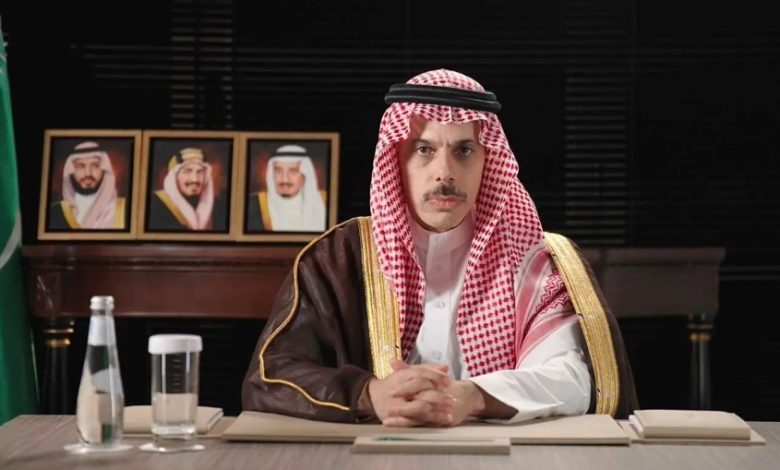
At the opening session of the 16th Gulf Research Meeting (GRM 2026), Saudi Foreign Minister Prince Faisal bin Farhan outlined the Kingdom’s strategic approach to resolve regional conflicts and establish peace in the Middle East, stating that it rests on prioritizing diplomacy over military force.
As the Middle East navigates a pivotal point, Prince Faisal’s remarks highlighted the main pillars of Saudi Arabia‘s foreign policy to chart a new regional order and achieve sustainable peace.
A Defining Moment
The big picture: Prince Faisal took part in the GRM 2026, held in Cambridge, UK, via video link. During his address, he noted that the Middle East is at a “defining moment” that requires enhanced dialogue, diplomacy, and joint action to address regional and international challenges.
What he said: “The moment should be used to lay the foundations for a more cooperative and stable regional order that is based on clear principles, mutual respect, and lasting agreements that deliver peace, security, and prosperity for all,” Prince Faisal said.
Addressing Root Causes
The context: The Saudi Foreign Minister stressed that military force alone cannot achieve lasting stability. Rather, regional conflicts need sustainable diplomatic solutions that address the underlying causes of crises.
Between the lines: Saudi Arabia launched the Global Coalition for the Implementation of the Two-State Solution as part of its diplomatic push to end the war on Gaza. Riyadh’s main goal was to gather international momentum for establishing an independent Palestinian State to address the root cause of the crisis and secure a permanent political resolution to the longstanding conflict.
Why it matters: Saudi efforts culminated in the endorsement of the New York Declaration on the Peaceful Settlement of the Question of Palestine and the Implementation of the Two-State solution by the UN in September 2025, which lays out a single roadmap to deliver the two-state solution.
An Economic Hedge
During his speech at the GRM 2026, Prince Faisal bin Farhan highlighted the spillover effect of the current regional tensions, with their implications extending to global security, energy markets, and economic growth.
The proof: In light of the recent regional escalation that has disrupted shipping in the Strait of Hormuz and the Arabian Gulf, Riyadh actively stepped in to safeguard global energy and supply chains.
Saudi Arabia’s maritime and logistics ecosystem has adopted a package of proactive measures to ensure operational continuity, such as:
- Activating alternative routes.
- Boosting transit services.
- Maintaining uninterrupted shipping line bookings.
Advocating Permanent Solutions
The Saudi Foreign Minister urged for focusing collective efforts on preserving the existing rules-based international order and creating the conditions conducive for reaching sustainable diplomatic solutions that provide real security and lasting peace, rather than temporary pauses or periodic de-escalation.
The blueprint: According to Prince Faisal, this requires confidence building, responsible statecraft, and a shared commitment to a more predictable and stable regional order.
Furthermore, Prince Faisal outlined the core principles for a more stable regional order, which are enshrined in the UN Charter:
- Respect for state sovereignty.
- Non-interference in internal affairs.
- Good neighborliness.
- Non-aggression.
- Freedom of navigation.
- Adherence to international law.
- Refraining from providing support to non-state actors.
Key takeaway:
The Saudi Foreign Minister stated that violations of these principles must carry real costs and be met with accountability. “Aggression, coercion, interference, and attempts to impose dominance or pursue hegemonic ambitions ultimately generate insecurity and are incompatible with the stable and prosperous region that all seek,” Prince Faisal said.
State of play: Saudi Arabia has been a key player in efforts to resolve regional crises. In order to end the conflict in Sudan and alleviate the humanitarian suffering of the Sudanese people, the Kingdom hosted the Jeddah talks, coordinated with the Quad members (The US, Egypt, and the UAE), and ramped up humanitarian aid to the African nation.
The Kingdom has also been a strong advocate for security and territorial integrity in Syria, Lebanon, and Yemen, providing diplomatic and economic support for the legitimate state authority to contribute to the stability and development of these countries.
The bottom line: Prince Faisal emphasized that the region possesses an extraordinary potential that enables it to navigate the existing challenges and chart a more prosperous future. He also noted that Saudi Vision 2030 stems from a firm belief that development, innovation, and opportunity offer a far more promising path than recurring conflict, creating a stable environment where societies can focus on investment, education, and growth.