
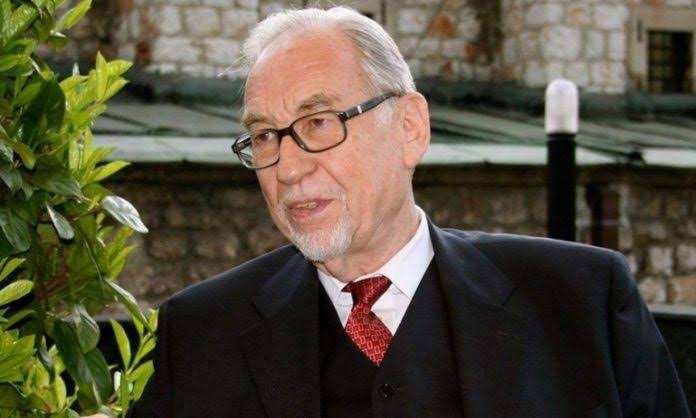
Murad Wilfried Hofmann: The German Diplomat Who Dedicated His Life to Explaining Islam
By: Taha Sakr
From a distinguished career in German diplomacy to a body of influential writing on Islam, Murad Wilfried Hofmann dedicated much of his life to explaining the faith he had embraced, challenging misconceptions about Muslims and building bridges between Islamic and Western intellectual traditions.
The story of Murad Wilfried Hofmann is more than that of a European diplomat who converted to Islam. It is the story of a man whose encounter with the faith reshaped his understanding of life, morality and humanity, eventually inspiring him to devote much of his intellectual energy to explaining Islam to audiences who often encountered it through political controversy and cultural misunderstanding.
A German jurist and diplomat who served as ambassador to Algeria and Morocco and held a senior information position at the North Atlantic Treaty Organization (NATO), Hofmann occupied a distinctive place in discussions about Islam in Europe. His professional background gave him an understanding of Western political institutions, while his years of engagement with Muslim societies introduced him to the religious traditions, intellectual heritage and everyday practices of Islam.
After embracing Islam in 1980, he used this combination of experiences to write books that presented the faith as a comprehensive religious and ethical tradition, capable of addressing questions of modern life. Rather than treating his conversion as a private decision alone, he turned it into an intellectual undertaking: to understand Islam more deeply, communicate its principles and encourage others to approach it with an open mind.
Hofmann died on 12 January 2020, aged 88. His legacy rests not only on his diplomatic achievements or his decision to become Muslim, but also on the effort he made to communicate the meaning of his faith across cultural and religious boundaries.
A life shaped by education, diplomacy and curiosity
Born Wilfried A. Hofmann in Aschaffenburg, Bavaria, on 6 July 1931, he grew up during a period of profound upheaval in European history. His education combined European legal traditions with exposure to American academic life. He studied law at the University of Munich, earned a doctorate in jurisprudence and later obtained a Master of Laws degree from Harvard Law School.
His interests extended beyond the courtroom and diplomatic negotiations. Hofmann was deeply interested in ballet, aesthetics and the arts, working as a ballet critic for specialist publications and teaching ballet history and aesthetics. This appreciation for beauty and cultural expression would later influence the way he understood Islamic civilisation, particularly its architecture, calligraphy and artistic traditions.
In 1961, he joined the West German Foreign Service. His early diplomatic experience in Algeria proved particularly significant. Working in a society undergoing a struggle for independence, he encountered Muslim communities whose religious convictions formed an integral part of their identity and daily lives.
These encounters encouraged him to look beyond the political descriptions of Islam that were common in European public discourse. He became increasingly interested in the relationship between religious belief and personal conduct, as well as the role faith could play in providing meaning and direction during periods of uncertainty.
His subsequent career included work on defence affairs at Germany’s Foreign Ministry, service as director of information at NATO headquarters in Brussels from 1983 to 1987, and appointments as West Germany’s ambassador to Algeria from 1987 to 1990 and Morocco from 1990 to 1994.
The significance of this career lies partly in the perspective it gave him. Hofmann was not approaching Islam as an outside observer with no experience of the societies in which it flourished. He had lived and worked among Muslims, studied their religious traditions and gradually developed questions that would lead him to examine the faith for himself.
The encounter that changed his understanding of life
Hofmann’s conversion to Islam in September 1980 followed years of reflection rather than a sudden change of conviction. His own account describes how encounters with Muslims, his reading and discussions about religious belief contributed to his decision.
A particularly important moment came during a seminar on Islam at the German Foreign Office’s diplomatic training school in Bonn. A conversation with Imam Muhammad Ahmad Rassoul, a German-Egyptian Islamic scholar and publisher, helped Hofmann recognise the relationship between the philosophical questions he had been considering and the principles of Islam.
On 25 September 1980, he formally declared his faith.
For Hofmann, the attraction of Islam lay in its understanding of the oneness of God and the relationship between belief, reason and moral responsibility. Islam offered him a framework through which questions about existence, human purpose and ethical conduct could be considered as parts of a coherent whole.
His conversion also changed the direction of his intellectual life. The diplomat who had spent years analysing international affairs began devoting substantial attention to explaining the religion that had become central to his personal convictions.
Yet he did not abandon his previous intellectual interests. Instead, he brought them into his study of Islam. His legal training encouraged him to examine arguments carefully; his diplomatic experience helped him understand the political and cultural contexts in which religious debates unfolded; and his appreciation of the arts deepened his interest in the cultural expressions of Islamic civilisation.
Islam, in this sense, did not erase his intellectual background. It gave him a new perspective through which to reconsider it.
Turning personal conviction into a contribution to Islam
One of Hofmann’s most significant contributions was his decision to use his writing to explain Islam to readers outside the Muslim world. He understood that personal belief could be accompanied by a responsibility to communicate: to describe what had persuaded him, address misconceptions and encourage informed discussion.
His book Islam: The Alternative, first published in German in 1992, became one of his best-known works. It presented Islam as a serious option for understanding human existence and organising ethical life, addressing questions of faith, modernity and the relationship between religious principles and contemporary society.
The book attracted attention and controversy in Germany, partly because its author was a prominent former diplomat who had embraced a religion often viewed through political and cultural tensions. Hofmann’s position made his arguments particularly noteworthy: he was familiar with Western institutions and intellectual traditions, yet he believed that Islam deserved to be examined on its own terms rather than reduced to the actions of particular governments or movements.
His contribution was not simply to argue that Islam should be treated more fairly. He sought to explain why he considered its teachings meaningful, how its moral framework could guide individual conduct and why its intellectual tradition merited serious engagement.
Through this work, Hofmann offered readers a perspective that differed from both superficial accounts of conversion and political discussions that treated Islam primarily as a security or integration issue. He approached it as a faith with theological foundations, ethical commitments, a rich intellectual history and continuing relevance to contemporary life.
His writing also provided Muslims with a way to discuss their religion through concepts familiar to Western readers, without presenting Islam as something that needed to abandon its identity to be understood.
Explaining Islam through the language of experience
Hofmann’s other books extended this effort. In Journey to Makkah, he reflected on the spiritual significance of pilgrimage and the experience of encountering Islam’s holiest places. His writings on the future of Islam examined the challenges and opportunities facing Muslim communities as they navigated a changing international environment.
His work as a German Muslim also gave him a distinctive perspective on questions of identity. He demonstrated through his own life that becoming Muslim did not require abandoning one’s nationality, professional experience or cultural background.
This was an important message in a European environment where Islam was frequently discussed in terms of difference and belonging. Hofmann’s example challenged the assumption that Islamic faith and European intellectual life were necessarily incompatible. He continued to draw on his education, diplomatic experience and cultural interests while developing a deeper commitment to Islam.
In doing so, he helped make the discussion of Islam more accessible to readers who might otherwise have approached it with limited knowledge. His contribution was not that he spoke for every Muslim, nor that his books resolved the misunderstandings surrounding Islam. Rather, he offered an informed personal perspective, supported by years of study and professional experience, that encouraged readers to consider the faith beyond familiar stereotypes.
Faith, beauty and the wider meaning of Islamic civilisation
Hofmann’s appreciation of Islamic art and architecture formed another important part of his intellectual journey. His interest in aesthetics encouraged him to look at mosques, calligraphy, geometric designs and traditional Islamic spaces not merely as works of art, but as expressions of a civilisation shaped by religious ideas.
This perspective helped him explore dimensions of Islam that were often overlooked in political debates. Islamic civilisation, as he understood it, could be appreciated through its artistic achievements, intellectual traditions and moral aspirations as well as through its historical conflicts and political institutions.
For Hofmann, such cultural expressions offered an additional way to communicate the depth and diversity of the Muslim experience. They allowed him to approach Islam not only through theological arguments, but also through the visible legacy of the societies that had developed around its teachings.
His writing therefore connected several fields that might otherwise have remained separate: religion, philosophy, law, aesthetics and international affairs. This interdisciplinary approach was one of the qualities that distinguished his work from more narrowly focused introductions to Islam.
A bridge between Muslim and Western intellectual traditions
Hofmann’s influence also extended to interfaith dialogue. In 2007, he was among the signatories of A Common Word Between Us and You, an initiative addressed by Muslim scholars and leaders to Christian leaders. The letter sought to identify shared foundations between Islam and Christianity, particularly love of God and love of one’s neighbour, and to encourage constructive engagement between the two communities.
His participation reflected a belief that explaining Islam and engaging with other faiths need not be contradictory objectives. A person could remain committed to Islamic principles while seeking common ground with people of different religious convictions.
This approach was particularly relevant to discussions about Islam’s place in Europe. Hofmann’s life demonstrated that religious identity, national belonging and intellectual engagement could coexist. His diplomatic career and subsequent writing gave him experience of both the institutions of the Western world and the religious tradition he had adopted.
He also offered a practical lesson about dialogue: meaningful understanding requires more than repeating general statements about tolerance. It requires learning about other traditions, examining assumptions and engaging seriously with the ideas that shape people’s lives.
Hofmann’s work did not eliminate the misunderstandings surrounding Islam, and its reception varied among readers. Nevertheless, his contribution lay in expanding the space for informed discussion and presenting a considered account of why Islam had become central to his life.
A legacy measured in ideas, not conversion alone
Hofmann died on 12 January 2020, following a prolonged illness, at the age of 88. The Central Council of Muslims in Germany remembered him as a distinguished thinker whose writings and advice had inspired generations. His passing marked the end of a life that had moved from European legal education and diplomacy to sustained engagement with Islamic thought.
His legacy should be understood through both sides of his journey: the transformation that Islam brought to his personal outlook and the effort he made to communicate that transformation to others.
Islam gave Hofmann a framework through which to understand faith, ethics, human purpose and the relationship between spiritual conviction and everyday life. In return, he offered the Muslim world his intellectual abilities, professional experience and determination to explain the faith to audiences beyond its traditional communities.
He was not the only Western convert to write about Islam, nor could one author’s work represent the full diversity of Muslim thought. His importance, however, lay in the particular combination of experience and commitment he brought to the task. He had served as a diplomat, studied law at leading institutions and worked in societies where Islam shaped public life. After his conversion, he used these experiences to develop a body of writing that invited readers to examine the religion more closely.
Ultimately, Hofmann’s story illustrates how faith can become more than a personal conviction. For him, Islam became a source of intellectual direction and a reason to engage more deeply with questions of culture, morality and human understanding. His writings, meanwhile, became a means of sharing that journey with others.
His enduring contribution was not simply that a German diplomat embraced Islam. It was that he sought to understand what the faith meant, articulate why it mattered to him and use his knowledge to help others approach it with greater understanding. In that effort, his life became an example of how personal transformation can inspire a wider intellectual contribution to the religion one has chosen to follow.