Anchors of Stability: Inside the Saudi-Egyptian Drive to Contain Regional Escalation
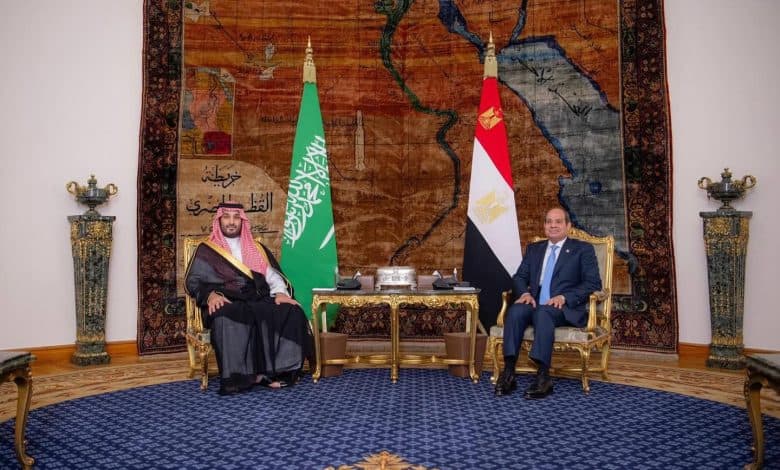
In a high-level phone call, Saudi Arabia’s Crown Prince and Prime Minister Mohammed bin Salman and Egyptian President Abdel Fattah Al-Sisi have reiterated their shared mandate for regional stability.
By prioritizing de-escalation, the two regional heavyweights reaffirm that the Riyadh-Cairo strategic alignment acts as the central force navigating current crises in the Middle East, actively anchoring the Arab world’s collective security strategy.
Advocates of Regional Peace
Driving the News: Crown Prince Mohammed bin Salman and President Al-Sisi addressed the escalating regional tensions in a phone call on Thursday, September 3, 2026, according to a statement released by the Egyptian Presidency.
The Big Picture: The Saudi and Egyptian leaders stressed the importance of de-escalation to safeguard regional stability and mitigate implications on energy security, supply chains, and regional and international trade.
Why It Matters: Riyadh and Cairo are key stakeholders in regional maritime and energy security. The recent military escalation in the Middle East has turned two key waterways to flashpoints. The maritime disruption has extended to the Strait of Hormuz, which links the Arabian Gulf with the Gulf of Oman and the Arabian Sea, as well as the Bab al-Mandab Strait, which connects the Gulf to Europe via the Suez Canal, and Asia through Saudi ports.
Worth a Mention: Saudi Arabia and Egypt have utilized high-level diplomatic channels to de-escalate tensions and prevent the conflict from spiraling into an all-out regional war.
The Saudi-Egyptian Bond
Between the Lines: During the call, President Al-Sisi reiterated the shared destiny linking Egypt and the Kingdom, emphasizing the significance of joint action to address challenges facing the region and its countries.
In His Words: “The security of the Kingdom of Saudi Arabia, and all Arab countries, is integral to Egypt’s national security.” – Abdel Fattah Al-Sisi, Egypt’s President.
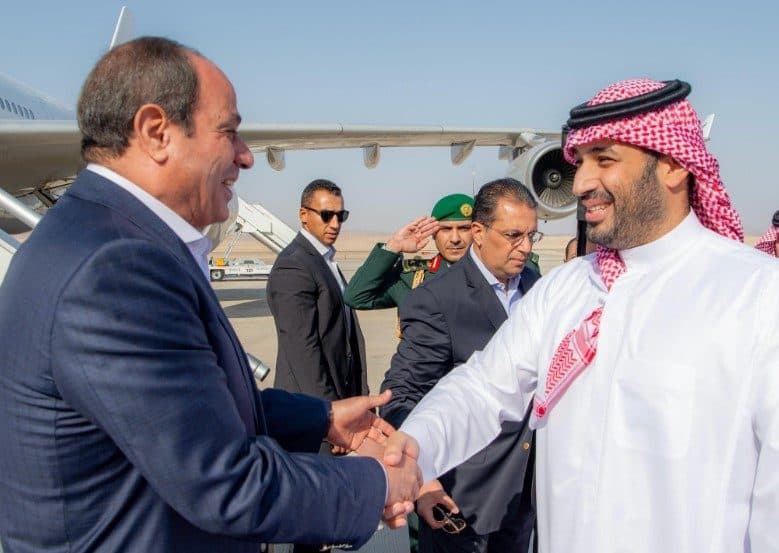
The Backstory: Since the outbreak of the US-Iran conflict in late February 2026, Egypt has consistently voiced its unwavering support for Saudi Arabia in the face of attacks by Iran and its affiliated militias, backing the measures taken by the Kingdom to safeguard its sovereignty, security, and stability.
Similarly, Riyadh underscored its full solidarity with Cairo following a drone attack that targeted two ships at Damietta Port in late July. Saudi Arabia expressed its support for all measures Egypt takes to safeguard its sovereignty and protect its security and interests.
Saudi-Egyptian Defense Coordination
State of Play: Saudi Arabia and Egypt share longstanding defense ties, anchored in military exercises aimed at enhancing interoperability and joint readiness.
- The Piercing Arrow: A bilateral military exercise involving the Saudi Arabian and Egyptian armed forces. The exercise features joint parachute jumps, special operations to neutralize terrorist strongholds, and coordinated coastal island assault simulation involving the naval and air forces of both countries.
- Red Wave: A Naval exercise involving units from Saudi Arabia, Egypt, and key regional allies such as Jordan, Sudan, Yemen, and Djibouti. It is aimed at reinforcing joint action among participating forces. The drill features live-fire drills, anti-submarine operations, coastal island assault simulations, and joint planning and training to counter unconventional maritime threats.
- Morgan Series: A bilateral naval drill conducted by the Royal Saudi Navy and Egyptian Navy to enhance maritime security measures, raise combat readiness, and develop the ability to exercise command-and-control procedures. It focuses on anti-mine warfare, amphibious landing operations, live-fire naval artillery drills, and protecting high-value offshore commercial assets.
- Tabuk Series: A joint military exercise involving the armed forces of Saudi Arabia and Egypt to enhance military cooperation and combat readiness. It aims to unify military concepts, share combat expertise, and train on managing joint tactical tasks in response to regional security challenges.
- Faisal Series: A periodic joint military drill conducted by the Royal Saudi Air Force (RSAF) and Egyptian Air Force (EAF). It focuses on aerial interception drills, joint offensive and defensive air counter-operations, air-to-air refueling integration, and coordinating joint strike packages.
- Multinational Drills: Saudi Arabia and Egypt participate in larger multilateral military drills, including the Bright Star, the North Thunder, and Medusa exercises alongside allies such as Greece, Cyprus, Türkiye, France, and the US.
Joint Frameworks
The Deep Dive: Riyadh and Cairo have strengthened coordination to navigate regional crises and protect the Bab al-Mandab Strait and the Red Sea corridor through multiple frameworks.
Red Sea Security:
- July 2026: Saudi Arabia launched the Multinational Maritime Defense Coalition to address and deter growing threats to maritime security, including attacks against commercial vessels, energy tankers, and naval infrastructure in the Bab al-Mandab Strait, the Red Sea, and the Gulf of Aden. In addition to the Kingdom and Egypt, 12 other countries joined as founding members.
- September 2025: Saudi Arabia and Egypt signed a cooperation protocol to support maritime security efforts in the region.
- January 2020: The Council of Arab and African Coastal States of the Red Sea and the Gulf of Aden was established in Riyadh to coordinate joint efforts to protect shipping lanes, combat piracy, and foster regional trade. It includes eight members: Saudi Arabia, Egypt, Jordan, Sudan, Yemen, Eritrea, Somalia, and Djibouti.
Regional Stability:
- August 2026: Saudi Arabia, Türkiye, and Pakistan signed the Makkah Joint Defense Agreement – a mutual defense pact establishing that “any armed attack against any one of the three states shall be regarded as an attack against them all.” Egypt is a potential candidate to join the pact once the institutionalization stage is completed.
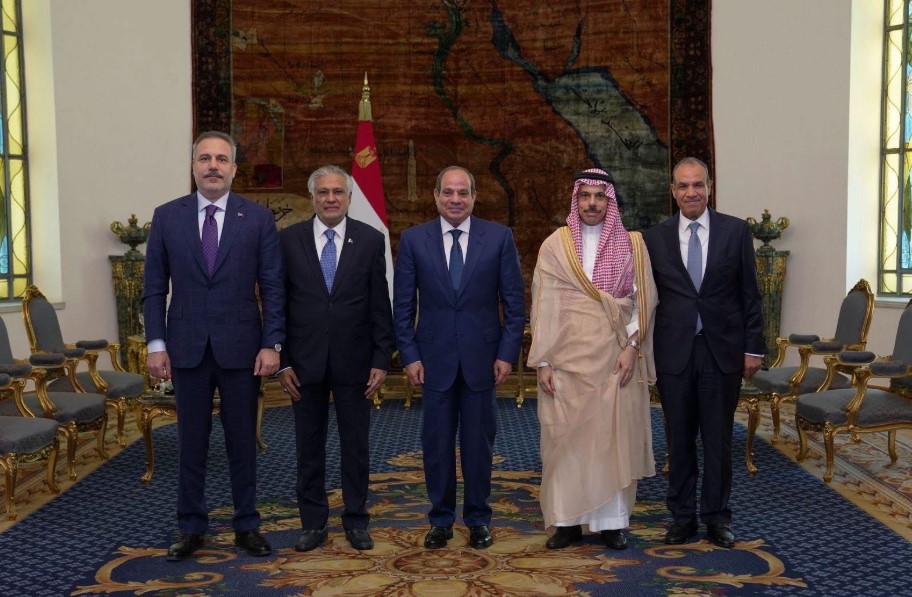
- March 2026: Riyadh, Cairo, Ankara, and Islamabad launched the Regional Four (R-4) mechanism – a quadrilateral consultative framework focused on boosting joint coordination and unifying positions in the face of the rapidly evolving developments and dangerous military escalation in the Middle East.
Multi-Front Stabilization Efforts
The Strategy: Saudi Arabia and Egypt have championed the stability, sovereignty, and territorial integrity of Arab and Muslim states, playing pivotal roles in ending conflicts and crises through peaceful solutions.
Palestine
Two-State Solution:
Saudi Arabia has spearheaded a sustained diplomatic push for advancing the two-state solution and the recognition of an independent Palestinian State along the 1967 borders (comprising the West Bank, East Jerusalem, and the Gaza Strip), with East Jerusalem as its capital.
To this end, the Kingdom launched the Global Alliance for the Implementation of the Two-State Solution, in partnership with Norway and the European Union (EU) in September 2024.
Furthermore, Riyadh, alongside Paris, co-hosted the High-Level International Conference for the Implementation of the Two-State Solution at the UN headquarters in July and September 2025, yielding the New York Declaration.
Gaza Conflict:
Egypt, alongside the US, Türkiye, and Qatar, is one of the Gaza peace deal mediators. Cairo hosts talks involving the Palestinian factions and other mediators to advance the second phase of the agreement.
Sudan
Saudi Arabia and Egypt have voiced strong support for Sudan‘s unity, territorial integrity, and state institutions, advocating for a political solution and a Sudanese-Sudanese dialogue to end the conflict.
The Kingdom hosted the Jeddah talks in May 2023 in a bid to resolve the deepening humanitarian crisis and alleviate the suffering of the Sudanese people. Moreover, Saudi Arabia and Egypt coordinated with the US and the UAE within the Quad mechanism, and ramped up humanitarian aid to the African nation.
The Bottom Line: Saudi Arabia and Egypt act as an indispensable anchor of Middle Eastern stability. The strategic alignment between Riyadh and Cairo sets the strategic tone for Arab collective action to address regional crises.