
Tarout Island: Top Migrating Birds’ Destination

Tarout Island, located in eastern Saudi Arabia, has been an important destination for various types of birds throughout its five-thousand-old civilization. It is the migratory birds’ first stops in the Arabian Gulf, reported Al Arabiya.
Tarout Island Draws Migrating Birds
In the island, migratory birds find an environment suitable for breeding and migration, as they immerse in natural habitats well-endowed with food and water.
These migratory birds play a significant role in the ecosystem as they help in seed dispersal and plant pollination, contributing to the region’s biodiversity.

Sea Birds VS. Terrestrial Birds
The Head of the Bird Monitoring and Protection Group for the Arabian Peninsula said that Sea birds land in large groups on the coast. Meanwhile, terrestrial birds are scattered around the island in farms, on trees, and in open areas, depending on their family or behavior.
Sea birds visit Tarout Island during their journey to live and reproduce. Unlike sea birds, terrestrial ones visit it to rest during their northward or southward migration.
Given its environmental diversity, the island is rich in food resources for both types.
Pink-Legged Flamingos in Tarout Island
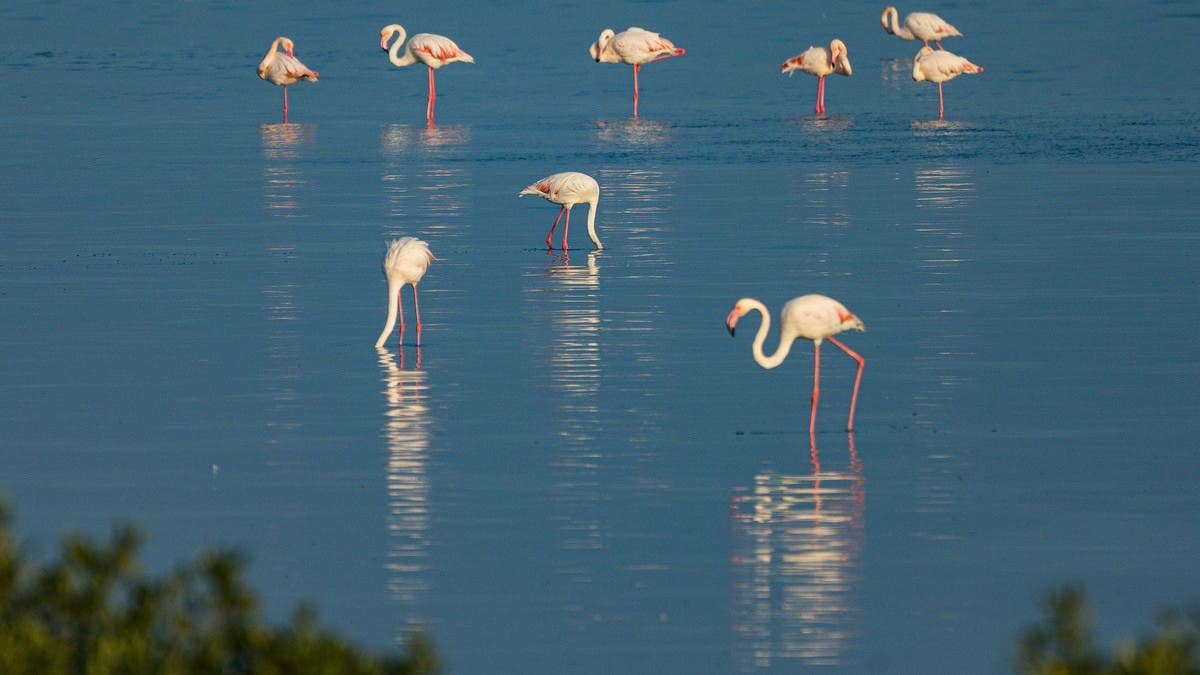
The head explained that some flamingos visit Tarout Island during their annual migration in winter. They migrate usually between November and March when the beaches are warm and food is plentiful.
Visitors can enjoy the flamingos sticking their slender pink legs and flexible, feathered necks in the turquoise waters of the island, creating a divine, unforgettable scene.
He pointed out that the density of flamingo flocks varies from year to year. In some years, the numbers are enormous, reaching about a thousand in a single flock. Meanwhile, in other years, the numbers range from 200 to 400 birds per flock. In the last ten years, the numbers have started to shrink annually.
Farsan Islands
The avian dwellers of Farasan Islands Reserve found themselves entwined in a battle for survival against electrocution from medium-voltage power lines.
Therefore, Saudi Arabia’s National Center for Wildlife embarked on a collaborative venture with BirdLife International and the Saudi Electricity Co.
The mission was clear- to install insulators on these power lines, casting a veil of protection over the winged inhabitants of the Farasan Islands Reserve.
Farasan Islands is home to a rich tapestry of biodiversity.
Adorned with pristine turquoise waters of the Red Sea, this haven of natural beauty hosts ancient sites marine habitats.
Related Topics:
KSA Establishes Imam Faisal bin Turki Royal Reserve
Saudi Arabia Deposits $2 Billion in Pakistan’s Central Bank to Shore Up Reserves
Saudi Tourism Authority: Annexation of Nature Reserve Equal to Area of 11 Countries