Hormuz Standoff: France, UK Launch Defensive Mission amid US-Iran Blockade Dispute
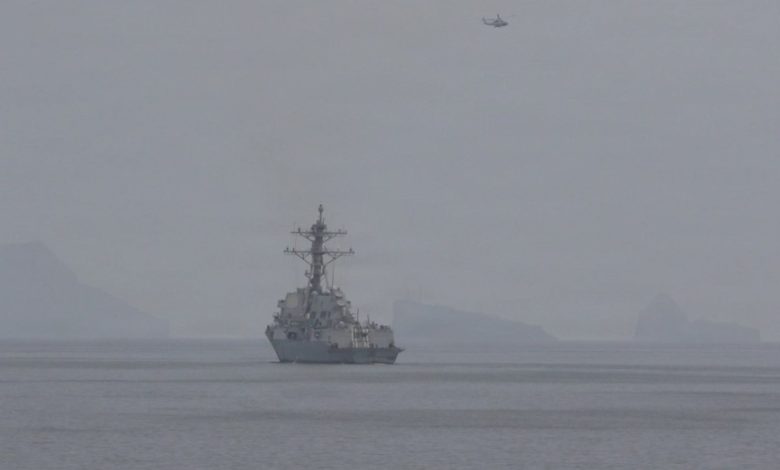
France and the UK have launched a multinational mission to protect commercial shipping through the Strait of Hormuz and conduct mine clearance operations after the US-Israeli war with Iran is over.
The announcement was made on Friday during a summit in Paris that brought together the leaders of 51 countries and international organizations, excluding “belligerent countries” US and Iran.
Meanwhile, the dispute between Washington and Tehran over Hormuz resurfaced again after declaring that the critical waterway was open to commercial shipping. US President Donald Trump reaffirmed that naval blockade on Iran will persist, driving Tehran to close the Strait again.
The Strait of Hormuz is a strategic maritime corridor linking the Arabian Gulf with the Gulf of Oman and the Arabian Sea, through which around a fifth of daily global oil supplies and LNG supplies pass.
Paris Summit
Leaders from over 50 European, Asian, African and South American countries and international organizations joined an international summit in Paris, co-chaired by French President Emmanuel Macron and UK Prime Minister Keir Starmer, on the Strait of Hormuz.
German Chancellor Friedrich Merz and Italian Prime Minister Giorgia Meloni attended in person, while others, including the prime ministers of Australia and Canada; the Presidents of South Korea and Ukraine and representatives of China and India; joined by videoconference.
The gathering aimed to stress the importance of safeguarding the freedom of navigation through the critical waterway and the protection of global economic stability and energy security, in accordance with international law.
Reopening Hormuz
In a joint statement, the leaders called for “the unconditional, unrestricted, and immediate re-opening of the Strait of Hormuz.” They welcomed the announcement made by the US and Iran about reopening the strategic shipping route.
As the summit was underway, Trump posted on Truth Social that the Strait of Hormuz “is fully open and ready for full passage.”
In parallel, Iranian Foreign Minister Abbas Araghchi announced that “the passage for all commercial vessels through Strait of Hormuz is declared completely open” for the remaining period of 10-day ceasefire between Lebanon and Israel.
However, Trump later said that the US naval blockade on Iranian ports will remain in effect “UNTIL SUCH TIME AS OUR TRANSACTION WITH IRAN IS 100% COMPLETE.”
Multinational Mission
In their joint statement, Macron and Starmer confirmed that their countries will establish an “independent and strictly defensive multinational mission to protect merchant vessels, reassure commercial shipping operators, and conduct mine clearance operations as soon as conditions permit following a sustainable ceasefire agreement.”
They stressed that this mission – named the Strait of Hormuz Maritime Freedom of Navigation Initiative – is strictly defensive, excluding the US and Iran. In light of this, Macron said the initiative is a “neutral mission, entirely separate from the belligerents to escort and secure the merchant ships transiting the Gulf.”
The two European countries called on all nations to join the mission. “We are grateful to those nations that have indicated their readiness to contribute, whether through military assets, logistical support, financial contributions or political solidarity, and call on all countries with an interest in the free flow of global trade to express their support for this initiative,” the statement said.
The UK will host a military planning conference in London next week with contributing countries for holding further discussions and sharing details about their potential role.
Hormuz Dilemma
As the US naval blockade on Iran remains in place, Iran has threatened to reverse its decision on reopening the Strait of Hormuz.
In a statement carried by Iranian state media on Saturday, the Iranian military’s joint operational command, Khatam Al-Anbiya, said that control of the Strait of Hormuz has “returned to its previous state” due to what it described as “continued acts of piracy and maritime theft under the guise of a so-called blockade” by the US.
“For this reason, control of the Strait of Hormuz has reverted to its previous state, and this strategic waterway is under the strict management and control of the armed forces,” the statement noted.
“Until the US restores the complete freedom of navigation for vessels from an Iranian origin to a destination, and from a destination back to Iran, the situation in the Strait of Hormuz will remain strictly controlled and in its previous state,” it added.
Earlier on Saturday, Trump threatened to resume bombing on Iran if a ceasefire agreement is not reached by Wednesday, the last day of the two-week ceasefire.
“Maybe I won’t extend it, but the blockade [on Iranian ports] is going to remain. So you have a blockade, and unfortunately we have to start dropping bombs again,” he told reporters aboard Air Force One, according to Reuters.