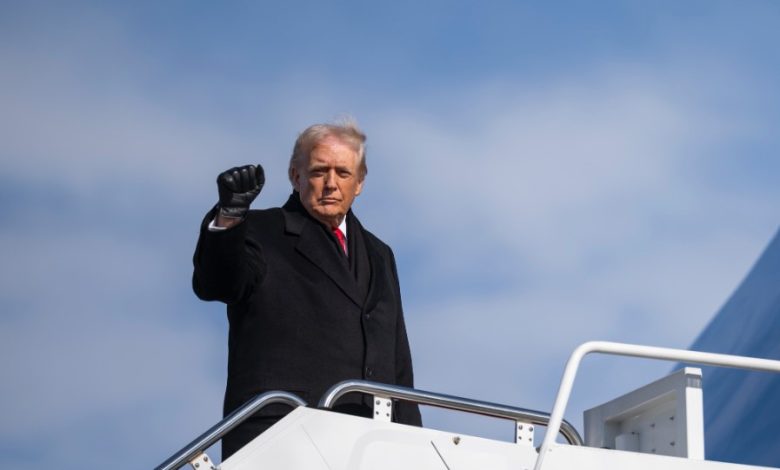
US President Donald Trump has signaled that a naval blockade could be his next move after talks with Iran ended without agreement in Islamabad.
The naval blockade mirrors the Trump administration’s strategy in Venezuela, where it imposed a maritime squeeze on drug boats and oil tankers before capturing President Nicolas Maduro in a military raid.
Naval Blockade Card
Trump on Sunday shared an article on his Truth Social platform, suggesting that the US President could follow the Venezuela playbook and enforce a naval blockade on Iran if it does not accept a deal.
Published on Just The News, the article – titled “The Trump card the president holds if Iran won’t bend: a naval blockade” – suggested that Trump could replicate his successful blockade strategy to cripple Iran‘s staggering economy.
This strategy will also ramp up diplomatic pressure on China and India, depriving them of one of their key oil sources.
The article noted that the naval blockade strategy was first floated by retired Gen. Jack Keane, one of the US’ top military strategists.
“If the war resumes and after we degrade Iran’s remaining military assets sufficiently, the US military could choose to occupy Kharg — or to destroy it. Alternatively, the US Navy could set up a blockade, shutting down Tehran’s export lifeline,” Keane wrote for the New York Post last week.
Venezuela Scenario
Since returning to office, Trump ramped up pressure on Venezuela as part of a campaign on Caracas over drug trafficking.
This maximum pressure strategy included expanded sanctions, a US military buildup in the Caribbean, an informal closure of Venezuela’s airspace, and more than two dozen strikes on alleged drug-trafficking boats.
A central pillar of this strategy was naval blockade, which choked the Venezuelan economy by cutting off its vital oil revenues.
The blockade was led by USS Gerald R. Ford Carrier Strike Group, which has been redeployed to the Arabian Gulf alongside the USS Abraham Lincoln and other naval assets to take part in military operations against Iran.
Controlling Hormuz
The article suggested that Trump could enforce naval blockade on Iran to seize control over the Strait of Hormuz – a crucial waterway linking the Arabian Gulf with the Gulf of Oman and the Arabian Sea, through which around a fifth of daily global oil supplies and LNG supplies pass.
The US-Israeli war with Iran has caused traffic disruption in the strategic waterway, as Tehran warned it would block shipping through the Strait.
“It would be very easy for the US Navy to exert complete control over what does and does not go up and down the Strait now,” the Lexington Institute’s national security expert Rebecca Grant told Just the News.
“If Iran gets intransigent, then absolutely, the US Navy can set up with great overwater surveillance … and watch everything that goes in and out of that Strait and you’ll have to ask the US Navy if you want to move past Kharg Island or past that narrow part by Oman,” she added.
US-Iran Talks
After 21-hour marathon talks in Pakistan, the US and Iran announced that they had not reached an agreement, with each side citing different reasons for the failure of the negotiations.
US Vice President JD Vance, who led the American delegation, said that Iran would not commit to abandoning a nuclear weapon, noting that the US left its “final and best offer” on the table.
“The simple fact is that we need to see an affirmative commitment that they will not seek a nuclear weapon, and they will not seek the tools that would enable them to quickly achieve a nuclear weapon,” he said.
Meanwhile, Iran cited the US’ “excessive demands” as a reason for disagreement. The Spokesperson for the Iranian Foreign Ministry, Esmaeil Baqaei, told state broadcaster IRIB that the two sides had a “gap in viewpoints” on “two or three key issues.”