
Negotiations between the US and Iran in Islamabad have ended without reaching an agreement, putting the fragile two-week ceasefire at risk.
Delegations from Washington and Tehran left the Pakistani capital early Sunday, after 21 hours of marathon talks aimed at reaching an agreement to bring a permanent end to the war and reopen the Strait of Hormuz.
No Agreement
Early Sunday, the US and Iran announced that no agreement was reached following the Pakistan-mediated talks, with each side blaming the other for the failure of the negotiations.
US Vice President JD Vance said that Iran would not commit to abandoning a nuclear weapon, while the Iranian Foreign Ministry pointed to a disagreement over two or three key issues.
The Islamabad talks followed extensive diplomatic efforts, led by Pakistan, Egypt and Türkiye, to resolve the conflict, resulting in a two-week ceasefire to begin the negotiation process.
Islamabad April 11 ,2026
As the Islamabad Talks commenced today, the Prime Minister of Pakistan, Muhammad Shehbaz Sharif held a meeting with His Excellency JD Vance, Vice President of the United States of America.
The U.S. Vice President was assisted by Special Envoy Steve… pic.twitter.com/XcH5x1VlHl
— Prime Minister's Office (@PakPMO) April 11, 2026
Vance led the US delegation, which also included US President Donald Trump’s Special Envoy Steve Witkoff and son-in-law Jared Kushner.
Meanwhile, the Iranian delegation was headed by Parliament Speaker Mohammad-Bagher Qalibaf. It also included Foreign Minister Abbas Araghchi and other senior officials.
The American Departure
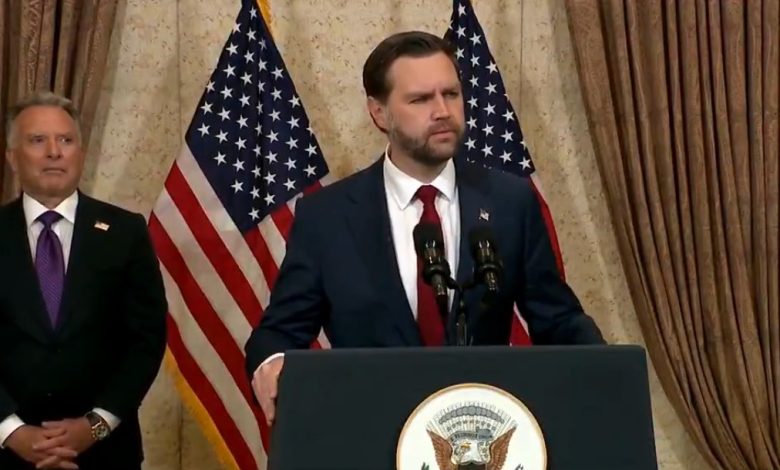
Despite the Iranian government initially suggesting that delegations would resume discussions later Sunday after a pause, Vance addressed the press to confirm that a deal had not been reached before leaving Pakistan.
“We’ve had a number of substantive discussions with the Iranians. That’s the good news. The bad news is that we have not reached an agreement — and I think that’s bad news for Iran much more than it’s bad news for the United States of America. So we go back to the United States having not come to an agreement,” Vance said.
“The simple fact is that we need to see an affirmative commitment that they will not seek a nuclear weapon, and they will not seek the tools that would enable them to quickly achieve a nuclear weapon,” he noted, adding that the US left its “final and best offer” for the Iranians.
Iran’s Response
On the other hand, Iran pushed back against Vance’s claims, blaming the US’ “excessive demands” for the failure of the talks, according to semi-official Tasnim News Agency.
“The negotiations between the Iranian and American teams concluded a few minutes ago and, due to what is described as US overreach and ambitions, the two sides have so far failed to reach an agreement,” Tasnim’s reporter in Islamabad said.
Islamabad April 11 ,2026.
Prime Minister Muhammad Shehbaz Sharif held a meeting with the Iranian delegation at the Islamabad Talks today.
The Iranian side was led by the Honorable Speaker of the Iranian Consultative Assembly, Mr. Mohammad Bagher Ghalibaf, assisted by Foreign… pic.twitter.com/xUSCq9sGpS
— Prime Minister's Office (@PakPMO) April 11, 2026
Iran’s Foreign Ministry Spokesperson, Esmaeil Baqaei, downplayed the collapse. He told state broadcaster IRIB that the two sides had a “gap in viewpoints” on “two or three key issues.”
Other Iranian media outlets reported that the Strait of Hormuz and Iran’s nuclear program were the main points of disagreement.
However, Baqaei hinted that diplomacy would continue. “There should have been no expectation that we could reach an agreement in a single session. I don’t think anyone had such an expectation,” he said.
Meanwhile, Iran’s state-affiliated Fars news agency used a more rigid tone. It reported, citing a source close to the negotiating team, that Tehran has no plans of holding a new round of negotiations.
“Iran is in no hurry, and until the US agrees to a reasonable deal, there will be no change in the status of the Strait of Hormuz,” the source said.
Ceasefire in Doubt
The US and Iran announced late Tuesday a temporary truce that suspends attacks for two weeks in exchange for the complete, immediate, and safe opening of the Strait of Hormuz.
Now, after the collapse of negotiations, it remains unclear if the ceasefire will stay in place or what will happen when the period expires.
In light of this, Pakistan’s Foreign Minister Ishaq Dar urged the US and Iran to maintain the ceasefire. “It is imperative that the parties continue to uphold their commitment to ceasefire,” he said in a statement after the talks.
Furthermore, he suggested that Islamabad will try to facilitate a new dialogue between Washington and Tehran in the coming days.
Strait of Hormuz
In his address to the press, Vance did not mention the Strait of Hormuz – a strategic shipping route and a key point of contention between the US and Iran.
Before the conclusion of the talks, US Central Command (CENTCOM) said that two Navy missile guided destroyers transited the critical waterway, despite Iran’s state media reporting that the joint military command denied the claim.
“USS Frank E. Peterson and USS Michael Murphy transited the Strait of Hormuz and operated in the Arabian Gulf as part of a broader mission to ensure the strait is fully clear of sea mines previously laid by Iran’s Islamic Revolutionary Guards Corps,” CENTCOM said in a statement.
Meanwhile, Trump said that the US military was “sweeping the strait,” downplaying the importance of reaching a deal. “Whether we make a deal or not makes no difference to me,” he told reporters.