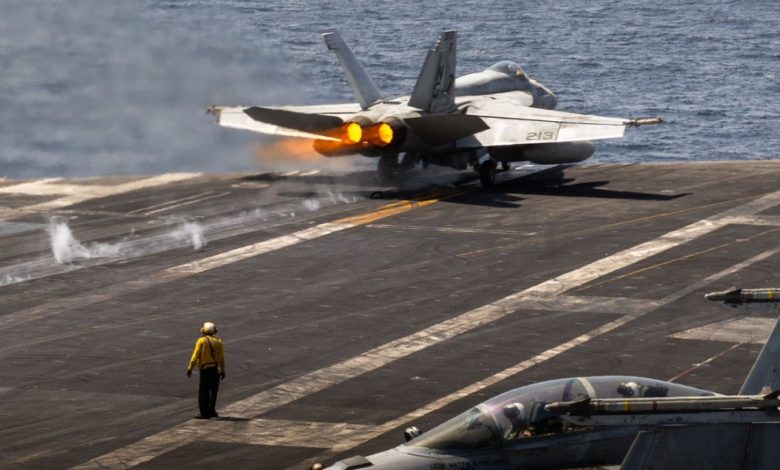
The US military targeted missile launch sites and boats in southern Iran on Monday, in what it called “self-defense” strikes.
The strikes took place as top Iranian negotiators arrived in Doha to meet with Qatari mediators as part of the ongoing talks to finalize a memorandum of understanding (MoU) that paves the way for a deal to end the US-Israeli war with Iran.
Defensive Strikes
US Central Command (CENTCOM) said on Monday that US forces carried out “self-defense strikes” in southern Iran to protect American troops from threats posed by Iranian forces, while emphasizing that the ceasefire remains in effect.
“Targets included missile launch sites and Iranian boats attempting to emplace mines. US Central Command continues to defend our forces while using restraint during the ongoing ceasefire,” CENTCOM spokesperson Tim Hawkins said in a statement.
CENTCOM statement followed reports about explosions in Bandar Abbas city in southern Iran – home to a military port and a dual-use airport – and around coastal areas near the Strait of Hormuz.
Iranian news website Tabnak reported that four Revolutionary Guards troops have been killed in US strikes on boats.
Peace Deal Talks
The strikes came despite a fragile ceasefire reached on April 8 and ongoing talks to secure a deal that brings the conflict to an end.
It also took place hours after Iran’s top negotiator and Parliament Speaker Mohammad Bagher Qalibaf, Foreign Minister Abbas Araghchi and Central Bank Governor Abdolnaser Hemmati arrived in Doha to meet with Qatari mediators, reported CNN citing a diplomatic source.
With Pakistan acting as the primary mediator, the US and Iran are working to finalize an MoU that extends the ceasefire for 60 days to negotiate a final agreement, opens the Strait of Hormuz, lift the naval blockade on Iranian ports, ends of the war on all fronts including Lebanon, and allows Iran to sell oil freely.
Qatar has recently stepped in to push mediation efforts and advance a peace deal amid disputes over a number of issues, most notably the control of the Strait of Hormuz, Iran’s frozen funds and Tehran’s highly enriched uranium.
US Secretary of State Marco Rubio expected the agreement to take a few days due to disputes over the wording. “There were some talks going on in Qatar today, so we’ll see if we can make progress. I think it’s a lot of talking back and forth going on about specific language in the initial document, so it’ll take a few days,” he told reporters on Tuesday.
Rubio also said the Strait of Hormuz is “going to be open one way or the other.”
Enriched Uranium
Iran’s highly enriched uranium is another point of contention in the ongoing talks. US President Donald Trump has insisted that Iranian stockpile should be destroyed, whether in Iran or in the US.
“The Enriched Uranium (Nuclear Dust!) will either be immediately turned over to the United States to be brought home and destroyed or, preferably, in conjunction and coordination with the Islamic Republic of Iran, destroyed in place or, at another acceptable location, with the Atomic Energy Commission, or its equivalent, being witness to this process and event,” he posted on Truth Social on Monday.
However, Iran has repeatedly said it has not made any commitments regarding the details of the nuclear issue at this stage of negotiations.
Iranian Warning
Following US strikes, Iran’s Revolutionary Guards (IRGC) announced in a statement they had downed a US MQ-9 drone – known as a Reaper – and shot at other aircraft after entering Iranian airspace in the Gulf region, according to Iranian media.
They also said that Iran reserves the “legitimate and definite” right to retaliate against any ceasefire violations by the US.
Iranian Supreme Leader Ayatollah Mojtaba Khamenei warned the US that it would no longer find a safe haven in the region for its military bases.
“What is certain in this regard is that the hands of time will not turn backwards, and the nations and lands of the region will no longer serve as shields for American bases,” the new Supreme Leader said in a written message published on his Telegram channel marking Hajj season and Eid Al-Adha.
He added that Washington was losing its influence in the region. “Day by day, it is growing more distant from its former status,” he noted.
Furthermore, Khamenei warned Israel and its leaders they were “approaching the final stages of their wretched existence.”