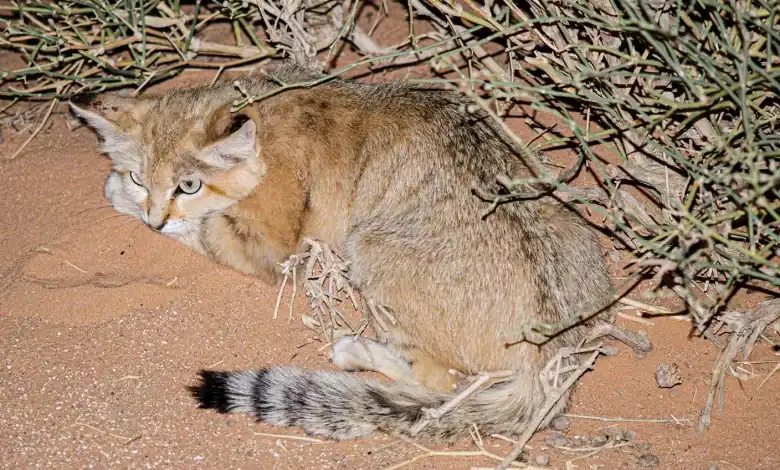
The Northern Borders region has spotted the rare species sand cat in the east of Arar, Saudi Press Agency (SPA) reported.
The sand cat is a nocturnal animal that only comes out after dark to search for food. It may travel up to 5 kilometers from its burrow, according to some studies.
It is a small-sized wild animal threatened with extinction due to poaching and natural habitat destruction.
Currently, the cat reappears again in Saudi Arabia thanks to the spread of natural reserves and its pivotal role in preserving the ecosystems.
Unique Features
Interestingly, this rare cat prefers to stay away from humans and live in stony desert areas with rugged terrain in which plants are accessible.
Thus, it stays in burrows during the day to avoid high temperatures, and to stay hydrated and satiated.
Nasser Al-Majlad, president of the Aman Environmental Association in the Northern Borders region, stated that the area is full of several wild animals of different categories, species and types.
Such diversity is mainly due to the various surrounding conditions, such as the diversity of the terrain; mountains, plateaus, plains, valleys and reefs, as well as the spread of different kinds of annual and seasonal plants.
Al-Majlad explained that the sand cat depends on small rodents, lizards and snakes as main food.
Amazingly, it hunts its prey at night as it has the ability to see fully in the dark, and can survive without water as it obtains all hydration from its prey.
Pregnancy and Birth

The female cat gives birth in burrows or rock crevices once and sometimes twice a year after a gestation period of 59 to 68 days, giving birth to 3-4 kittens.
The sand kittens cannot see for ten days after birth, but begin to be self-reliant in hunting prey after three or four months.
Physical Appearance
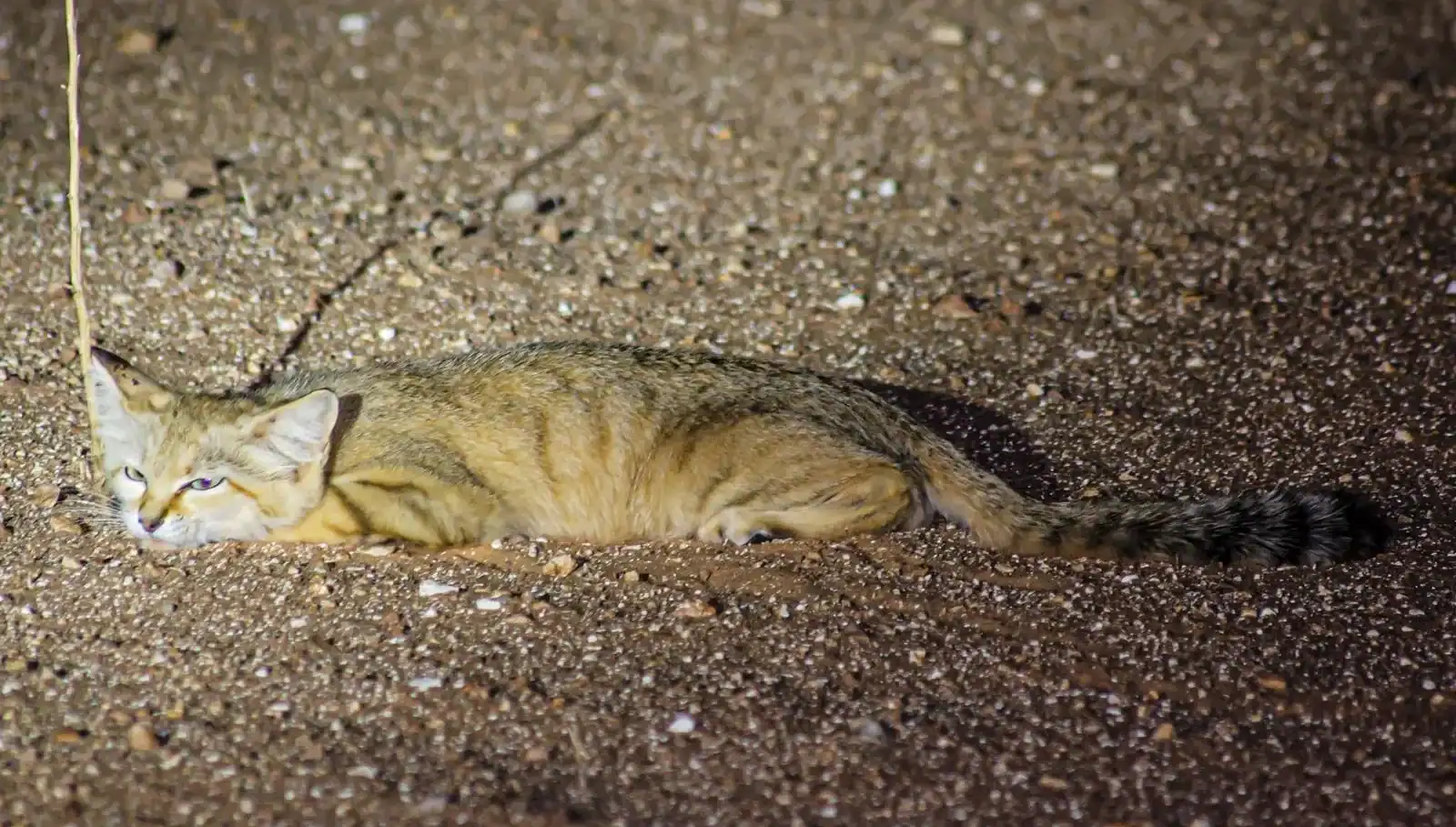
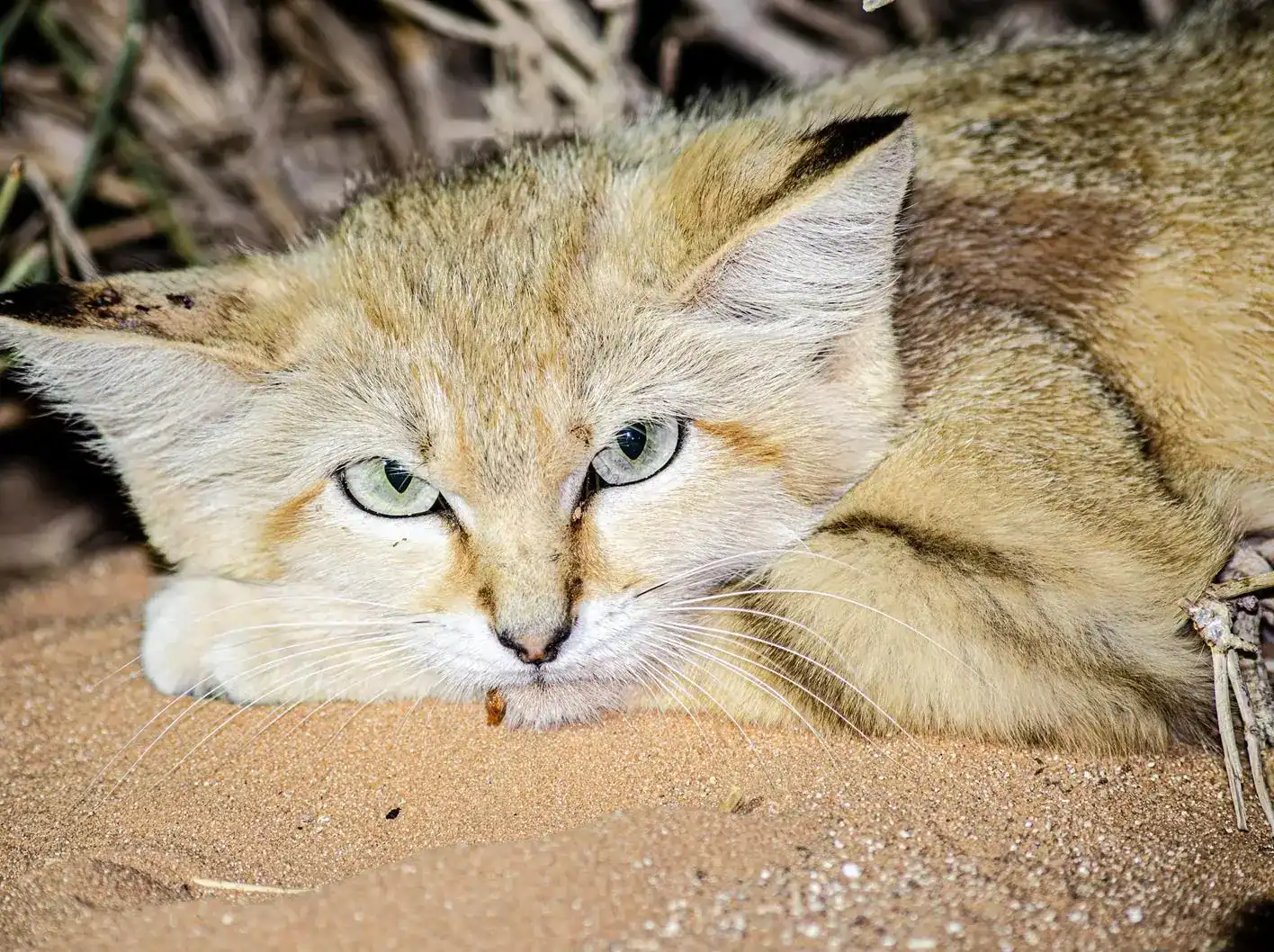
Al-Majlad clarified that the cat has a sandy color, tending to pale yellow-orange, with light-colored markings on the top of its body.
The front legs have two black rings, with a tail surrounded by (2-5) black rings that are not completely round, alternating with orange bands.
The cat has a white belly, a broad flattened head, and large, black-edged and triangular ears.
Moreover, it enjoys sharp hearing with thick hair spreading between its fingers and feet to protect its bare feet from the heat of the ground in the summer.
One Threat
Al-Majlad indicated that the only threat for this cat is humans with their frivolous hunting. As for its natural enemies, the cat protects itself well either by quickly fleeing or hiding in burrows that it digs under perennial trees.
Related Topics:
Take a Look: Dazzling Geckos Glow in the Dark Desert of Saudi Arabia
In Photos: Saudi Wildlife Center to Explore Caves in Northern Borders
Take a Look at Stunning Shots for Color Gradients of Saudi Camels