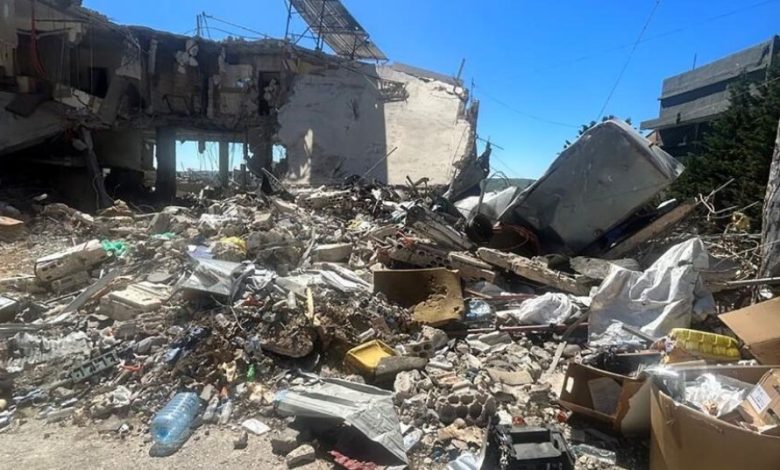
Israel said it will continue its military operations in southern Lebanon, despite a recently signed US-Iran preliminary deal that calls for ending the war on all fronts, including in Lebanon.
Meanwhile, Israel is in talks with the US to maintain its troop presence in southern Lebanon as Israeli Prime Minister Benjamin Netanyahu refuses to withdraw forces from the so-called “buffer zones” in Lebanon, Syria and Gaza.
Occupation Map
The Israeli military on Thursday published a map identifying an expanded zone where its troops operate in southern Lebanon. The map showed what it called a “security zone” running around 10 kilometers inside Lebanese territory, including near the Hezbollah stronghold of Nabatieh north of the Litani River.
In a statement, the Israeli military said its troops are deployed in the security zone “due to operational requirements,” adding that they will continue to “remove threats and strengthen the defense of Israel’s northern residents.”
Furthermore, an Israeli military official said the military “will continue to remove threats” to Israeli soldiers and civilians “beyond the security zone,” implying it could carry out attacks deeper into Lebanon, according to Reuters.
Since the outbreak of the war with Iran and Hezbollah’s involvement in the fighting, the Israeli military seized large portions of territory in Lebanon, Syria and Gaza, calling these areas “buffer zones” needed for preventing attacks from Israel’s enemies.
US-Iran Deal
US President Donald Trump and Iranian counterpart Masoud Pezeshkian on Wednesday signed a 14-point memorandum of understanding (MoU) to halt the war and open the Strait of Hormuz. The deal sets a period of 60 days to negotiate on other issues, including Iran’s nuclear program, and secure a final agreement.
According to the US readout of the deal, Washington and Tehran “declare the immediate and permanent termination of military operations on all fronts, including in Lebanon.” It calls on the parties to ensure “the territorial integrity and sovereignty of Lebanon.”
Moreover, the MoU notes that the final deal “will confirm the permanent termination of the war on all fronts, including in Lebanon.”
However, Israeli officials quickly slammed the deal for falling short of addressing Israel’s concerns over Iran’s nuclear program and constraining their military operations in Lebanon.
Commenting on the deal, Netanyahu said that Israel valued its relationship with the US but it needed to maintain security for northern Israeli towns that came under Hezbollah rocket fire during the war.
“This requires maintaining the security strip in southern Lebanon, it requires that we not leave there as long as Israel’s security needs require it,” he said.
Lebanon Dilemma
Ahead of the official signing of the MoU, the US, Iran and mediator Pakistan said that the deal includes a clause on Lebanon. However, Israel rejected calls to withdraw its troops from Lebanon, saying it is not bound by any agreement between the US and Iran.
Israeli Defense Minister Israel Katz said that Israeli forces “will remain in the security zones in Lebanon, Syria and Gaza for an unlimited period of time.”
Lebanon has been dragged into the US-Israeli war with Iran in early March following Hezbollah’s decision to retaliate for the killing of the Iranian Supreme Leader Ayatollah Ali Khamenei by sending barrages of missiles and drones towards Israel.
Israel responded by launching heavy airstrikes and ground operations into southern Lebanon, seizing control of large swaths of the country.
Despite strong opposition from Hezbollah, Lebanon and Israel have been engaged in US-mediated direct talks to reach a peace agreement that ends the conflict, which has so far killed over 3,900 Lebanese, according to Lebanon’s Health Ministry. The fifth round of direct talks will take place next week in Washington.
‘Stubborn’ Talks
Israel is holding talks with the US to extend its military presence in southern Lebanon, Reuters reported, citing two Israeli officials, including a senior official close to Netanyahu.
The senior official described the talks with Trump’s administration as “stubborn negotiations,” saying that Israel will not compromise on its positions, including keeping troops deployed in the area south of Lebanon’s Litani River.
Trump has recently voiced his frustration with Netanyahu over Israeli strikes on Beirut, which jeopardized the deal with Iran when it was near finalization.
“Too many people have been killed. You don’t have to knock down an apartment house every time you’re looking for somebody, because there are a lot of people in those apartment houses, and they’re not all Hezbollah,” Trump said during the G7 Summit in France.
While touting his “great relationship” with Netanyahu, Trump noted that he should be “more responsible” with Lebanon. “Without us, without the United States, there would be no Israel. Without me, there would be no Israel, because no other president was willing to do what I did,” Trump said.