Hezbollah has rejected the terms of a renewed, US-backed ceasefire between the governments of Lebanon and Israel, demanding a comprehensive deal and an Israeli withdrawal from Lebanese territory.
The renewed ceasefire was announced following the fourth round of talks between Lebanese and Israeli delegations in Washington, hinging on the cessation of attacks by the Iranian-backed group, which is not a formal party in the negotiations.
Hezbollah’s Rejection
Hezbollah leader Naim Qassem on Thursday rejected the US-brokered ceasefire agreement, saying that negotiations had been “futile” and “humiliating” for Lebanon, urging the Lebanese government to end direct talks with Israel.
He claimed that the agreement amounted to surrender and would fulfill Israel’s objectives, stressing that “resistance will continue” as long as the Israeli occupation persists.
“The ceasefire must be comprehensive, without a separation between the south and the rest of Lebanon, and without the Israeli enemy having the freedom to kill,” Qassem said in a written statement carried by Al-Manar TV.
US-Backed Ceasefire
Following US-led direct talks on June 2-3, 2026 in Washington, Lebanon and Israel agreed to a conditional ceasefire agreement. “The ceasefire is contingent on a complete cessation of Hezbollah fire and the evacuation of all Hezbollah operatives from the South Litani Sector,” a joint statement said.
Furthermore, the US will help accelerate “the creation of pilot zones in which the Lebanese Armed Forces will take exclusive control of the territory to the exclusion of all non-state actors,” according to the statement, which did not identify the location or mechanism of these zones.
The two parties agreed to meet again the week of June 22 to advance the security and political tracks, “with a view toward reaching a comprehensive agreement.”
However, Israel’s Defense Minister Israel Katz said on Thursday that Israeli forces will not withdraw from the area they occupied or halt operations in Lebanon. He added that Israeli troops retain the “freedom of action, with American backing, to strike in Beirut in response to fire on Israeli communities and territory.”
Lebanon Conflict
Lebanon has been dragged into the US-Israeli war with Iran in early March following Hezbollah’s decision to retaliate for the killing of the Iranian Supreme Leader Ayatollah Ali Khamenei by sending barrages of missiles and drones towards Israel.
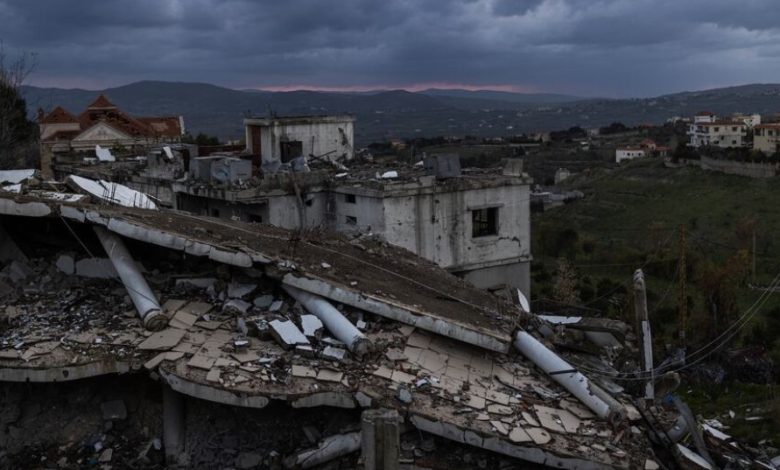
In response, Israel launched heavy airstrikes and ground operations into southern Lebanon, seizing control of large swaths of the country.
The US has mediated to end the fighting in Lebanon in parallel to broader diplomatic efforts to resolve the conflict with Iran, hosting direct talks between Lebanese and Israeli delegations in Washington.
However, fighting between both sides has continued despite a US-brokered ceasefire taking effect on April 17. Earlier this week, Israel ordered the military to launch strikes against targets in Beirut’s southern suburbs (Dahiyeh) – the stronghold of the Iranian-backed group Hezbollah – citing ceasefire violations.
Furthermore, Prime Minister Benjamin Netanyahu ordered an expansion of the incursion into Lebanon, a few days after crossing the Litani River. He also announced that Israeli forces captured the 900-year-old Beaufort Castle, also known as Qalaat al-Shaqif, which offers views across Lebanon and into northern Israel.
Iranian Precondition
Iran has put a ceasefire in Lebanon as a precondition for any deal to end the ongoing conflict with the US. In light of this, Iran’s Revolutionary Guards said that their initial condition for accepting a ceasefire in the regional war was a “ceasefire on all fronts, including Lebanon.”
In a statement carried by state media on Thursday, they said that Israel must halt attacks in Lebanon, evacuate the areas it occupies and retreat behind international borders.
Separately, the commander of the Quds Force said that “the minimum demand” is that Israeli troops withdraw to positions it held in Lebanon before the war.
“Supporting the resistance in Lebanon is the duty of all of us, and removing Israel from the region is an attainable goal for Muslims,” Esmail Qaani said in a social media post.
Trump-Netanyahu Friction
Israel’s actions in Lebanon have sparked tensions between US President Donald Trump and his longtime ally Netanyahu. On Monday, Trump announced that Netanyahu refrained from attacking Beirut’s southern suburbs (Dahiyeh) and pulled back troops, while Hezbollah pledged not to attack Israel or its soldiers.
The announcement followed a tense phone conversation, during which Trump blasted Netanyahu for his plans to strike Beirut, which jeopardize his efforts to end the war with Iran, according to several news reports. At points, Trump used expletives, called Netanyahu “crazy” and accused him of ingratitude.