
Experts link the recent climate trend in the Middle East to a western disturbance from the Mediterranean and anti-cyclone activity, key factors in the floods in Dubai and Riyadh.
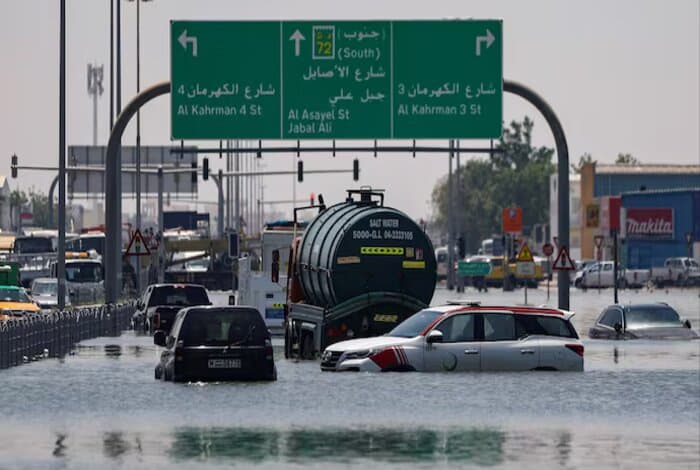
Despite its vast deserts and scorching heat, Saudi Arabia is undergoing a dramatic shift in weather patterns. Some areas are experiencing severe flooding following heavy rainfall. Riyadh witnessed numerous cars swept away by the floods.
Flowing waters have turned dry valleys in Saudi Arabia into rivers, leading to unusual and devastating floods across the region.
Dr. Raghu Murtugudde, previously a faculty member at the University of Maryland and IIT Bombay in Earth System, Atmospheric, and Oceanic Science, explained, “As we move towards the monsoon season, winds in the upper atmosphere above the Arabian Sea, Peninsular India, and the Bay of Bengal start blowing sporadically from east to west. These winds are known as the Indian Easterly Jet. Simultaneously, there are strong winds at the same altitude blowing from west to east north of India, which are referred to as the Westerly Jet.”
“The easterly and westerly jets together have been causing persistent anti-clockwise winds near the surface called anti-cyclones since mid-March. Anti-cyclones have descending winds in their centre, which compress the air and warm it and produce heatwaves over parts of India,” he said.
Experts suggest that the recent climate trend in the Middle East may result from a western disturbance originating in the Mediterranean.
“A western disturbance from the Mediterranean ran into this anti-cyclone to produce the devastating deluge over Dubai recently. Now, the anti-cyclone that pumped moisture from the warm Arabian Sea into the UAE, is meeting a cyclonic circulation over the Mediterranean and Saudi Arabia to produce very heavy rainfall over parts of Saudi Arabia,” Dr Murtugudde said.

El Nino Amplifies Floods in Dubai
“The warmth due to El Nino has supercharged the jets and produced high moisture that resulted in extreme rain. It is a classic case of natural variability getting a massive boost from El Nino and global warming,” he added.
The floods in Dubai halted life in many areas, disrupting normal activities. Moreover, the authorities urged safety measures and avoidance of low-lying flood-prone areas. Civil defense teams conducted rescue operations and assisted residents during the sudden crisis.
The floods in Saudi Arabia, following those in Dubai, emphasize the region’s evolving climate and the necessity for Gulf Cooperation Council (GCC) countries to develop long-term strategies to address these weather extremes. Building resilience to such challenges is a significant test and responsibility in the era of climate change.
Venomous Snakes: New Climate Change-related Threat
Climate Change and Threat of Diseases
Azerbaijan, COP29 Climate Summit Host, Defends Oil Investments