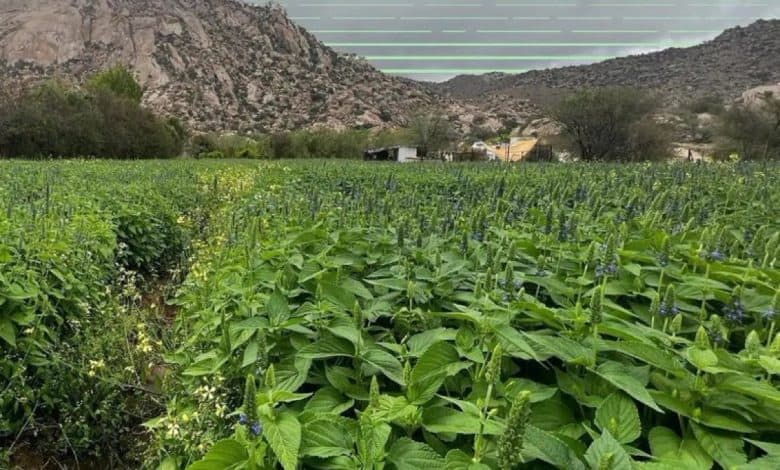
The Ministry of Environment, Water and Agriculture announced the successful localization of chia cultivation in several advantageous areas of Saudi Arabia, particularly in the Makkah region. This achievement highlights the ministry’s efforts to develop the agricultural sector by introducing crops suited to local climates, enhancing food security and environmental sustainability.
Chia’s Adaptability and Benefits
Chia seeds, part of the mint family, originate from Central America and thrive in warm climates. Their evergreen leaves feature serrated edges and small purple flowers with white centers, reaching up to one meter in height. With a yield of 800–1200 kg per hectare, they are fast-growing, requiring only 130 days and minimal water, making them ideal for Saudi Arabia’s arid conditions.
The ministry promotes chia cultivation in areas with comparative advantages, such as the “Saudi Rural” program, which empowers farmers and supports agricultural growth. The plant’s versatility extends beyond seeds, as its leaves are used in food, beverages, cosmetics, and natural oils.
Adaptation and Sustainability in Saudi Conditions
Chia plants thrive in Saudi Arabia’s warm climate, growing in temperatures between 15–30°C. Field experiments in Taif Governorate (Makkah region) confirmed successful localization on plots measuring 100m by 70m. This aligns with national plans to diversify crops and ensure sustainable agricultural practices.
Farmers use fully decomposed organic fertilizer (30 cubic meters per hectare) with integrated chemical fertilization to boost yields. The plant’s drought tolerance ensures sustainable and efficient crop production, supporting Saudi Vision 2030’s self-sufficiency goals.
This breakthrough strengthens Saudi Arabia’s agricultural diversification, contributing to self-sufficiency and environmental sustainability. By embracing innovative crops like chia, the kingdom advances its commitment to global food security and ecological balance.