As the term of the current UN Secretary-General is set to expire on December 31, 2026, four candidates are vying for leading the world body.
The race comes at a time when the UN faces mounting challenges, including global instability, geopolitical turmoil, internal financial pressures and doubts over its ability to address conflicts.
Next UN Chief
The current UN Secretary-General, António Guterres, will complete his two five-year terms at the end of 2026, opening a leadership race to choose his successor. The tenth UN chief will assume office on January 1, 2027.
On April 21-22, 2026, the UN’s 193 Member States and members of civil society will question candidates in televised three-hour “interactive dialogues” in the Trusteeship Council chamber.
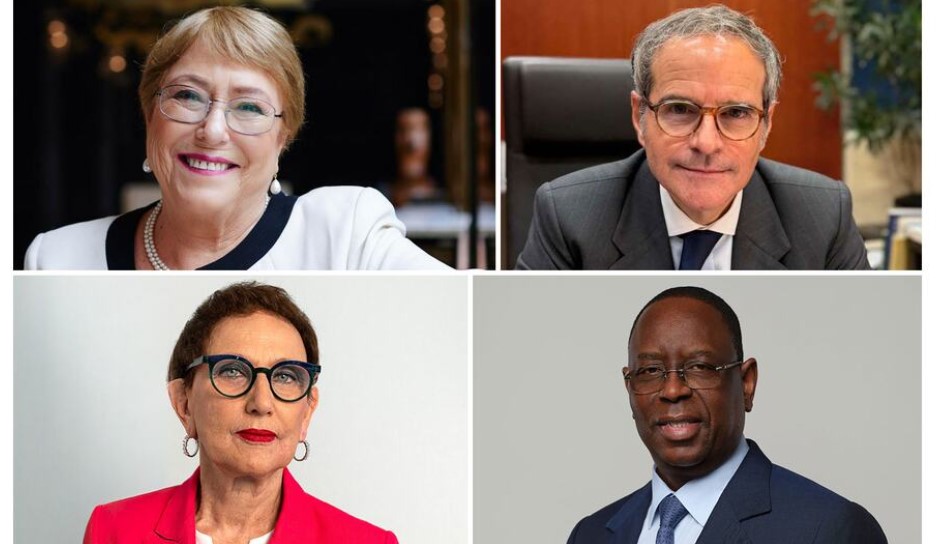
There are four nominees for this term: former Chilean president Michelle Bachelet, Argentinian diplomat and head of the UN’s nuclear watchdog Rafael Grossi, Costa Rican economist and former vice president Rebeca Grynspan, and former Senegalese president Macky Sall.
Secretary-General’s Role
According to the UN, the Secretary-General serves as the body’s premier diplomat and chief administrative officer. Beyond leading the UN Secretariat and its expansive global operations, the Secretary-General brings emerging threats directly to the Security Council’s attention.
As both a mediator and a public advocate, the UN chief also provides a moral voice during global crises while ensuring that the complex policy decisions made by Member States are effectively implemented across the organization.
Selection Process
In November 2025, the presidents of the 15-member UN Security Council and the General Assembly invited Member States to nominate candidates by April 1, 2026.
The candidates will hold public “interactive dialogues” over Tuesday and Wednesday, presenting their visions and taking questions from Member States.
Then, in late July 2026, the UN Security Council will hold a series of secret straw polls, during which council members will signal whether they “encourage,” “discourage,” or have “no opinion” on each candidate.
Finally, the council’s five permanent veto-wielding members (the US, Russia, China, Britain and France) must agree on a candidate and recommend them to the General Assembly for formal appointment in late 2026.
The UN Secretary-General position traditionally rotates geographically, though the process is not official and often unpredictable. When Guterres was elected in 2016, he bypassed the expected Eastern European rotation.
Now, as the search for his successor begins, Latin America is technically next in line. Despite this, diplomatic circles remain open to candidates from other regions.
The US envoy to the UN, Mike Waltz, said the next chief must align with “American values and interests,” suggesting that Washington would back the best candidate – not necessarily a Latin American or a woman.
Key Challenges
The next Secretary-General will inherit a myriad of global challenges amid heightened geopolitical tensions and a fraying international order. The UN chief will be tasked with spearheading collective responses to a wide range of cross-border crises, such as climate change, health, and refugee flows.
Furthermore, the new Secretary-General will have to handle a serious budget crisis as the US – the UN’s largest financial contributor – refuses to meet its financial obligations.
With the organization’s core budget at $3.45 billion and peacekeeping at $5.4 billion, the new Secretary-General will have to implement radical reforms to ensure the UN remains functional despite a massive shortfall in funding.
Four Contenders:
The race to the UN leadership involves four candidates; three from Latin America and one from Africa. The nominees also include two women, raising the chances for having the first female UN chief since the body’s establishment.
Michelle Bachelet
The first candidate is the former Chilean President Michelle Bachelet. Her candidacy was supported by Mexico and Brazil, although Chile withdrew its backing on March 24 after a change in leadership and a pivot to the right.
Bachelet served as UN high commissioner for human rights from 2018 to 2022 and executive director of UN Women from 2010 to 2013.
In her vision statement, she underscored confidence in her experience to tackle “unprecedented” challenges facing the international system, vowing to focus on “rebuilding trust in the UN.”
Rafael Grossi
The second candidate is Rafael Grossi – a seasoned diplomat from Argentina. He currently serves as Director General of the International Atomic Energy Agency (IAEA) and was nominated by his country in November 2025.
Grossi called for a “purposeful, performance-driven renewal” to boost the UN and “return to its founding promise – to save humanity from the scourge of war.”
He also advocates for a “wider process of rightsizing, which is sustainable and reconciles mission with available resources,” building on the UN80 reform initiative.
Rebeca Grynspan
Rebeca Grynspan, the current head of UNCTAD and a former Vice President of Costa Rica, is the third candidate for the UN Secretary-General race. In her vision statement, she stressed the need for restoring trust in the UN’s capacity to deliver peace and development.
Macky Sall
While Latin America is technically “next in line” for the Secretary-General post, former Senegalese President Macky Sall has emerged as the final candidate for the race after being nominated by Burundi.
In his vision statement, Sall emphasized the need for reforming, streamlining, and modernizing the UN to address 21st-century challenges. He also said that peace can never be “sustainable” if development is undermined “by poverty, inequality, exclusion and climate vulnerability.”