
The UN Security Council (UNSC) will vote next week on a Bahraini-proposed resolution aimed at reopening the Strait of Hormuz.
The vote has been postponed several times amid opposition from China and Russia over the authorization of the use of force to secure the strait. As a result, Bahrain has significantly watered down its proposal, shifting the focus from offensive action to strictly “defensive measures.”
UNSC Vote
The UNSC is set to vote next week on the Bahraini-backed resolution designed to secure commercial shipping through the Strait of Hormuz, which has been largely shut down by Iran amid its ongoing conflict with the US and Israel.
The vote was supposed to take place on Friday. It was rescheduled for Saturday, and then postponed until next week, Reuters reported, citing diplomats. No specific date has been announced yet.
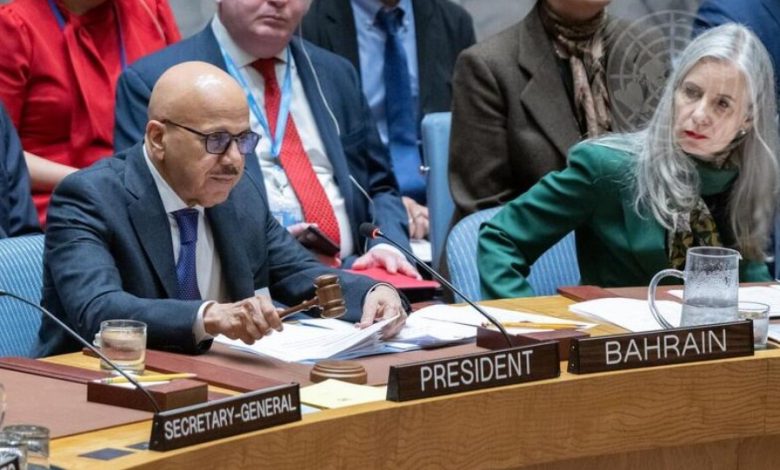
As the chair of the UNSC this month, Bahrain on Thursday finalized a resolution that would authorize “all defensive means necessary” to protect commercial shipping in the strait, through which one-fifth of global energy supplies pass.
Bahraini Foreign Minister Abdullatif bin Rashid Al Zayani said that the vote would take place on Friday, expressing Manama’s aspiration for a “unified position from this esteemed council.”
Use of Force Dilemma
The resolution’s initial draft would have authorized countries “to use all necessary means in the Strait of Hormuz, the Gulf and the Gulf of Oman” to secure passage and deter attempts to interfere with navigation.
This language indicates possible military action. In response, veto-wielding China, Russia and France voiced their opposition to authorizing the use of force.
Addressing the 15-member UNSC on Thursday morning, China’s UN envoy Fu Cong opposed the authorization of force as “unlawful and indiscriminate.” He warned that this “would inevitably lead to further escalation of the situation and lead to serious consequences.”
He also called on the UNSC to “proceed with caution” and ramp up efforts for de-escalation and dialogue.
This has led Bahrain to drop any reference to approving possible military action. However, the position of the three countries regarding the changes remains unclear, according to the Associated Press (AP).
Defensive Means
The resolution’s final draft allows countries to “use all defensive means necessary and commensurate with the circumstances in the Strait of Hormuz and adjacent waters” to secure shipping and prevent attempts to interfere with international navigation.
The draft authorizes these measures “for a period of at least six months … and until such time as the council decides otherwise.”
Furthermore, the draft resolution allows countries acting alone or in “multinational naval partnerships” to take defensive means, contingent upon prior notification to the UN Security Council.
For a UNSC resolution to pass, it must get at least 9 votes in favor and no vetoes from the five permanent members, Britain, China, France, Russia and the US.
Hormuz Closure
The US-Israeli war with Iran has caused traffic disruption in the strategic waterway, as Iran warned it would not allow “enemy ships” to cross the Strait. It also threatened to deploy naval mines across the Arabian Gulf to cut routes in case the US invaded its southern coast and islands.
Additionally, US President Donald Trump called on other oil-importing nations to “build up some delayed courage” and seize the critical waterway, noting that the US would consider a ceasefire only when Hormuz is “free and clear.”
Trump has set April 6 as a deadline for Iran to reopen the critical waterway or the US “will hit and obliterate” Iranian power plants.
The UK convened over 40 countries on Thursday to discuss efforts to reopen and ensure safe passage through the strait. Britain also backed Bahrain’s move to secure a UNSC resolution to resolve the issue.