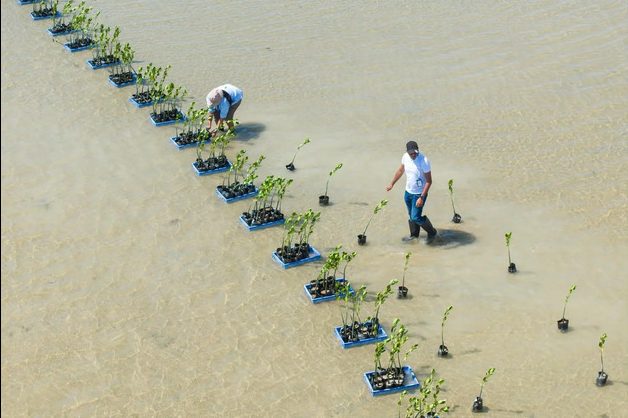
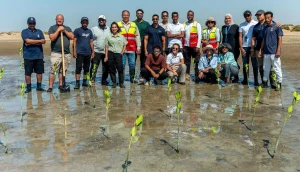
Red Sea Global (RSG) has announced the successful planting of more than 5,000 seedlings of the rare red mangrove species (Rhizophora mucronata) in Al Wajh Lagoon. The initiative represents the largest restoration effort of its kind for this species in the area.
Strategic Ecological Significance
According to the company, the project holds considerable environmental importance. The planting site lies at the extreme northern edge of the red mangrove’s global distribution and is home to the largest natural concentration of these trees in the region. Known locally as “Qandal,” red mangroves act as a vital ecological safeguard for marine ecosystems.
They contribute to coastal protection, create essential breeding grounds for fish and crustaceans, and are highly efficient at capturing and storing carbon—often surpassing terrestrial forests in carbon sequestration capacity.
Scientific Achievement, Environmental Impact
Raed Albasseet, Group Chief Environment and Sustainability Officer at RSG, described the milestone as more than a numerical accomplishment. He emphasized that restoring red mangroves at this scale represents a scientific breakthrough, particularly given the species’ strict environmental requirements.
Red mangroves require precise conditions, including specific salinity levels, tidal flows, and stable temperatures. Their successful restoration signals a renewed ecological balance within sensitive coastal habitats. Albasseet noted that the initiative lays the foundation for a more sustainable environmental future, benefiting Red Sea communities while preserving natural heritage for generations.
Advanced Techniques Deliver Record Survival Rates
Red mangroves differ significantly from grey mangroves (Avicennia marina), which are more adaptable to varying environmental conditions. Because red mangroves are especially sensitive, cultivating them demands advanced scientific methods.
RSG’s environmental team achieved an impressive 97% seedling survival rate. This record was made possible through innovative in-house approaches, including enhanced sediment stabilization techniques and carefully managed water-flow systems designed to replicate optimal natural conditions.
Rashid AlHatilah, Group Head of Environmental Sustainability at RSG, described Qandal trees as a rare ecological treasure along the coastline. He noted that the success at Al Wajh Lagoon demonstrates the company’s ability to transform environmental challenges into opportunities for ecosystem regeneration, marking the beginning of a broader conservation journey.
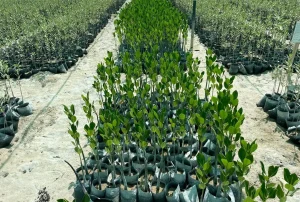
This achievement forms part of RSG’s long-term environmental commitment. To date, the company has planted more than three million grey mangrove seedlings, with a target of reaching six million—placing the initiative among the region’s largest ecological restoration programs.
Expanding Sustainable Tourism Destinations
Beyond conservation, The Red Sea destination currently welcomes guests across nine luxury resorts, along with the Thuwal Private Retreat. Meanwhile, anticipation is building for the launch of AMAALA. Its first phase at Triple Bay will introduce six luxury resorts, complemented by signature attractions such as a Yacht Club, a Marine Life Institute, and a Marina Village—offering a distinctive and elevated tourism experience aligned with sustainability goals.
Related Topics:
Red Sea Global, Marriott Launch Luxury Ritz-Carlton Resort at AMAALA
Shura Island by Red Sea Global: A Captivating Destination
Red Sea Global’s Two Diving Centers Earn PADI Global Rating
Saudi Researchers Unveil Revolutionary Nanoplastic for Sustainable Street Lighting