As escalating regional tensions continue to disrupt maritime shipping and supply chains, the revival of the historic Hejaz Railway has re-emerged as a pivotal alternative to connect Europe to the Gulf region through Türkiye and Syria.
The Hejaz Railway is an Ottoman-era line that extended from Damascus to Madinah, transporting pilgrims and troops, but was largely destroyed during World War I.
Alternative Transport Corridor
Maritime instability has pushed countries across the region to navigate alternative shipping routes. Turkish Foreign Minister Hakan Fidan raised the idea of establishing a land transport corridor linking Türkiye and the Gulf through Syria and Jordan.
Speaking at an IISS foreign policy dialogue in Singapore on June 2, Fidan said that Türkiye is in active negotiations with Saudi Arabia, Jordan and Syria to revive a transport corridor, adding that several options are under review to strengthen regional connectivity.
The Turkish Minister highlighted global maritime challenges and rising freight costs as a drive for searching for stable, reliable overland alternatives linking regional markets.
He also noted that this corridor is not just about energy transport, but a comprehensive trade route for goods, food supplies, and commercial exchange between European markets and the Arabian Gulf.
Reviving Hejaz Railway
The Hejaz Railway is now at the center of Ankara’s ambitious diplomatic push to create a secure corridor bypassing volatile waters. Turkish Transport and Infrastructure Minister Abdulkadir Uraloglu told the Anadolu Agency that Türkiye plans to modernize the historic Hejaz Railway to create a global trade corridor bypassing the Strait of Hormuz.
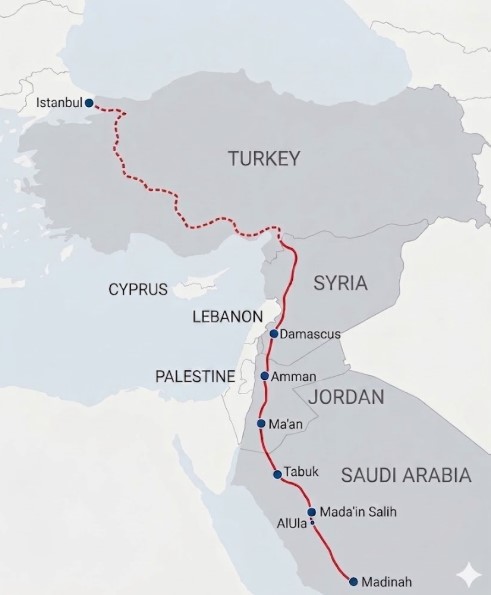
Uraloglu said that the initial phase of the plan involves connecting Türkiye to Aleppo while leveraging the existing Aleppo-Damascus-Jordan network. He also noted that negotiations are underway with Saudi Arabia.
Targeting tourism and modern freight transit, Turkish authorities aim to extend the line to Oman to reach the ocean, establishing a strategic alternative to the Strait of Hormuz, Uraloglu added.
The Hormuz Chokepoint
The Strait of Hormuz is a crucial waterway linking the Arabian Gulf with the Gulf of Oman and the Arabian Sea, through which around a fifth of daily global oil and LNG supplies pass.
However, the US-Israeli war with Iran, which broke out on February 28, 2026, has paralyzed traffic through the strategic waterway, as Tehran has partially closed the Strait, blocking transit without its permission and demanding an end to the US naval blockade on its ports.
This has also disrupted the flow of goods, essential commodities and aid supplies, triggering a massive surge in transport and insurance costs as shipping firms scramble for alternative routes.
Amid escalating tensions, Iran has also threatened to completely block the Strait of Hormuz and activate other fronts, including the Bab El Mandab Strait in the Red Sea, further exacerbating the current crisis and exposing how vulnerable the existing global energy and supply chains really are.
Enhancing Land Connectivity
Saudi Arabia has actively hedged against the disruptions in the Strait of Hormuz by enhancing maritime connectivity and supporting supply chain resilience through the Red Sea.
This has included introducing new shipping services to the Jeddah Islamic Port and launching a new multimodal land bridge connecting Europe, Egypt, Saudi Arabia, Iraq and the Gulf Cooperation Council (GCC) countries through the Port of NEOM.
Furthermore, the Kingdom is exploring ways to expand regional land networks. In April 2026, the Saudi Minister of Transport and Logistic Services, Saleh al-Jasser, told Al-Arabiya Business that joint studies regarding the revival of the Hejaz Railway are expected to be finalized before the end of the year.
He noted that the project will “enhance regional integration, support trade, and develop a sustainable land transport system between the countries of the region.”
In the same month, Al-Jasser and his Syrian counterpart Yarub Badr discussed ways to strengthen bilateral cooperation in land and rail transport to secure supply chains and boost economic integration among countries in the region, SANA reported at the time.
Al-Jasser also noted that the Saudi railway network extends all the way to the Jordanian border, offering the potential to build an integrated regional link through Jordan and into Syria. He added that specialized technical teams are continuously working to finalize these future rail connectivity blueprints.
The Saudi Rail Revolution
Saudi Arabia boasts a robust and rapidly expanding railway network, propelled by the massive domestic transformation under Vision 2030.
The Saudi Arabia Railway (SAR) network already extends to Al-Haditha crossing near the Jordanian border through the North-South Line, effectively paving the way for immediate regional expansion.
Moreover, the ambitious Saudi Landbridge railway project is a megaproject designed to connect the Kingdom’s eastern and western coasts. With an estimated cost of $7 billion, the project targets the construction of over 1,500 kilometers of new track to seamlessly link the Kingdom’s coasts, ports, and industrial hubs.
The Landbridge project centers on three key lines: a 900-kilometer line to King Abdullah Port, connecting Riyadh and Jeddah; an update for the Riyadh-Dammam corridor for faster trips; and a 172-kilometer line from King Abdullah Port to Yanbu Industrial City on the Red Sea.