The Islamic Development Bank (IsDB) Group used its participation in the 2026 World Bank Group and International Monetary Fund (IMF) Annual Meetings in Bangkok to advance its development agenda, placing greater emphasis on stronger financial partnerships, institutional capacity, and the role of Islamic finance in supporting economic resilience.
Expanding IsDB–IMF Cooperation
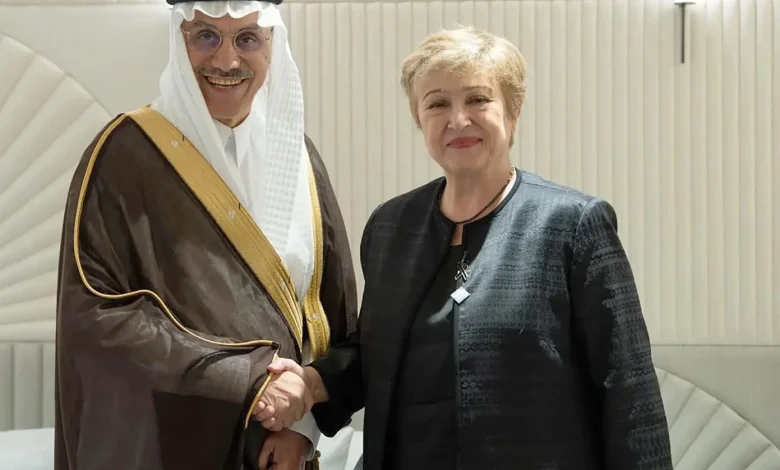
On the sidelines of the meetings, IsDB Group Chairman Muhammad Al Jasser met with IMF Managing Director Kristalina Georgieva to explore ways to expand cooperation in financial stability, capacity development, and knowledge exchange, the Saudi Press Agency reported.
Joint research and economic analysis remain important areas of cooperation between the IsDB and the IMF. Their current initiatives include a forthcoming report on Islamic banking and financial stability, as well as broader efforts to strengthen collaboration on regional macroeconomic developments.
More boldly, the discussions focused on opportunities to improve coordination on financial stability, with particular attention to the conditions and challenges shaping economies across IsDB member countries.
Al Jasser underscored the need to expand joint capacity development programs through the IsDB Institute and the IMF Middle East Center for Economics and Finance. These effort builds on recent cooperation in Islamic banking, financial legislation, and related policy areas.
In this context, both institutions reaffirmed their commitment to translating this cooperation into practical initiatives spanning joint research, professional development, policy dialogue, and knowledge exchange, with the broader aim of supporting resilient, inclusive, and sustainable economic growth.
How Can IsDB Support Benin’s Growth?
Alongside its engagement with the IMF, the IsDB Group also advanced its development partnerships through talks with Benin on expanding bilateral cooperation.
On the sidelines of the 2026 World Bank Group and IMF Annual Meetings in Bangkok, Al Jasser met with Hugues Oscar Lokossou, Benin’s minister delegate responsible for external resource mobilization and debt management, to discuss the country’s development priorities and opportunities for closer collaboration.
The meeting also focused on strengthening cooperation across key sectors, particularly infrastructure and agriculture, while exploring further opportunities to support Benin’s development agenda.
Advancing Connectivity and Food Security
Following their meeting, the IsDB and Benin signed two co-financing agreements addressing the country’s transport and agricultural priorities.
With a total cost of €576.06 million ($643.87 million), the Godomey–Ouidah–Hillacondji road widening and upgrading project represents the larger of the two investments.
The IsDB will provide €306.89 million to support safer roads, more efficient traffic, shorter journeys, and lower transport costs. The project is also poised to strengthen regional connectivity and trade along the Abidjan–Lagos Corridor.
Meanwhile, the second project targets the foundations of agricultural productivity. The Sustainable Intensification of Legume-Based Agricultural Systems initiative has a budget of €20.70 million, including €19.17 million in IsDB financing.
Across five development poles, the project will promote legume-based farming practices that enhance soil fertility, support food security, and build resilience to climate change.
Together, the two projects reflect the IsDB Group’s broader commitment to supporting Benin’s development priorities, from improving regional connectivity and trade to strengthening agricultural productivity and food security.
Related Topics:
IsDB Participates in Roundtable on Partnerships for Impact in Washington
President of IsDB Group Unveils ‘Solidarity 2.0’ Initiative
IsDB Broadens Engagement with IMF’s Financial Sector Assessment Program