Much of Europe witnessed its most dramatic solar eclipse in nearly 30 years on Wednesday, with millions thought to have seen the once-in-a-generation event.
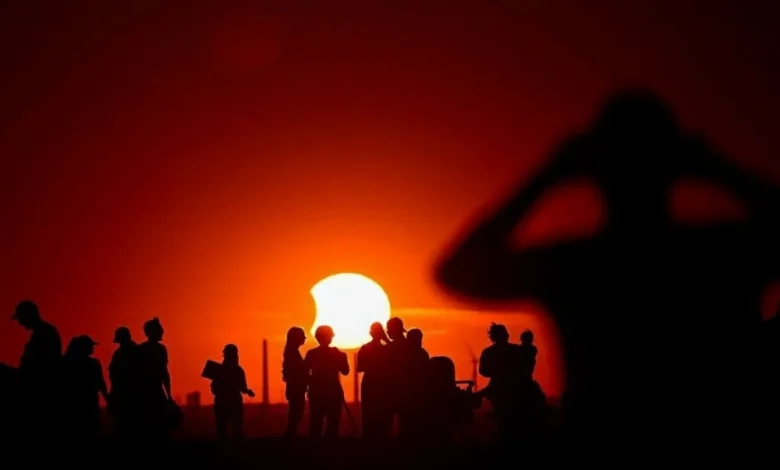
Observers in the UK were treated to a partial eclipse that peaked shortly after 19:00 BST, when most saw more than 90% of the Sun covered by the Moon. Meanwhile, parts of Greenland, Iceland and Spain experienced the complete darkness and spectacle of a total eclipse.
The path of totality began at the northern tip of Siberia in Russia, far from crowds and telescopes, before curving around the Arctic Ocean and arriving in Iceland in the early evening. It then swept southwards, offering the UK a partial view of its wonder.
Day briefly turned to night in Spain as the country witnessed its first total solar eclipse in more than a century, plunging large areas into eerie darkness in one of nature’s greatest spectacles. The spectral glow of the Sun’s outer corona, shimmering around the shadowy Moon, drew gasps and cheers from huge crowds just 90 minutes after the eclipse first appeared in the remote Arctic region of northern Russia.
This eclipse, the first in mainland Europe since 2006, also cast its shadow over parts of Greenland before racing south to smother Keflavík, some 50km from Iceland’s capital, Reykjavik, and arcing across the Atlantic Ocean towards northern Spain.

In Spain, the lunar shadow moved diagonally in a narrow path from the northern coast to the Balearic Islands, where tourists and locals gathered on beaches, many in swimming costumes accessorised with protective glasses.
“Spectacular, very beautiful, truly a unique moment,” said Rosa Maria Zamora, 72, who watched the eclipse in Colmenar Viejo, around 30km north of Madrid.
Supplies of special viewing glasses were in high demand as huge crowds turned out across Europe to watch the partial eclipse, which was also visible in Canada, the northern United States and northwest Africa.
A partial eclipse began in parts of northern Spain shortly after 19:30 CET, prompting gasps from waiting crowds and applause from South Korean tourists in a field in Lodoso, near the northern city of Burgos.
On the summit of the Pic du Midi in the French Pyrenees, heavy clouds parted minutes beforehand, allowing visitors to see the spectacle, which also drew crowds in London, Paris and across the continent.
Earlier on Wednesday, a total eclipse plunged western Iceland into complete darkness, though heavy cloud cover and rain blocked the view of the Sun disappearing behind the Moon in many areas.
Total darkness swept over Keflavík, some 50km southwest of Reykjavik, at 5:47pm local time, according to reporters at the scene. It was the first time the rare phenomenon was visible in Iceland’s capital since 1433, attracting thousands of tourists and locals across the country.
Astronomer and popular scientist Saevar Helgi Bragason was among the most eager spectators. He said he had been “waiting for this day for more than 10 years” after a partial solar eclipse over Iceland on 20 March 2015.
Speaking to the AFP news agency just before the event, he said he was filled with “excitement and heartbreak” because of the unfavourable weather forecast, which predicted that clouds would obscure the view of the Moon blocking out the Sun.
“It’s almost like I’ve lost someone.”
The total eclipse lasted longest over the cliffs of Latrabjarg in the westernmost part of Iceland, about 2 minutes and 13 seconds, while further south in the centre of Reykjavik it lasted just over one minute.
Hotels in Reykjavik and the rest of Iceland were fully booked, with one hotel in the western village of Breidavik receiving its first booking for the event 14 years ago, according to national broadcaster RUV.
Throughout human history, eclipses have stirred amazement, fear and reverence, as they appear to momentarily halt the normal course of nature. The shadow, or “umbra”, cast by the alignment of Sun and Moon creates a strange twilight during which temperatures drop, shadows appear at strange angles and some animals go to sleep.
But the phenomenon is generally fleeting: in parts of Russia and Greenland, the total eclipse lasted under two-and-a-half minutes. The partial eclipse, which occurs as the Moon starts and finishes crossing the Sun’s path, dimming its light, was expected to last around one hour and 45 minutes.
NASA, ESA
The event, which was livestreamed by both NASA and the European Space Agency, presented scientists with a rare opportunity to study the Sun’s atmosphere and its outermost layer as they seek to uncover secrets about solar winds and our star’s magnetic field.
Much of central and southern England and Wales enjoyed perfectly clear skies, giving them an unrivalled view as the Moon moved slowly across the Sun over the course of an hour. Northern England, Scotland and Northern Ireland were cloudier, but it did not stop crowds turning out at famous landmarks across the country.
As time ticked by, slowly but surely the Moon obscured more of the Sun — acting like a dimmer switch as it did so.
As seen from the UK, the Sun, Moon and Earth were not quite directly in line. The result was a partial eclipse, with the Moon covering about 90% of the Sun for most of the UK — the country’s most dramatic eclipse since 1999. In Cornwall, this was as high as 95%.
Crowds along the path of the total eclipse in Spain were treated to that rare event with the red glow of the Sun behind the Moon. The light coming from the darkness was the Sun’s corona — superheated jets of gas thrown thousands of miles out into space. And for those looking closely, they may have seen small loops of pink gas called prominences following the Sun’s turbulent magnetic field.
The fact that we get to experience a total eclipse at all is an incredible cosmological coincidence. The Sun is 150 million kilometres (93 million miles) away from the Earth — 400 times further away than the Moon. But because the diameter of the Moon is 400 times less than the Sun’s, they appear exactly the same size in our sky. If the Moon was slightly smaller or its orbit was a little further away from the Earth, we would never see a total eclipse.
A total solar eclipse happens somewhere on Earth every 18 months or so. But they are much rarer for any given place, only occurring once in roughly 400 years.
golden age
We are about to enter a “golden age” of total solar eclipses between 2026 and 2028. Eclipse chasers can travel around the world to be wowed by the spectacle of three total solar eclipses in the next couple of years.
It will be decades until the UK experiences a fuller solar eclipse than Wednesday’s. That will be in 2081, when up to 99% of the Sun will be covered. And the UK’s next total solar eclipse will be in 2090.
Related Topics:
Which Countries to See Solar Eclipse in April?
The Southern Side from Saudi Arabia is Expecting a Solar Eclipse
NOAA Warns of Solar Magnetic Storm