The United Nations (UN) has reimposed sanctions on Iran over its nuclear program, following a ‘snapback’ process triggered by France, Germany and the UK (E3), reported Reuters.
The three European powers accused Tehran of not meeting its obligations under the 2015 nuclear deal, known as the Joint Comprehensive Plan of Action (JCPoA), which aimed to stop Iran from developing nuclear weapons.
On the other hand, Tehran denies pursuing a nuclear bomb, threatening that this action will be met with harsh response.
Triggering Snapback
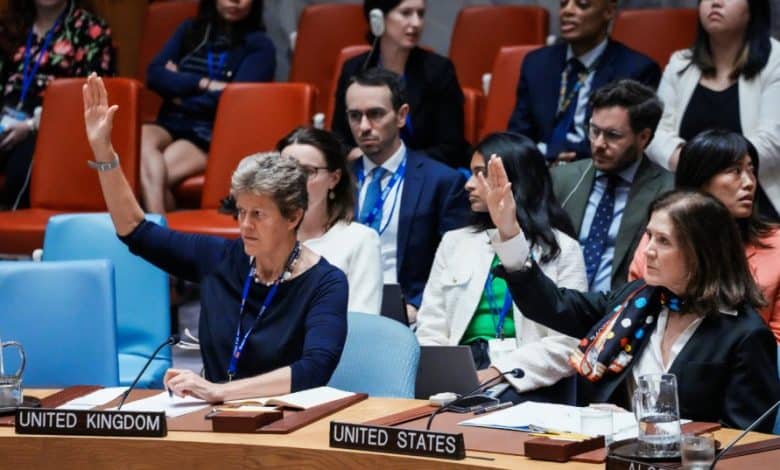
Early on Sunday, the UN Security Council reimposed sanctions on Iran via a mechanism called “snapback” included in the original JCPoA with the E3, the US, Russia and China.
“It is due to Iran’s persistent and significant non-performance of its JCPoA commitments that we triggered the snapback mechanism,” the E3 foreign ministers said in a joint statement.
“We urge Iran and all states to abide fully by these resolutions,” they added.
The E3 initiated the “snapback” mechanism on August 28, 2025 “in view of Iran’s continued nuclear escalation.” This triggered a month-long process aimed at giving Iran a chance to address concerns over its nuclear activities, with a snapback extension offer.
However, “Iran did not take the necessary actions to address our concerns, nor to meet our asks on extension, despite extensive dialogue, including during United Nations High-Level Week,” the E3 statement noted.
“The reimposition of UN sanctions is not the end of diplomacy. We urge Iran to refrain from any escalatory action and to return to compliance with its legally binding safeguards obligations. The E3 will continue to work with all parties towards a new diplomatic solution to ensure Iran never gets a nuclear weapon,” the statement concluded.
Reimposing Sanctions
Under the original JCPoA, sanctions were due to expire on October 18, 2025. But the agreement allowed any signatory to reinstate sanctions before that date if they determined Iran had failed to uphold its commitments.
In August, the E3 notified the UN Security Council they were preparing to trigger the snapback mechanism because Iran had violated “the near entirety of its JCPoA commitments,” giving Tehran a month’s warning to address concerns, according to CNN.
Earlier this month, Iran and the International Atomic Energy Agency (IAEA) agreed on resuming inspections of Iran’s nuclear sites, but European diplomats said this was insufficient.
The sanctions reinstated on Iran include an arms embargo, freezing Iran’s assets abroad and banning the country from getting technology to develop its ballistic missile program, in addition to other measures that target Iran’s oil and financial services sectors.
How Iran Responded?
Iran has recalled its envoys to Paris, Berlin and London for consultations. Meanwhile, the Iranian Foreign Minister, Abbas Araghchi, sent a letter to the UN Security Council describing the triggering of the snapback mechanism as “simply a stark abuse of process,” according to Iran’s IRNA news agency.
Moreover, Iranian President, Masoud Pezeshkian, said that by invoking snapback, “They block the road, but it is the brains and the thoughts that open or build the road.”
Previously, Iranian officials had warned that, if snapback was reactivated, Tehran would end its participation in IAEA inspections.
US & Russia Reactions
The US hailed the E3 move as an “act of decisive global leadership.” In a statement, the US State Secretary, Marco Rubio, said that “President Trump has been clear that diplomacy is still an option—a deal remains the best outcome for the Iranian people and the world.”
“For that to happen, Iran must accept direct talks, held in good faith, without stalling or obfuscation,” Rubio added.
Russia, meanwhile, has objected to the reimposition of sanctions on Iran. The Russian Foreign Minister, Sergei Lavrov, said that the decision “is unlawful, and it cannot be implemented.”
Lavrov added that he had written to UN Secretary-General, Antonio Guterres, warning that it would be “a major mistake” to acknowledge a return of sanctions on Iran.
Impact on Tehran
Iran’s economy has been under severe pressure after the US withdrew from the nuclear deal in 2018 and imposed crippling sanctions on the country. Iranian rial currency is at a record low over fears of new sanctions, increasing pressure on food prices.
However, the European Council on Foreign Relations (ECFR) underestimated the impact of the new sanctions on Iran. “The economic impact of UN and EU sanctions on Iran would be limited, given the gravity of US restrictions,” it said.
It also pointed to Tehran’s insistence on its right to uranium enrichment. “It is inconceivable that – having experienced the pain of military strikes – snapback can force Iran to accept the US demand of zero-enrichment of its uranium,” the ECFR added.
Risk of Renewed Conflict
After the 12-day war between Iran and Israel in June, during which the US launched strikes on Iranian key nuclear sites, the state of Iran’s program remains unclear.
In the light of this, Kelsey Davenport, a nuclear expert at the Washington-based Arms Control Association, warned of miscalculations on both sides.
“The Trump administration appears to think it has a stronger hand post-strikes, and it can wait for Iran to come back to the table. Given the knowledge Iran has, given the materials that remain in Iran, that’s a very dangerous assumption,” she told the Associated Press (AP).
As for Iran, she noted that “in the short term, kicking out the IAEA increases the risk of miscalculation. The US or Israel could use the lack of inspections as a pretext for further strikes.”