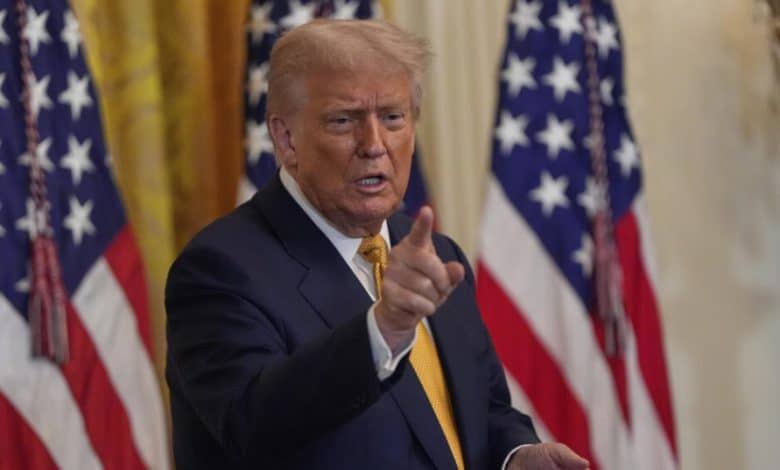
US President Donald Trump claimed on Monday that Iran wants to make a deal, saying that the situation remains volatile.
His remarks came as the USS Abraham Lincoln Carrier Strike Group arrived in the Middle East amid mounting tensions between Washington and Tehran over the latter’s violent crackdown on domestic protests.
Diplomacy on the Table
In an interview with Axios, Trump suggested that Iran is interested in making a deal with the US. “They want to make a deal. I know so. They called on numerous occasions. They want to talk,” he said.
He also pointed to the arrival of USS Abraham Lincoln, which he described as “armada,” in Middle Eastern waters. “We have a big armada next to Iran. Bigger than Venezuela,” Trump noted, adding that the situation with Iran is “in flux.”
In light of this, a senior US official told reporters that Washington “is open for business” with regards to talks with Iran. “If they want to contact us and they know what the terms are, then we’re going to have the conversation,” the official said.
Deal’s Conditions
The official noted that the US has repeatedly communicated its conditions for a potential agreement to Iran over the past year.
These conditions, according to other US officials, include a complete removal of all enriched uranium from the country; a total ban on independent domestic uranium enrichment; a cap on the development and stockpiling of long-range missiles; and an end to the policy of funding and directing regional proxy forces.
While Iranians signaled openness to negotiate, they have not showed any willingness to accept these conditions.
Aircraft Carrier in Region
On Monday, the US Central Command (CENTCOM) announced the arrival of the USS Abraham Lincoln Carrier Strike Group in the Command’s area of responsibility in the western Indian Ocean.
“The Abraham Lincoln Carrier Strike Group is currently deployed to the Middle East to promote regional security and stability,” it said in a statement.
The aircraft carrier is supported by three destroyers equipped with Tomahawk missiles. As the US military awaits an order from Trump, it has intensified its presence in the region, deploying additional F-15 and F-35 fighter jets, more refueling tankers, and additional Patriot and THAAD air defense systems.
Venezuela Scenario
The arrival of the aircraft carrier expands Washington’s military options, as Trump is set to hold more consultations this week to make his final decision on Iran, according to sources with knowledge on the matter.
The current standoff with Iran mirrors the recent January 3, 2026, “Operation Absolute Resolve” in Venezuela. In both cases, the Trump administration has paired diplomatic overtures with a rapid military buildup.
Just as domestic instability in Caracas served as a catalyst for the US intervention earlier this month, the current crackdown on protests in Iran is being cited by Washington as the primary justification for its shifting naval posture in the Middle East.
Weak Position
Multiple US intelligence reports indicated that the nationwide protests in Iran, which erupted in late December 2025, shook elements of the Iranian government, reported the New York Times.
According to sources familiar with the matter, Trump has received multiple US intelligence reports signaling that the Iranian government’s hold on power is at its weakest point since the 1979 revolution.
Although the protests have been largely suppressed, the Iranian government remains in a difficult position due to the country’s economic hardship, the intelligence reports showed.
Iranian Retaliation
Iran has repeatedly warned of strong retaliation to any US military action. On Monday, Iran’s Foreign Ministry spokesperson, Esmail Baghaei, downplayed the arrival of the US aircraft carrier to the region, saying it would not affect Iran’s defense posture.
Meanwhile, he dismissed reports suggesting that Iranian top diplomat, Abbas Araghchi, was in contact with Trump’s Special Envoy, Steve Witkoff, to discuss a diplomatic deal.
Baghaei said that the Iranian armed forces are “carefully monitoring every movement,” warning of a “comprehensive and regrettable response to any aggression.”
Echoing a similar stance, the chief justice, Gholam-Hossein Mohseni-Ejei, called for Iran not to return to the negotiating table.
Moreover, Iran’s Defense Ministry Spokesperson, Reza Talaei-Nik, vowed a strong response to any US attack. “If there is any aggression by the US or Israel, it will be met with a more painful and decisive response than in the past,” he said.