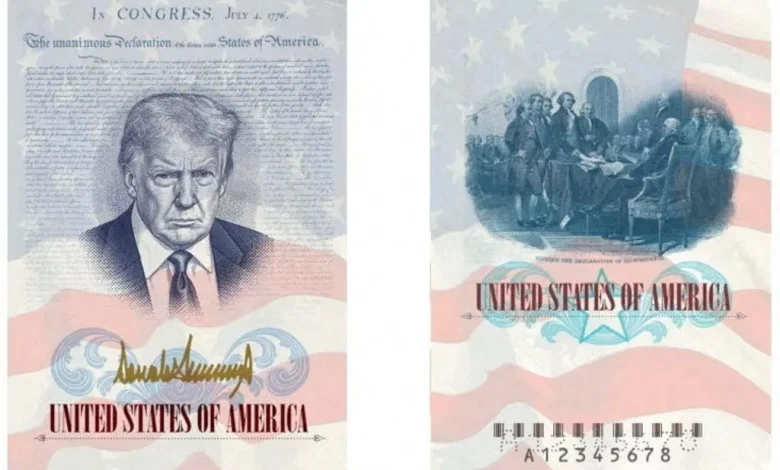
The White House confirmed on Tuesday that the US will release limited-edition passports featuring a portrait of President Donald Trump, after Fox News first reported the design, which commemorates the 250th anniversary of the American Declaration of Independence this July.
According to an administration official, any American citizen may apply for the new design while current supplies last. However, the State Department will only issue these specific documents at the Washington Passport Agency during the initial rollout phase.
The design displays a portrait of Trump surrounded by the Declaration of Independence and a large American flag. Furthermore, the president’s signature appears in gold ink across the page to mark the historic semiquincentennial milestone for the nation.
“President Trump’s new patriotic passport design provides yet another great way Americans can join in the spectacular celebrations,” a White House spokesperson stated. “President Trump continues to proudly lead a renewal of national pride and patriotism during our historic semiquincentennial celebration,” they added.
A Growing Commemorative Legacy
This release follows a series of moves to associate the president’s likeness with major government programs and public landmarks. For instance, the US Mint plans to release a gold coin, and Trump’s signature will soon appear on banknotes.
While current passports usually depict historical scenes like the Moon landing, this new edition shifts the focus toward current leadership. Consequently, many citizens wonder if they can opt out of the special design when applying for travel documents.
Beyond currency and travel documents, the administration recently announced the “Arc de Trump,” a 250ft gold-accented victory arch in Washington. Additionally, the Kennedy Center board recently voted to rename their performing arts venue the Trump-Kennedy Center despite significant public backlash.
Construction projects also continue at the White House, where crews demolished the East Wing to build a new ballroom. However, the National Trust for Historic Preservation has sued the administration, alleging that officials skipped mandatory federal filing processes.