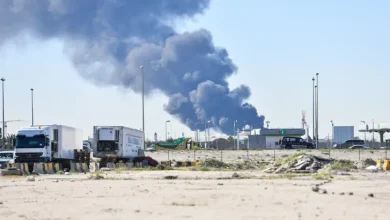
The Sudanese Armed Forces (SAF) has agreed to a weeklong ceasefire in El-Fasher besieged city to facilitate humanitarian aid distribution.
The UN Secretary-General, António Guterres, proposed the ceasefire during a phone call with the Chairman of Sudan’s Transitional Sovereign Council and the Commander-in-Chief of SAF, Abdel Fattah Al-Burhan.
7-Day Truce in El-Fasher
On Friday, the Sudanese Transitional Sovereign Council said that Al-Burhan received a phone call from Guterres, during which the UN chief proposed a humanitarian pause in fighting for seven days in El-Fahser, the capital of North Darfur province, to facilitate the delivery of humanitarian aid.
In response, Al-Burhan agreed to the 7-day truce proposal, stressing the urgency of implementing the UN Security Council (UNSC) resolutions in that regard.
UN Efforts
The UN Secretary-General said that he was in contacts with the two warring parties to alleviate the suffering of Sudanese people in El-Fahser, which the Rapid Support Forces (RSF) has been besieging for more than a year.
“We are making contacts with both sides with that objective, and that was the fundamental reason for that phone contact. We have a dramatic situation in El-Fasher,” Guterres told reporters on Friday.
“The people are starving in an extremely difficult situation, so we need to have an amount of time of truce for aid to be distributed, and you need to have it agreed with some days in advance to prepare a massive delivery in the El-Fasher,” he added.
“I have a positive answer from General Burhan, and I am hopeful that both sides will understand how vital it is to avoid the catastrophe that we are witnessing in El-Fasher,” the UN chief said.
Guterres did not reveal the details of the ceasefire and when it might go into effect. Meanwhile, the RSF said it had not received any truce proposals, according to AFP.
Situation in El-Fasher
The civil war in Sudan, which broke out in April 2023, has split the country in two, with the SAF controlling the center, north and east, and the RSF holding almost all of the western Darfur region and parts of the south.
In March 2025, the SAF regained control over most parts of the Sudanese capital Khartoum, in a significant victory for the country’s army after two years of fighting against the RSF.
The SAF maintains control of El-Fasher, located more than 800 kilometers southwest of Khartoum. The RSF has intensified its attacks on El-Fasher – the only state capital in Darfur the paramilitary group does not control – to capture the city to solidify its control over the entire Darfur region, according to the Associated Press (AP).
This included besieging El-Fasher and launching repeated attacks on the city and two major famine-hit displacement camps on its outskirts, the Zamzam and Abu Shouk displacement camps, killing more than 100 people, including 20 children.
Worsening Humanitarian Crisis
The UN described the war in Sudan as “the world’s most devastating humanitarian and displacement crisis,” killing tens of thousands of people and displacing millions inside Sudan and to neighboring countries. It has displaced more than 14 million people and pushed parts of the country into famine, according to AP.
The UN Assistant Secretary-General for Africa, Martha Ama Akyaa Pobee, stressed that “de-escalation is urgently needed” in Sudan, suggesting that humanitarian pauses could extend to other regions in the country.
“We are pursuing a predictable and time-bound humanitarian pause to facilitate safe humanitarian movements into and out of areas affected by ongoing fighting, beginning with El-Fasher, and allow civilians to leave voluntarily and securely,” she told the UNSC on Friday.
Similarly, Sudan Specialist and Senior Advisor with Preventing and Ending Mass Atrocities (PAEMA), a US-based organization, Shayna Lewis, briefed the UNSC on the worsening humanitarian situation following her recent return from Sudan.
She pointed to more than 15 million children in need of assistance due to ongoing attacks on civilians, saying that up to 80% of health facilities in conflict areas are no longer functioning.