Seeing Isn’t Believing: Saudi Arabia Launches “Tarah AI” Campaign to Expose Deepfake Threats
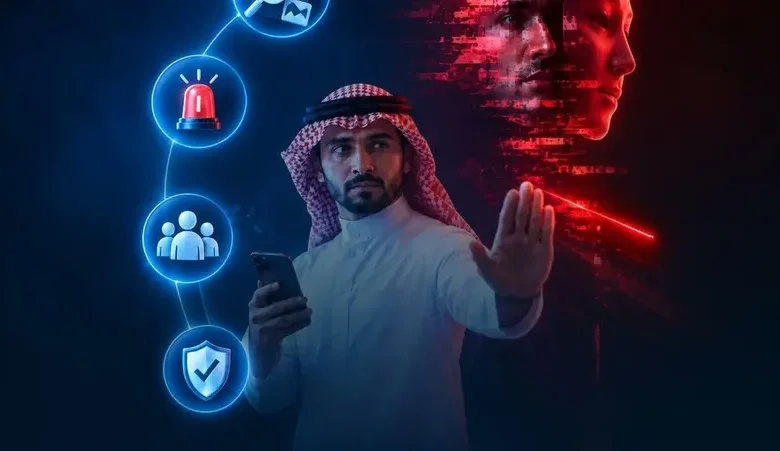
Driving the news: Saudi Arabia has launched “Tarah AI,” a nationwide awareness campaign on the dangers of deepfakes and misleading content. The Saudi Data and Artificial Intelligence Authority (SDAIA) and the Communications, Space and Technology Commission (CST) lead the effort. Their goal is simple: help people verify content before they believe it or share it.
Why it matters: AI tools now clone faces and voices with striking accuracy. As a result, one fake clip can spread falsehoods, trick victims into sending money or damage a reputation within hours.
The big picture: The campaign arrives as the Kingdom races to become a global AI hub. Accordingly, Saudi Arabia wants its people to embrace the technology and to defend themselves against its misuse.
Inside the “Tarah AI” Campaign
The campaign coincides with the Kingdom’s Year of Artificial Intelligence 2026. It pursues two clear aims. First, it helps people protect their personal data. Second, it builds the habit of checking content before anyone believes, publishes or shares it.
Officials point to the pace of change. Tools that generate images, video and audio improve constantly. Consequently, they can now mimic a person’s features and voice so closely that eyes and ears alone cannot spot the difference.
“Tarah AI” first explains what deepfakes are and the many forms they take. Next, it outlines the main risks: misinformation, fraud, identity theft and harm to personal reputations.
The campaign also offers practical advice. Residents learn how to protect their visual identity, their voice and their personal data. They also learn to spot the signs of manipulation. Finally, they learn to confirm a clip’s context by checking original, trusted sources.
The message is blunt. A clip does not prove itself just because a familiar face appears or a familiar voice speaks. Likewise, people should resist the urge to repost shocking content or form opinions before they verify it. Careless sharing, the campaign stresses, widens the circle of deception and cements false information.
SDAIA and CST place the campaign within wider efforts to promote safe and responsible AI use. They describe verification and critical thinking as the first line of defense against deepfakes. In turn, that mindset supports a safer, more trustworthy digital environment.
By the numbers:
- 2026: Saudi Arabia declared 2026 the “Year of Artificial Intelligence.” The announcement came with more than $9 billion (SAR 33.75 billion) in tech-company investment in the Kingdom.
- SAR 11.25 billion ($3 billion): HUMAIN’s investment in xAI.
- SAR 37.5 billion ($10 billion): the value of HUMAIN’s AMD agreement, which targets 500 megawatts of computing capacity within five years.
- SAR 20 billion ($5.33 billion): the data-center financing HUMAIN is reportedly arranging with Goldman Sachs.
- SAR 56.25 billion ($15 billion): partner investments at LEAP 2026, up from $14.9 billion (SAR 55.88 billion) at the previous edition.
- 27 million: people who will receive free Adobe AI tools for one year, under a collaboration worth more than $4 billion (SAR 15 billion).
- 53: member states that unanimously approved the Riyadh Charter on AI for the Islamic World.
- SAR 500,000 ($133,333): the maximum fine under Article 3 of the Anti-Cyber Crimes Law, alongside up to one year in prison, for harming another person’s private life or reputation through technology.
Saudi Arabia’s AI Surge Raises the Stakes
The campaign follows an extraordinary burst of AI activity. SDAIA leads the national data and AI strategy, which develops skills, encourages innovation, attracts investment and builds a supportive regulatory environment. Meanwhile, the Public Investment Fund (PIF) backs HUMAIN, which launched in 2025 and works across data centers, computing, models and applications.
HUMAIN has also invested in Luma AI, a video-generation startup, and formed a joint venture with AMD and Cisco to expand data-center capacity in the Kingdom. Moreover, the company plans to raise an initial $2.5 billion (SAR 9.38 billion) for a data-center fund that could eventually reach one gigawatt.
Skills programs keep pace with the hardware. Microsoft plans to help three million more people in the Kingdom gain AI skills by 2030. Therefore, millions of residents will soon use powerful AI tools every day.
Yet the same progress sharpens the deepfake threat. SDAIA warns that deepfakes can fuel financial fraud, identity impersonation and misinformation, although the technology also offers benefits in education, healthcare and entertainment. In one example the authority highlights, scammers used a deepfake video call to impersonate a senior executive and defraud a company.
SDAIA backs the awareness drive with firm rules. In May 2025, it released deepfake guidelines. They ban the use of deepfake services for fraud, impersonation or defamation and require visible, tamper-resistant watermarks on synthetic content. The guidelines also recommend a three-step check. Users assess the source and context, look for glitches such as irregular blinking, lip-sync delays or lighting inconsistencies, and then authenticate the content with AI-based detection tools. Notably, the guidelines call for public awareness campaigns, and “Tarah AI” delivers exactly that.
The Kingdom also leads on the global stage. SDAIA works with the UNESCO-affiliated International Center for AI Research and Ethics in Riyadh to promote awareness of AI ethics and deepfake risks. In addition, the law adds weight at home, because Saudi authorities treat harming others through technology as a cybercrime.
What’s next: The takeaway is straightforward. As AI tools improve, fakes will look more convincing, so personal vigilance matters more than ever. Before you share the next shocking clip, pause, check the source and verify it.