Saudi Cutting-Edge Medical Tech: KSU Invents Revolutionary Mechanical Heart Valve
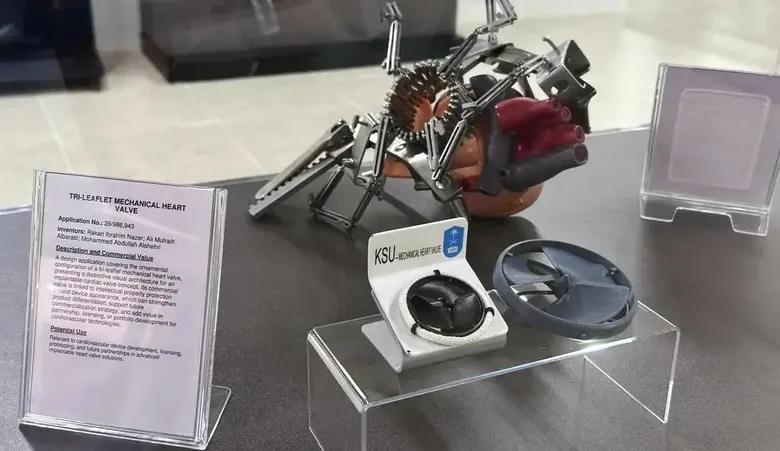
Driving the news: Saudi Arabia’s King Saud University (KSU) has secured a US patent for a tri-leaflet mechanical heart valve, which Dr. Rakan bin Ibrahim Nazer, a professor of cardiac sciences at the College of Medicine, developed.
Why it matters: The patent shows that Saudi researchers now compete in advanced medical devices. It also adds to a growing list of KSU inventions that win US recognition.
Inside the Valve Design
Zoom in: The valve has three movable leaflets that connect to a central mechanism and a peripheral ring. Together, these parts let the leaflets open and close in a coordinated way, which regulates blood flow and reduces regurgitation. Regurgitation means blood leaking backward through the valve.
The big picture: Mechanical valves last a long time. However, patients who receive them need anticoagulation therapy to prevent blood clots. Designers therefore keep refining leaflet shape and pivot mechanisms. For example, engineers note that a tri-leaflet valve opens into a single central flow, much like the human aortic valve, while two-leaflet designs split the flow into three streams.
The announcement does not include clinical data. As a result, the valve’s real-world performance remains to be shown.
Nazer brings deep clinical experience to the project. He is a professor and consultant cardiac surgeon who earned his Canadian board certification in Toronto and a fellowship in aortic surgery at Yale. He also led the national 2030 transformation plan for cardiac care and already holds patents from the US Patent Office. In addition, he founded cardiac surgery programs in the Kingdom and abroad.
KSU’s Growing Innovation Record
The valve patent builds on a strong year for the university. KSU ranked 31st globally for US patents granted in 2025, with 95 patents, the highest number in its history.
The momentum shows elsewhere too. KSU took 10 patents to the 2025 Geneva International Exhibition of Inventions and won 8 medals. Meanwhile, a Saudi medical team at the university’s medical city won a global patent for a wide-jaw tissue forceps used in surgery and dental implant procedures. That patent passed the US Patent and Trademark Office’s review.
The university also gives inventors a stage at home. Its Innovation Center hosted a three-day exhibition for World Creativity and Innovation Day to showcase patented work by its researchers.
By the numbers:
- 95: US patents granted to KSU in 2025, its highest total ever.
- 31st: KSU’s global rank for US patents granted in 2025.
- 8 medals: Won with 10 patents at the 2025 Geneva inventions exhibition.
- 3 leaflets: The number of movable leaflets in the new valve.
- 5%: Target share of GDP for annual R&D spending by 2040.
- SAR 60 billion ($16 billion): Expected R&D contribution to GDP by 2040.
- SAR 130 billion ($34.7 billion): R&D spending needed by 2040, according to RDIA.
- 30,000 to 140,000: Planned growth of the Kingdom’s research talent pool.
- 64%: Saudi R&D spending as a share of GDP in 2024.
- 92nd: Riyadh’s rank among global innovation clusters in 2026, with 419 venture capital deals and 162 international patent applications
Saudi Arabia’s Research Push
The bigger picture: KSU’s results fit a national drive. In 2022, Crown Prince Mohammed bin Salman announced priorities that target annual research and development spending of 2.5% of GDP by 2040. The sector should add SAR 60 billion ($16 billion) to GDP by that year.
Officials back the target with a plan for people. Dr. Saeed Al-Turki of the Research, Development and Innovation Authority (RDIA) said the authority aims to be “the North Star for the whole country’s research sphere.” He also said the Kingdom would need to spend SAR 130 billion ($34.7 billion) on research by 2040, which means growing the research talent pool from 30,000 to almost 140,000.
Spending still has room to grow. UN data put Saudi research spending at 0.64% of GDP in 2024, up from 0.49% in 2023. However, the global rankings already reflect progress. Riyadh ranked 92nd among the world’s innovation clusters in the 2026 Global Innovation Index and stood as the only Gulf city on the list. The report named KSU among the city’s leading research institutions.
What’s next: A patent marks a first step, not the finish line. Medical devices normally need testing and regulatory approval before they reach patients. Still, the grant gives KSU a protected design and gives Saudi cardiac research a fresh milestone.