Saudi Arabia Embraces Deep Tech: SDAIA Expands Quantum Computing Bootcamps
Why it matters: Saudi Arabia is investing in people, not just machines. The Saudi Data and AI Authority (SDAIA) is building a national quantum workforce while the technology is still young.
Driving the news: SDAIA’s academy trained more than 70 quantum computing specialists in 2026. The programs covered quantum fundamentals, links to data and AI, adoption challenges, and feasibility assessment.
SDAIA recognised the importance of quantum computing early. Global efforts to turn the technology into real applications are accelerating. Consequently, the academy has worked to build national capacity and prepare Saudi talent for that race.
Why Quantum Skills Matter
Quantum computing relies on quantum mechanics to process information. It works differently from classical computing. As a result, it shows promise for hard scientific problems, such as simulating molecules and materials.
However, promise alone does not deliver results. Progress in hardware, error correction, and algorithms must advance together. The field also needs people who can use the tools and judge the results.
SDAIA’s academy targets exactly that gap. Moreover, it has trained both technical specialists and senior decision-makers.
Training Specialists and Leaders
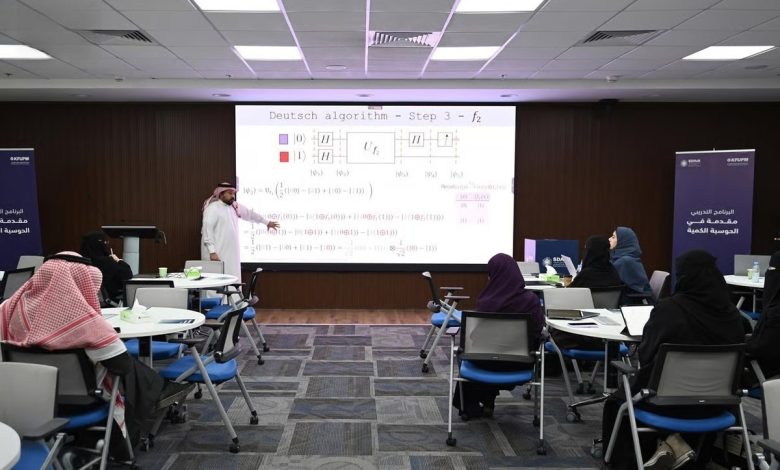
Zoom in: The academy ran a five-day quantum computing bootcamp from 11 to 15 January 2026, with five training hours each day. It organised the bootcamp with King Fahd University of Petroleum and Minerals (KFUPM). The course targeted computer science specialists and related fields.
Participants learned the physical and mathematical principles behind quantum computing. They also studied its expected effect on information security and advanced technologies. In addition, they practised designing quantum algorithms with tools such as Qiskit and CUDA-Q.
The academy then turned to leaders. On 14 April 2026, it ran the “Strategic Transformation Toward Quantum Technologies” program. The session examined how quantum computing could affect critical infrastructure, including communications, encryption, and quantum sensing.
By the numbers:
- 70+: quantum computing specialists the academy trained in 2026.
- 5 days: length of the January bootcamp (11–15 January), at five hours daily.
- 14 April 2026: date of the leaders’ program on quantum strategy.
- 13 September 2026: date of the advanced quantum and AI bootcamp.
- 200: programmable qubits in the Aramco–Pasqal quantum computer in Dhahran.
- 56 million+: Saudis who have benefited from SDAIA training programs.
- 14,495: data and AI specialists and experts among them.
- 1 million+: citizens trained through the SAMAI initiative.
- 30,000+: participants at ICAN 2026.
- 40 programs at 14 universities: academic programs launched through ICAN 2026.
- SAR 1.5 million ($400,000): incubation support for top Tuwaiq Academy bootcamp projects.
Quantum Meets Artificial Intelligence
On 13 September 2026, the academy trained another group of specialists. This bootcamp focused on advanced applications and on integration with generative and agentic AI. The goal: solutions that combine classical and quantum computing strengths.
Trainees designed quantum circuits and algorithms and ran them with specialist tools. They also studied how quantum systems work and how they connect to high-performance computing.
The bootcamp reviewed promising uses in several sectors:
- Optimisation and decision-making.
- Cybersecurity and encryption.
- Financial services and logistics.
Labs and hands-on projects used simulators and quantum platforms. Trainees could also try real quantum hardware, depending on availability.
The academy’s interest in quantum computing fits a wider plan. It aims to grow national skills in deep and emerging technologies, especially among university students. It also aims to link technical training with academic knowledge. This supports Vision 2030’s goals for human capital and the knowledge economy.
Hardware and Talent Grow Together
The big picture: Saudi Arabia is not only teaching quantum computing. It is also installing the hardware.
Aramco and Pasqal deployed a neutral-atom quantum processor in November 2025. The unit controls 200 programmable qubits. The partners officially inaugurated Saudi Arabia’s first quantum computer in May 2026 and launched the Middle East’s first commercial quantum-computing-as-a-service platform. The machine sits at Aramco’s data centre in Dhahran.
Ahmad O. Al Khowaiter, Aramco’s executive vice president of technology and innovation, framed the milestone as a national achievement. “This quantum milestone belongs to our Saudi researchers, engineers, and scientists,” he said. Pasqal will also deliver training and joint research programs for Saudi engineers and scientists.
SDAIA’s capacity-building chief shares that logic. Ahmed Alghamdi has said that building quantum capabilities should reduce the Kingdom’s reliance on outside expertise. Therefore, training and infrastructure now move in step.
The push also reaches far beyond quantum. SDAIA reports more than 1.56 million Saudis have benefited from its training programs, including 14,495 data and AI specialists. Meanwhile, the “One Million Saudis in AI” (SAMAI) initiative has trained over one million citizens in a free, Arabic-language online program. The ICAN 2026 capacity-building conference drew more than 30,000 participants and launched 40 academic programs at 14 universities.
Other bodies are joining in. Tuwaiq Academy and the National Technology Development Program announced ten-week AI product-building bootcamps for 2026. Top projects will receive more than SAR 1.5 million ($400,000) in incubation support.
What’s next: Quantum skills remain niche today. Officials expect them to become strategically important within the coming decade. By training early, Saudi Arabia aims to have the people ready when that moment arrives.