
King Abdullah University of Science and Technology (KAUST) has built a 282-startup portfolio now valued at $5.7 billion, proving that homegrown Saudi research and development (R&D) can command global private capital.
In a landmark announcement, KAUST unveiled that its supported startups have attracted $1.4 billion in cumulative funding, demonstrating how the university supports broader innovation and draws investment to the Kingdom.
Deep-Tech Venture Engine
Driving the News: KAUST announced on November 23, 2026, that investment activity in its entrepreneurship ecosystem accelerated, with its supported startups raising $1.4 billion in cumulative funding.
The Big Picture: KAUST’s contribution has so far reached $77 million. Meanwhile, 90% of all funding comes from external investors, such as the National Technology Development Program (NTDP), which has contributed $33 million, underscoring the companies’ appeal to investors from outside the university.
In His Words: “The success of so many of our portfolio companies is a testament to the fact that Saudi Arabia is a great place to grow and scale as a business. KAUST is a vital part of this thriving ecosystem, supporting startups to find commercialization opportunities that help bring their innovations from the lab to the market.” – Dr. Ian Campbell, Senior Vice President, National Transformation Institute (NTI) at KAUST.
The Startup Momentum
State of Play: KAUST’s portfolio includes 282 active startups, spanning artificial intelligence (AI), enterprise software, financial technology, healthcare, agriculture, and advanced technology sectors.
By the Numbers:
- 282: Active startups.
- $5.7 billion: Combined estimated valuation.
- $1.1 billion: Cumulative revenue generated.
Zoom In: From July 2025 to June 2026, 66 startups raised $338 million, marking a more than 30% year-on-year increase, reflecting the Saudi venture ecosystem’s growth beyond consumer apps into hard science, intellectual property (IP), and deep tech.
Standout Deals: Among the largest reported funding rounds were $200 million for quantum computing company Pasqal and $9.2 million for cybersecurity firm COGNNA, followed by major raises from Aajil (formerly Buildnow), Iyris, and Agellus Tank Robotics.
From the Lab to the Market
Between the Lines: Through a four-tier ecosystem, KAUST takes founders seamlessly from scientific discovery to global commercialization:
- Company Creation: The KAUST Venture Studio initiative builds ventures from scratch around university intellectual property, targeting national priorities such as advanced materials, industrial processes, and sensor-based healthtech, according to Haitham Al-Homsi, Director of Innovation Ecosystem Development.
- Funding and Mentorship: Specialized programs such as TAQADAM, NextEra, and ScaleX provide founders with early-stage capital and guidance to build and scale their businesses.
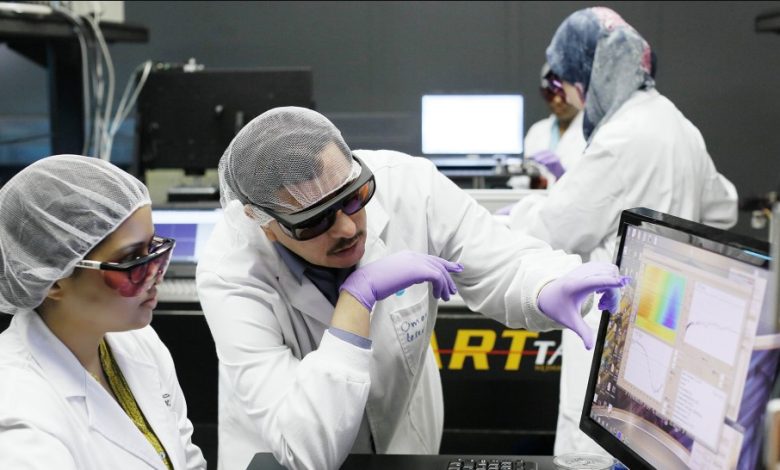
- Labs and Facilities: Startups get direct access to specialized R&D labs and the KAUST 4th Industrial Revolution Center to prototype, test, and refine deep-tech products.
- Key Partnerships: KAUST connects founders with major partners, including Saudi Awwal Bank (SAB), the National Technology Development Program (NTDP), the National Industrial Development and Logistics Program (NIDLP), and domestic venture capital firms, to commercialize and localize technologies across the Kingdom.
Inside KAUST’s Portfolio
Go Deeper: KAUST’s 282 active startups span critical sectors driving Saudi Arabia’s economic diversification, from quantum computing and robotics to sustainable food systems and digital health.
Key Startups:
- Education: iStoria, Faheem
- Finance: Kestrl, EdfaPay
- Healthcare: Cura, Atomica AI
- Food: Barakah, Aqua Development
- Waste Reduction, Recycling & Reuse: TileGreen, Edama
- Quantum and Robotics: Pasqal, Agellus Tank Robotics
Driving Global Innovation
The Context: The KAUST Research and Technology Park acts as a vital bridge connecting startups with KAUST’s researchers, faculty, talent, and facilities. Moreover, it is actively attracting international scale-ups to localize their R&D and test technologies inside the Kingdom.
The Vision 2030 Link: The substantial growth in KAUST’s startup portfolio directly serves Vision 2030’s objectives by creating high-skilled knowledge jobs, localizing advanced manufacturing and IP, and building non-oil productive sectors.
The Takeaway: The $1.4 billion funding milestone proves that KAUST has moved beyond producing academic research to scaling commercially viable deep-tech companies that sit at the heart of Saudi Arabia’s post-oil economy.