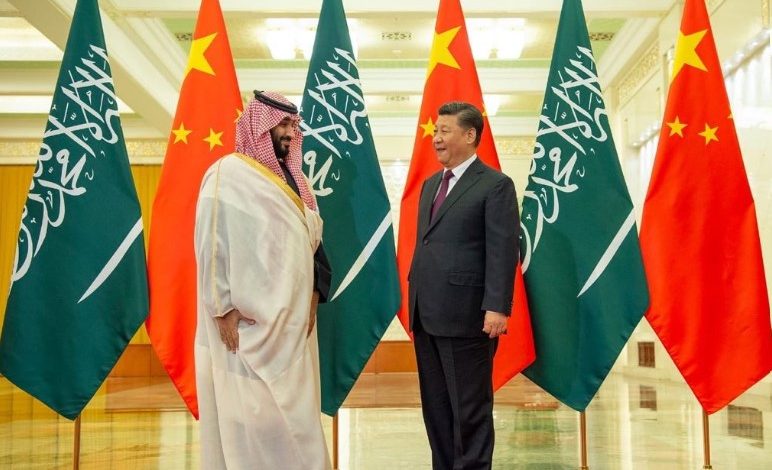
Saudi Crown Prince and Prime Minister Mohammed bin Salman discussed the security of the Strait of Hormuz and maritime stability with China’s President Xi Jinping.
The two leaders also expressed willingness to strengthen cooperation and deepen mutual trust as Saudi Arabia and China mark the 10th anniversary of their comprehensive strategic partnership.
Maritime Security
In a phone call on Monday, the Saudi and Chinese leaders discussed the current situation in the Middle East, against the backdrop of the ongoing US-Israeli war on Iran. Their discussions focused on the regional and international security and economic repercussions of the conflict.
Furthermore, they explored efforts aimed at de-escalation and bolstering security and stability across the region, particularly with regards to maritime security and its implications on economy and global vital supplies, according to the Saudi Press Agency (SPA).
The Chinese President reiterated Beijing’s call for an immediate and comprehensive ceasefire and cessation of hostilities, China’s Foreign Ministry said in a statement.
He also said that China supports all efforts conducive to restoring peace, and stands for resolving disputes through political and diplomatic means.
Navigation in Hormuz Strait
During the call, Xi stressed the need to keep the Strait of Hormuz open to navigation.
“The Strait of Hormuz should maintain normal passage, as this serves the common interests of regional countries and the international community,” he noted, according to the Chinese Foreign Ministry.
He reaffirmed Beijing’s support for regional countries in building a common home of good-neighborliness, development, security and cooperation, as well as holding their future in their own hands, and promoting lasting peace and security in the region.
The Strait of Hormuz is a strategic maritime corridor linking the Arabian Gulf with the Gulf of Oman and the Arabian Sea, through which around a fifth of daily global oil supplies and LNG supplies pass.
China is the world’s largest importer of oil and fossil gas. It has also become a major buyer of Iranian oil, making it one of the countries most vulnerable to the interruption to energy shipments.
Saudi-Chinese Strategic Partnership
The phone call between the two leaders came on the 10th anniversary of the establishment of the comprehensive strategic partnership between Saudi Arabia and China.
On this occasion, Beijing expressed readiness to work with Riyadh to “deepen mutual strategic trust, enhance practical cooperation, expand exchanges at all levels, continuously increase the scope and depth of our bilateral relations, and set a fine example for the relations between China and Arab states,” the statement said.
Crown Prince Mohammed bin Salman, for his part, noted that the Saudi-Chinese ties are “strategic in nature,” emphasizing the importance of deepening relations with Beijing.
Moreover, he underscored Saudi Arabia’s commitment to resolving disputes and differences through dialogue to prevent further escalation.
He also said that China is a responsible major country that consistently upholds a just position and supports Middle Eastern countries in pursuing good-neighborliness, dialogue and cooperation.
Thus, Riyadh is willing to strengthen communication and coordination with Beijing to maintain the ceasefire, prevent the resumption of hostilities, ensure the safety and freedom of navigation in the Strait of Hormuz, and cooperate to find a pathway to lasting peace and stability in the region.
Middle East Conflict
The US-Israeli war with Iran, which broke out on February 28, 2026, has disrupted traffic at the Strait of Hormuz as Tehran closed the strategic waterway and Washington imposed a naval blockade on Iranian ports.
On Sunday, the US Navy intercepted and seized the Iranian-flagged ship Touska in the Arabian Sea while it was enroute from China.
The incident added to the already intensified tensions between Washington and Tehran, days before the two-week ceasefire expires. It also raised more doubts regarding a second round of peace talks in Islamabad to reach a deal.
Since the start of the conflict, China has repeatedly called the warring parties to protect navigation through the Strait of Hormuz and is adjacent waters. It has also stressed that dialogue and negotiations remain the only viable path for resolving conflicts.