Dr. Munir Eldesouki, President of King Abdulaziz City for Science and Technology (KACST), reaffirmed Saudi Arabia’s dedication to achieving net-zero emissions by 2060. He highlighted the Kingdom’s national innovation strategy, which prioritizes expanding clean energy solutions and investing in deep technologies expected to drive 40% of future emissions reductions—advancing the goals of Vision 2030 and the nation’s broader sustainability agenda.
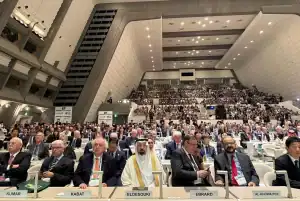
Dr. Eldesouki made these remarks during a panel discussion titled “The Road to Sustainability: Toward a Carbon-Free Society” at the annual Science and Technology in Society (STS) Forum in Kyoto, Japan. The event was attended by Emperor Naruhito of Japan, Prime Minister and Honorary Chairman Shigeru Ishiba, alongside senior officials, industry leaders, and representatives of international organizations.
Circular Carbon Economy
“The Kingdom adopts the Circular Carbon Economy as a comprehensive and practical framework to achieve its national targets under Vision 2030,” Dr. Eldesouki stated. “Through this model, Saudi Arabia aims to reach net-zero emissions by 2060 via pioneering initiatives that include reducing 278 million tons of carbon emissions annually, planting 10 billion trees through the Saudi Green Initiative, capturing 44 million tons of carbon dioxide each year by 2035, and achieving a 50% clean energy mix by 2030.”
He highlighted several groundbreaking national projects, such as the Carbon Capture Center at Aramco, large-scale battery storage systems in Bisha, and green hydrogen and ammonia facilities in NEOM—all contributing to energy security and industrial competitiveness. Dr. Eldesouki also noted international collaborations, including partnerships with the University of California, Berkeley in clean energy, water desalination, and carbon capture research. Additionally, Saudi Arabia is deploying artificial intelligence applications during the Hajj season to enhance real-time monitoring and decision-making efficiency.

Dr. Eldesouki emphasized that research and development are the cornerstone of sustainability, underscoring KACST’s role as the Kingdom’s national laboratory and hub for innovation. KACST leads advanced research programs focused on converting carbon waste into hydrogen fuel, extracting water from desert environments, and enhancing solar panel performance in arid climates. He also noted the integration of cutting-edge technologies in semiconductors, artificial intelligence, and satellites to support desertification monitoring, emissions tracking, and efficient water management.
Related Topics:
Higher Education: Saudi Arabia’s Emergence as Global Destination
Saudi Students Organize Qur’an Competitions in UK
Saudi Women in the Workforce: How Does the Kingdom achieve real Empowerment?
International Mining Conference to Host Global Geological Survey Leaders in Jan.