Green Ambitions: How Saudi Arabia Leads the Way for a Climate-Resilient Middle East

As the Middle East and North Africa region faces the tough challenge of extreme desertification and environmental vulnerability, Saudi Arabia has taken charge of leading regional efforts to restore land and build international climate partnerships. At the center of the Kingdom’s efforts is the Middle East Green Initiative (MGI) – a Saudi-led regional effort to mitigate the impact of climate change and restore degraded lands across the region.
The participation of the MGI in the 17th Conference of the Parties to the United Nations Convention to Combat Desertification (UNCCD COP17) in Ulaanbaatar, Mongolia, is a further testament to Saudi Arabia’s commitment to fostering shared prosperity, green diplomacy, and ecological restoration.
The Green Effect
The Big Picture: The MGI General Secretariat will participate for the first time in UNCCD COP17, taking place from August 17-28, 2026, according to the Saudi Press Agency (SPA).
State of Play: Launched by Saudi Crown Prince Mohammed bin Salman in 2021, the MGI is a collaborative regional effort of 35 member states, designed to combat climate change, reduce carbon emissions, and restore degraded lands across the Middle East and North Africa.

Key Objectives:
- Plant 50 billion trees across the region
- Restore 200 million hectares of degraded land
Why It Matters: According to MGI Secretary-General Ibrahim Alturki, the participation in UNCCD COP17 provides a significant opportunity to foster dialogue with countries from the region and beyond, international organizations, financial and scientific institutions, the private sector, and civil society organizations to bolster land restoration and anti-desertification efforts.
From Riyadh to the World
Between the Lines: By championing global joint action, Saudi Arabia has established a blueprint for climate resilience. The Kingdom leveraged its G20 presidency in 2020 to launch the Global Land Initiative, aimed at preventing and reversing land degradation.
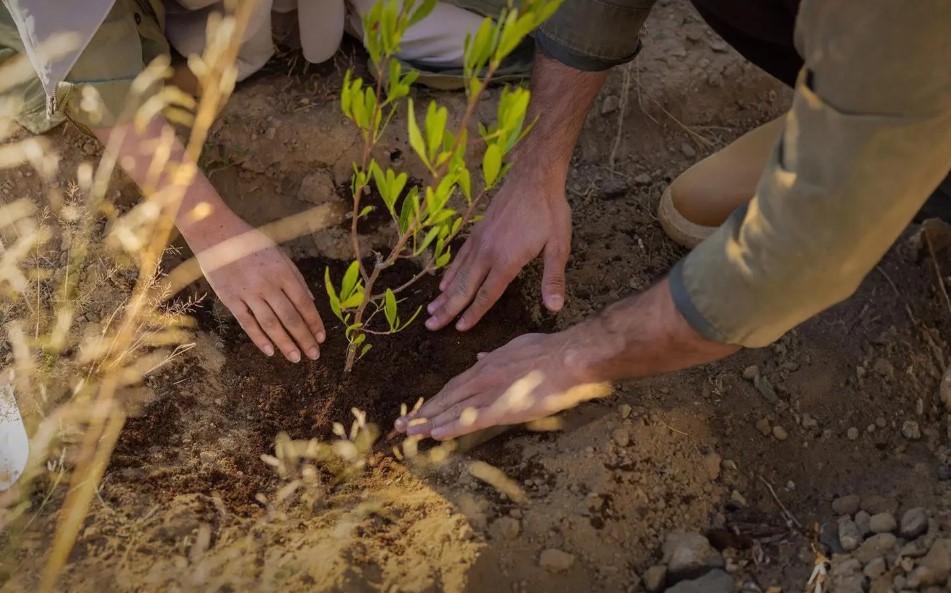
Global Land Initiative Core Objectives:
- 50% Reduction in the amount of degraded land globally by 2040.
- Knowledge Sharing: Share best practices, conservation incentives, and sustainable land and water management policies.
- Ecosystem Restoration: Promote nature-based solutions, reforestation, and sustainable agricultural practices to restore land.
This paved the way for hosting UNCCD COP16 in Riyadh in December 2024 to accelerate land restoration, fight desertification, and boost global drought resilience. Marking the largest summit in the convention’s history, COP16 adopted 39 formal decisions to address the urgent global climate crises.
UNCCD COP16 Outcomes:
- The Riyadh Action Agenda: Launched by the Saudi COP Presidency to rally global pledges to conserve and restore 5 billion hectares of degraded land by 2030.
- Drought Funding: The Riyadh Global Drought Resilience Partnership announced $12.15 billion in commitments to support 80 vulnerable nations battling extreme dry conditions.
- Agriculture & Rangelands: Adopted new decisions targeting sustainable management of agricultural lands and rangelands/pastoralists (which cover 54% of global land area) as primary drivers of, and solutions to, land degradation.
- Science-Policy Interface: Enhanced the mandate of the Science–Policy Interface (SPI) to better integrate Earth observation and scientific research into land-use policy.
Milestone: In July 2026, the MGI and UNCCD Secretariat signed a memorandum of understanding (MoU) in Riyadh to bolster cooperation on land rehabilitation and vegetation cover development. The partnership establishes a sustainable framework for:
- Knowledge sharing
- Technology transfer
- Capacity building
- Financial resources integration
Saudi Anti-Desertification Push
The Context: Under Vision 2030, the Kingdom launched the Saudi Green Initiative (SGI) in 2021 to achieve three main goals:
- Help the Kingdom achieve net-zero emissions by 2060
- Support its green transformation
- Protect land and sea.
With more than 80 initiatives to reduce emissions, enhance afforestation efforts and protect biodiversity, Saudi Arabia has rehabilitated one million hectares of degraded land.
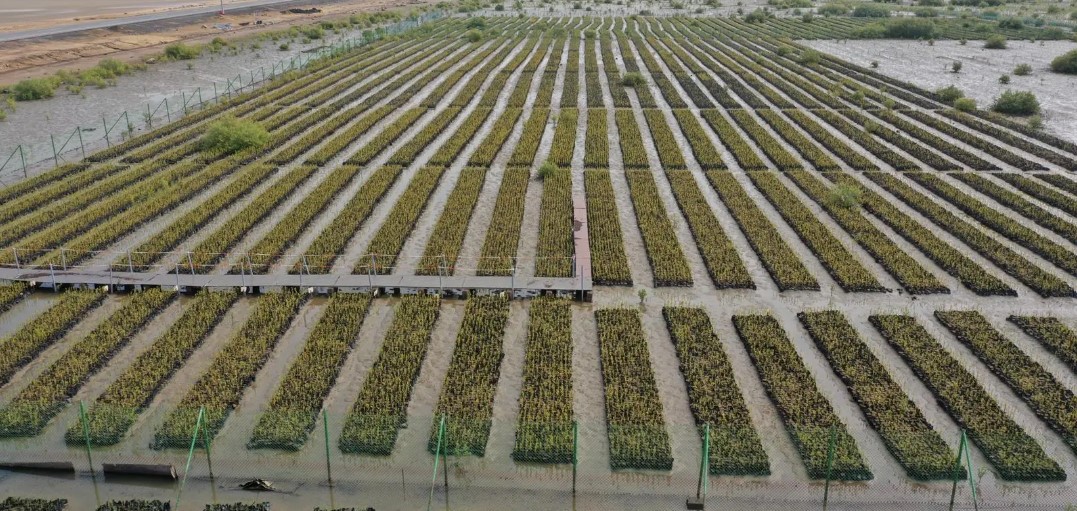
The Model: Major domestic initiatives, such as King Salman Park, Green Riyadh, and coastal mangrove restoration along the Red Sea and Arabian Gulf, provide a practical example that guides MGI’s broader regional strategies.
Advanced Toolkit
In line with Vision 2030, Saudi Arabia is deploying an ambitious, tech-driven framework to combat desertification and rehabilitate millions of hectares of degraded land.
Vegetation Expansion & Afforestation
Deploying cutting-edge aerial, GIS, and seed technologies to drive the SGI’s target of growing 10 billion trees and rehabilitating degraded land.
- Tech & Strategy: AI-driven satellite land mapping, drone seedpod dispersion, multispectral soil analysis, and native seed germplasm banking.
- Regional Application: Accelerating high-speed afforestation across hyper-arid desert terrains, coastal mangrove wetlands, and mountain rangelands.
Water Resource Efficiency
Utilizing advanced irrigation technologies to safeguard the Kingdom’s groundwater reserves.
- Tech & Strategy: AI-controlled smart drip irrigation paired with secondary and tertiary treated industrial and municipal wastewater recycling networks.
- Regional Application: Sustaining large-scale urban green belts and rural afforestation projects without depleting deep primary groundwater reserves.

Soil Stabilization & Dust Control
Combating desertification and mitigating extreme dust events through ecological and atmospheric interventions.
- Tech & Strategy: Planting protective belts of native, deep-rooted shrubs (Ghadha, Acacia) integrated with targeted cloud-seeding operational programs.
- Regional Application: Stabilizing shifting sands, curbing urban sandstorms, preventing topsoil erosion, and improving air quality in major metropolitan centers.
Biodiversity Preserves & Ecosystem Corridors
Scaling protected sanctuaries to restore endangered species and safeguard natural habitats.
- Tech & Strategy: Expanding Royal Reserves and sanctuaries under the National Center for Wildlife to protect 30% of Saudi Arabia’s land and marine environments by 2030.
- Regional Application: Establishing cross-border wildlife migration corridors and reintroducing endangered native species (such as the Arabian Oryx and Nubian Ibex) into natural habitats.
The Bottom Line: Through the Middle East Green Initiative, Saudi Arabia is establishing a sustainable model for environmental restoration, leveraging its visionary leadership to build a greener, more resilient Middle East for future generations.