The most powerful conservation stories are not loud; they are whispered in silence.
They usually take shape beneath mesmerizing desert skies, across sweeping dunes, and within hidden wetlands where wildlife moves unnoticed.
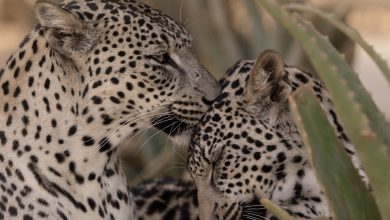
Today, each wildlife sighting serves as compelling evidence that the Kingdom’s protected landscapes are becoming vibrant havens and thriving ecosystems that nurture biodiversity.
When the Desert Revealed Its Best-Kept Secret
Among the most remarkable recent discoveries is the first scientifically confirmed breeding record of the Egyptian Nightjar within the King Abdulaziz Royal Reserve.
From Mystery to Milestone
Rarely revealing itself, the Egyptian Nightjar has long been regarded as one of the Arabian desert’s most elusive residents.
Known locally as Mulhi Al-Ru’yan, the nocturnal bird has marked a new milestone in Saudi Arabia’s wildlife discoveries, with researchers confirming for the first time its successful nesting and breeding within the King Abdulaziz Royal Reserve.

This discovery has earned international scientific recognition following the acceptance of a peer-reviewed study in the journal Applied Ecology and Environmental Research, underscoring Saudi Arabia’s commitment to advancing global biodiversity research and wildlife conservation.
Unlocking the Secrets of the Desert
Categorized as Least Concern (LC) on the IUCN Red List, the Egyptian Nightjar is difficult to observe due to its secretive, nocturnal habits and exceptional camouflage. That is why the confirmation of its breeding within the reserve is not simply a new wildlife record; it expands scientific understanding of the species’ breeding range and ecological behavior, offering valuable insights into the biodiversity of Saudi Arabia’s desert ecosystems.
This remarkable finding crowns years of meticulous field monitoring at Umm Al-Dhiyabah, one of the King Abdulaziz Royal Reserve’s outstanding seasonal wetlands.
The Discovery That Changed the Whole Story
Amid the stillness of the desert, researchers discovered an exceptional sight: two eggs carefully laid on the open ground, with no nest in view. This marked a distinctive breeding strategy that enables the Egyptian Nightjar to blend seamlessly into its surroundings.
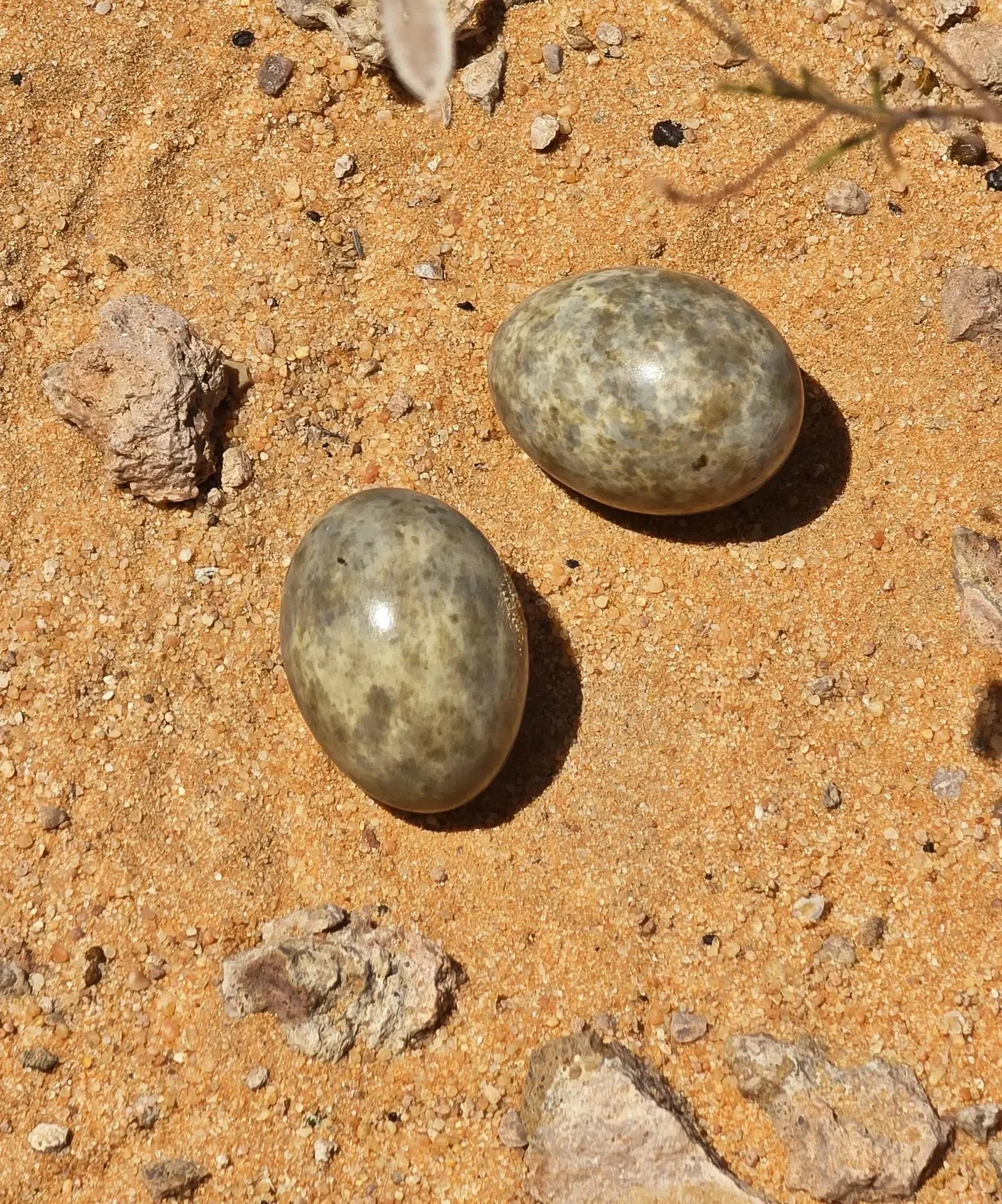
A few days later, the mystery resolved itself. When the team revisited the site, they found fragments of broken eggshells, offering silent yet compelling evidence that the chicks had already taken their first steps into the world.
By unveiling this secret, what had once been a mere suspicion became a scientific fact, unfolding a bold new chapter Saudi Arabia’s expanding record of wildlife conservation accomplishments.
The discovery provides valuable data that will help reshape the Egyptian Nightjar’s breeding distribution across the Arabian Peninsula while advancing scientific research of its ecological behavior and habitat use.
From mid-October onward, researchers repeatedly encountered the Egyptian Nightjar across diverse locations, offering a living proof that the bird continued to utilize the reserve’s several habitats throughout the season.
Together, these observations completed a scientific puzzle that had remained unsolved for years. What was once confined to scattered sightings and presumed nesting has now culminated in Saudi Arabia’s first verified breeding record of the species.
The Desert’s Silent Hunter
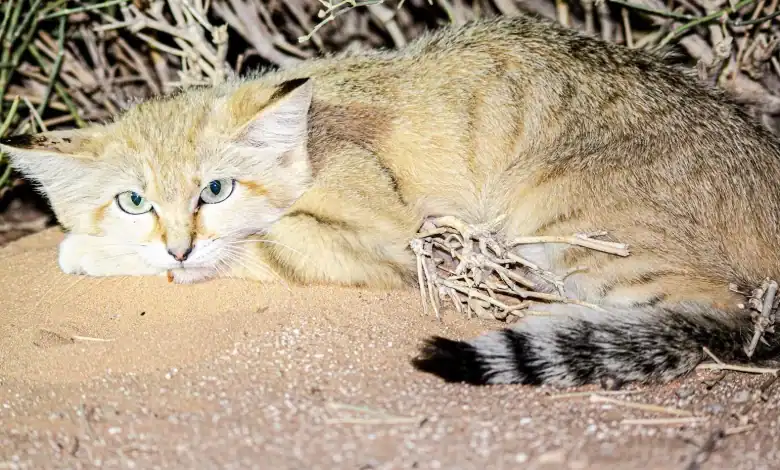
Perfectly camouflaged against the golden sands, the sand cat remains one of the Arabian desert’s most elusive inhabitants.
Born to Conquer the Desert
This small wild feline has perfectly mastered survival in one of the planet’s harshest landscapes, moving between scorching dunes with impressive agility while blending seamlessly into its surroundings.
Known as a true creature of the night, the sand cat emerges only after sunset to hunt, sometimes venturing as far as five kilometers from its burrow in search of prey.
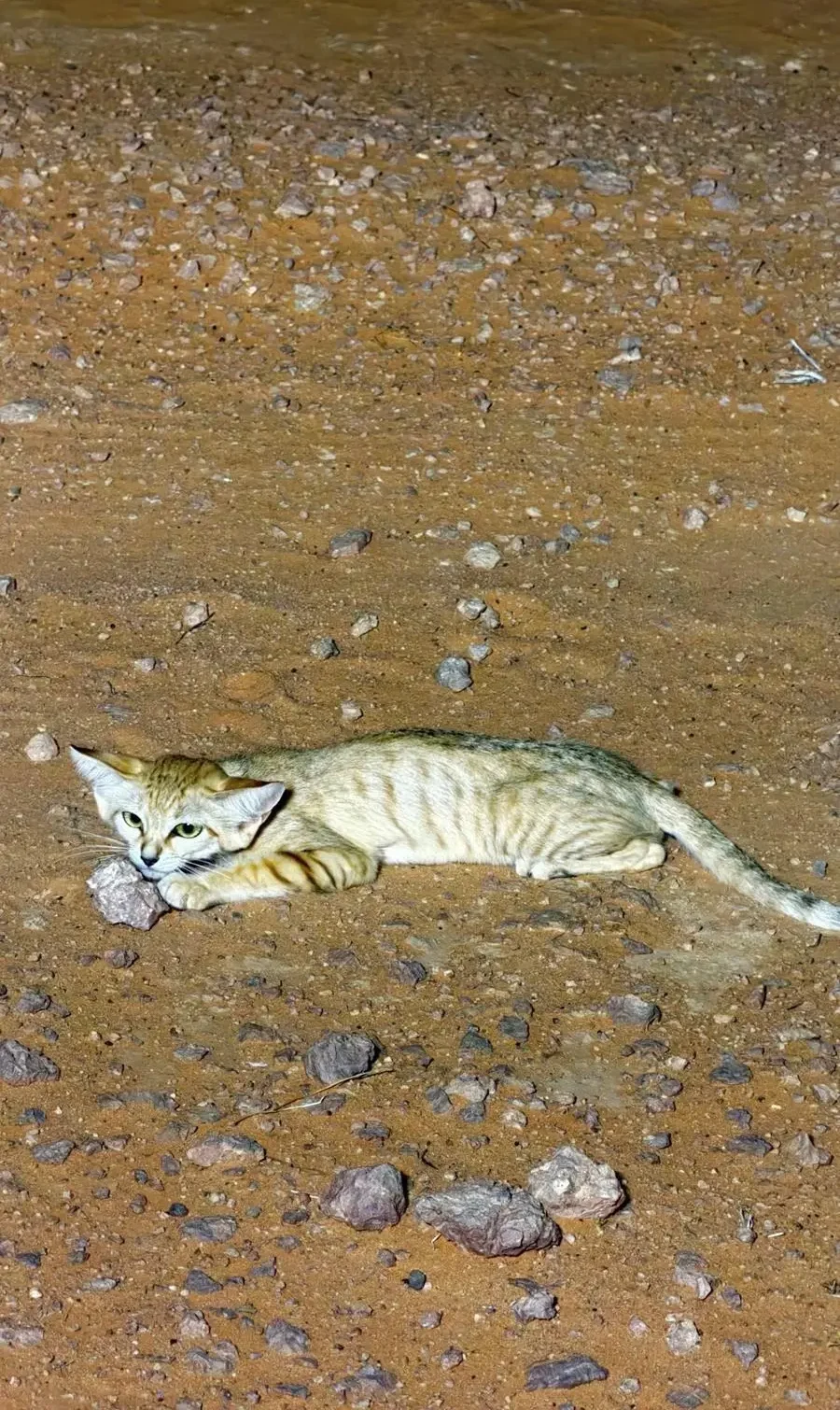
Despite its small size, the sand cat is a true predator, relying on unparalleled night vision and acute hearing to detect rodents, lizards, and snakes beneath the desert surface.
Notably, it can survive without drinking water, obtaining all the moisture it needs entirely from its prey. It also favors remote, rocky deserts and rugged terrain where sparse vegetation offers both cover and suitable hunting grounds, avoiding human activity whenever possible.
Designed for Survival
Its sandy coat, merged with pale yellow‑orange hues and light markings across the upper body, offers perfect camouflage against the desert backdrop.
The front legs have two black rings, with a tail surrounded by (2-5) black rings that are not completely round, alternating with orange bands. The cat has a white belly, a broad flattened head, and large, black-edged and triangular ears.

Moreover, the sand cat possesses remarkably sharp hearing, aided by thick fur that spreads between its toes and pads to protect its feet from the scorching desert heat during summer.
The female cat gives birth in burrows or rock crevices once and sometimes twice a year after a gestation period of 59 to 68 days, giving birth to 3-4 kittens.
The sand kittens cannot see for ten days after birth, but begin to be self-reliant in hunting prey after three or four months.
Finding Sanctuary in Saudi Arabia
Once threatened by poaching and the loss of its natural habitat, the sand cat is now making encouraging appearances across Saudi Arabia thanks to the remarkable expansion of protected areas and the Kingdom’s dedication to safeguarding fragile desert ecosystems.
Today, the species has found refuge and continues to flourish within the Imam Turki bin Abdullah Royal Reserve, standing as a living testament to Saudi Arabia’s successful conservation initiatives that safeguard one of the Arabian Peninsula’s most iconic desert mammals.
The Watcher of the Wilderness
A quiet moment in the Imam Turki bin Abdullah Royal Reserve was enough to capture one of the desert’s most charismatic birds.
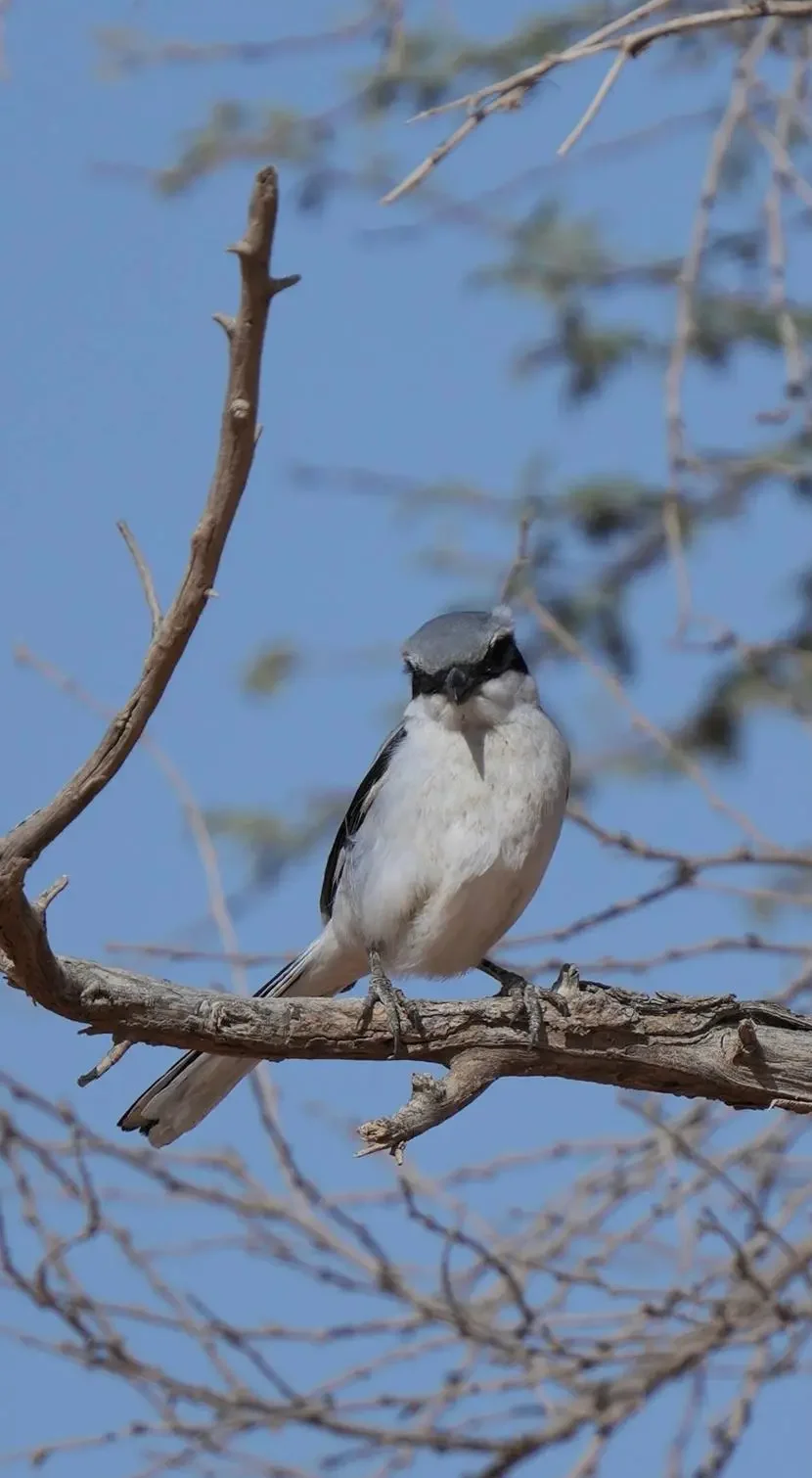
Resting calmly on a tree branch, the Great Gray Shrike stands as a testament to the remarkable biodiversity thriving within the reserve, whose safe habitats provide havens for a wide range of resident and migratory bird species.
A Picture of Ecological Harmony
The bird’s tranquil presence atop a tree branch paints a vivid portrait of life within the Imam Turki bin Abdullah Royal Reserve.
Its striking plumage mirrors the ecological richness of the reserve and strengthens its position as a sanctuary where protected habitats not only shelter wildlife but also promote the delicate balance required for long‑term biodiversity.
Apart from providing captivating desert scenery, the Imam Turki bin Abdullah Royal Reserve has emerged as one of Saudi Arabia’s dynamic strongholds for biodiversity.
Spanning across vast wilderness, the reserve stands as a safe haven for an array of resident and migratory bird species, as well as countless other forms of wildlife.
With ongoing conservation programs, habitat restoration, and environmental awareness initiatives, it is plating a pivotal role in preserving the Kingdom’s rich natural heritage while ensuring that its distinctive ecosystems continue to thrive for generations to come.
Related Topics:
Saudi Environment Week 2026 Showcases Diverse Landscapes and Wildlife
Say Hello to Umm Quwaik: Saudi Arabia’s Silent Desert Guardian
Saudi Wildlife Documentaries Shine at Muse Creative Awards
Take a Look: Dazzling Geckos Glow in the Dark Desert of Saudi Arabia