A United Front: Pakistan, Türkiye & Egypt Back Saudi Arabia Against Houthi Threats
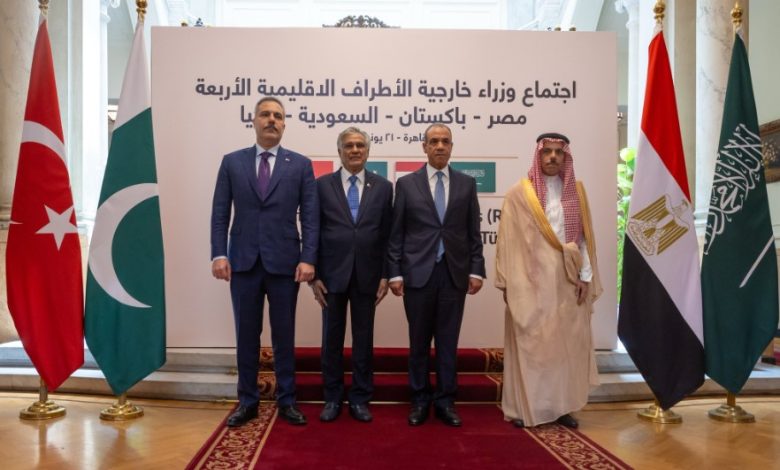
In addressing regional crises, Saudi Arabia adopts a dual-track approach of diplomacy and deterrence. This has been evident in its response to the recent Houthi escalation. Riyadh has championed de-escalation and diplomatic solutions, yet it has stressed its right to defend its territory and national assets against any attacks.
The Iranian-backed Houthi militia has been targeting Saudi Arabia’s civilian and energy facilities with drones and missiles, including a flagrant attempt to target the holy city of Makkah, which sparked widespread outrage across the Muslim world.
While these attacks triggered condemnation and solidarity from Riyadh’s partners, three key allies have reiterated their steadfast support for the Kingdom in defending its sovereignty and national security.
Crossing the Red Line
The Big Picture: Saudi Arabia has warned of the threats posed by the Houthis to maritime security in the Red Sea and the Bab al-Mandab Strait, calling for collective action to address this challenge. Importantly, the Kingdom has emphasized its commitment to de-escalation, while reserving its right to defend its territory and citizens.
What to Watch: A regional official told the Associated Press (AP) that Riyadh is preparing to launch a collective response alongside international allies, but so far, the Kingdom prioritizes diplomacy, with Oman and Egypt leading efforts for de-escalation in Yemen.
The Context: The Houthi attacks against Saudi Arabia have targeted several Saudi cities, including Abha, Khamis Mushait, Jazan, Najran, and Taif, injuring dozens of civilians and killing one Yemeni resident in Taif as a result of intercepted drone debris.
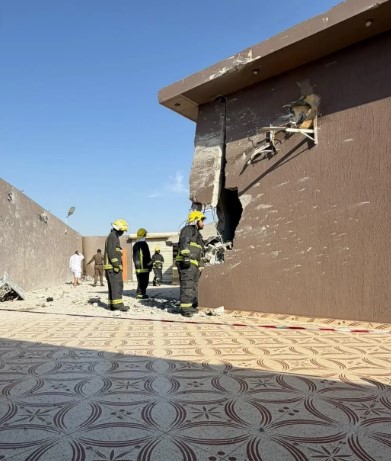
Moreover, the terrorist militia attempted to target Makkah, the holiest city in Islam, with a drone, which the Royal Saudi Air Defense Forces successfully intercepted and destroyed before it entered the city’s prohibited airspace.
Locking Arms under Makkah Alliance
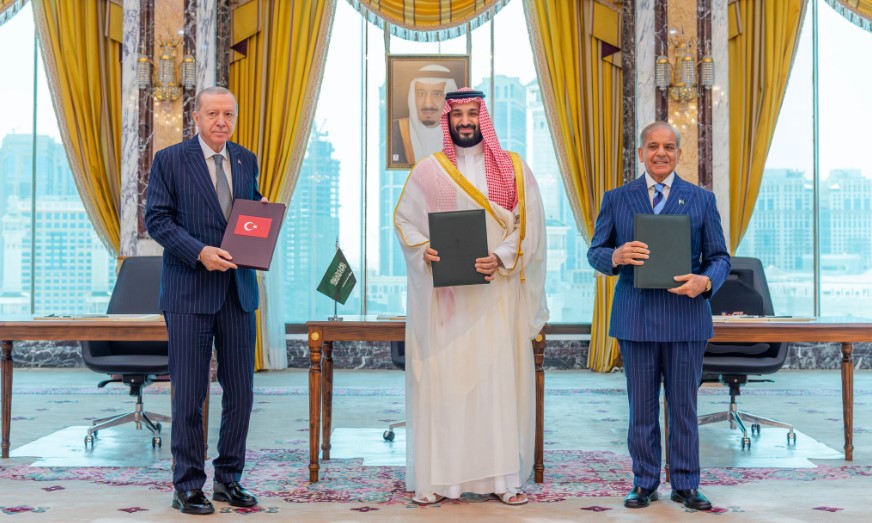
Flashback: On August 7, 2026, the leaders of Saudi Arabia, Türkiye, and Pakistan signed the Makkah Joint Defense Agreement, which establishes that an attack against any one of the three countries will be considered an attack against all three, laying the ground for collective deterrence, joint readiness, and coordinated military response. According to Turkish Foreign Minister Hakan Fidan, the three countries agreed to name the pact “Makkah Defense Alliance.”
The Deep Dive: Pakistan and Türkiye – Saudi Arabia’s allies under the Makkah Defense Alliance – have reaffirmed that their support for the Kingdom extends beyond paper treaties into real strategic alignment.
Pakistan
Reiterating Islamabad‘s support for Riyadh in confronting the Houthi threat, Pakistan’s Defense Minister Khawaja Asif said that the time has come to implement the Makkah Defense Pact. In statements to Pakistani TV channel Geo News, Asif noted that the agreement makes it clear that if the territorial sovereignty or geographical limits of any one of the three countries are violated, then it would be implemented and that all three would combat that aggression together.
In His Words: “I think that situation has already arrived. And if the situation escalates any further, then without any doubt we stand with Saudi Arabia both practically and diplomatically.” – Khawaja Asif, Pakistani Defense Minister.
Pakistan’s Foreign Ministry further reiterated this position, stating on Thursday that its bilateral Strategic Mutual Defense Agreement (SMDA) with Saudi Arabia was “operational” without providing details, confirming that Pakistan had made “some force deployments” in the Kingdom. It also underscored its commitment to the Makkah Defense Pact.
What He Said: “Pakistan is committed, in intent and spirit, to implementing the SMDA as well as the Makkah Joint Defense Agreement. However, when, how, where, and what force will be used against which objectives, in which modes, and other matters involving operational confidentiality require us to maintain some discretion at this stage.” – Sajjad Haider Khan, Pakistani Foreign Ministry Spokesperson.
Türkiye
Zoom In: The Turkish Defense Ministry voiced its categorical rejection of Houthi attacks against Saudi Arabia and the threat they pose to freedom of navigation in the Red Sea and the Bab al-Mandab Strait.
During a weekly briefing in Ankara, the Defense Ministry’s Spokesperson Zeki Akturk said that the Houthis’ destabilizing conduct must cease immediately, warning of its implications for regional security, international maritime trade, and global stability. Furthermore, he noted that work is underway to formalize the Makkah Alliance’s institutional structures, indicating that joint exercises to boost interoperability and defense capacity are proceeding in tripartite coordination.
The Maritime Defense Alliance
The Strategy: To translate diplomatic coordination into tangible defense, Saudi Arabia launched the Multinational Maritime Defense Coalition in late July 2026, bringing together 14 founding nations, including Pakistan, Türkiye, and Egypt.
With its headquarters based in Riyadh, the coalition aims to address and deter growing threats to maritime security, including attacks against commercial vessels, energy tankers, and naval infrastructure in the Bab al-Mandab Strait, the Red Sea, and the Gulf of Aden.
The Red Sea Anchor
Building on their historical alliance and geographical proximity, Saudi Arabia and Egypt have bolstered coordination to safeguard freedom of navigation and maritime security in the Red Sea, which serves as a pivotal route for global trade and supply chains, linking Gulf countries to Europe, through the Suez Canal, and to Asia through Saudi ports.
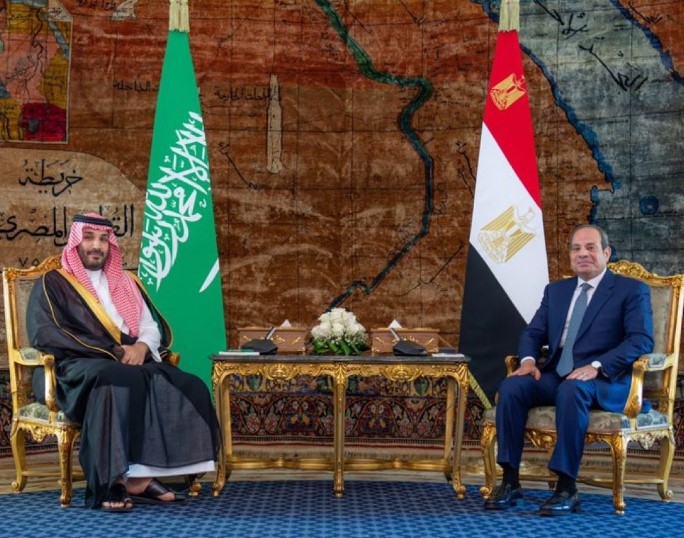
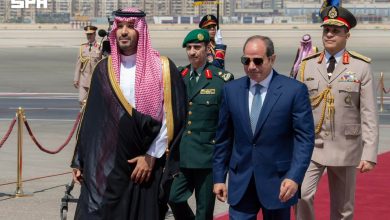
Go Deeper: During a high-level meeting in Cairo on Tuesday, September 15, Saudi Arabia’s Crown Prince Mohammed bin Salman and Egypt’s President Abdel Fattah Al-Sisi underscored their aligned position on ensuring freedom of navigation and maritime security in the Straits of Hormuz, Bab al-Mandab, and the Red Sea.
Moreover, the Egyptian President stressed Cairo’s support for the measures taken by Riyadh to safeguard the Kingdom’s security and stability, as well as for efforts to reach a comprehensive and sustainable political solution to the Yemen crisis.
State of Play: In remarks to Al Hadath, Egyptian Border Guard Forces Commander Maj. Gen. Osama Dawood highlighted ongoing security coordination between Saudi Arabia and Egypt to secure their shared borders, the Gulf of Aqaba, and the Red Sea amid the mounting security challenges in the region.
The Bottom Line: In line with its balanced approach, Saudi Arabia has paired its push for de-escalation and diplomacy with strong deterrence, anchored in a united regional front backed by Pakistan, Türkiye, and Egypt.