A Look into SAUDIA Unlimited Journey over 77 years in Sky
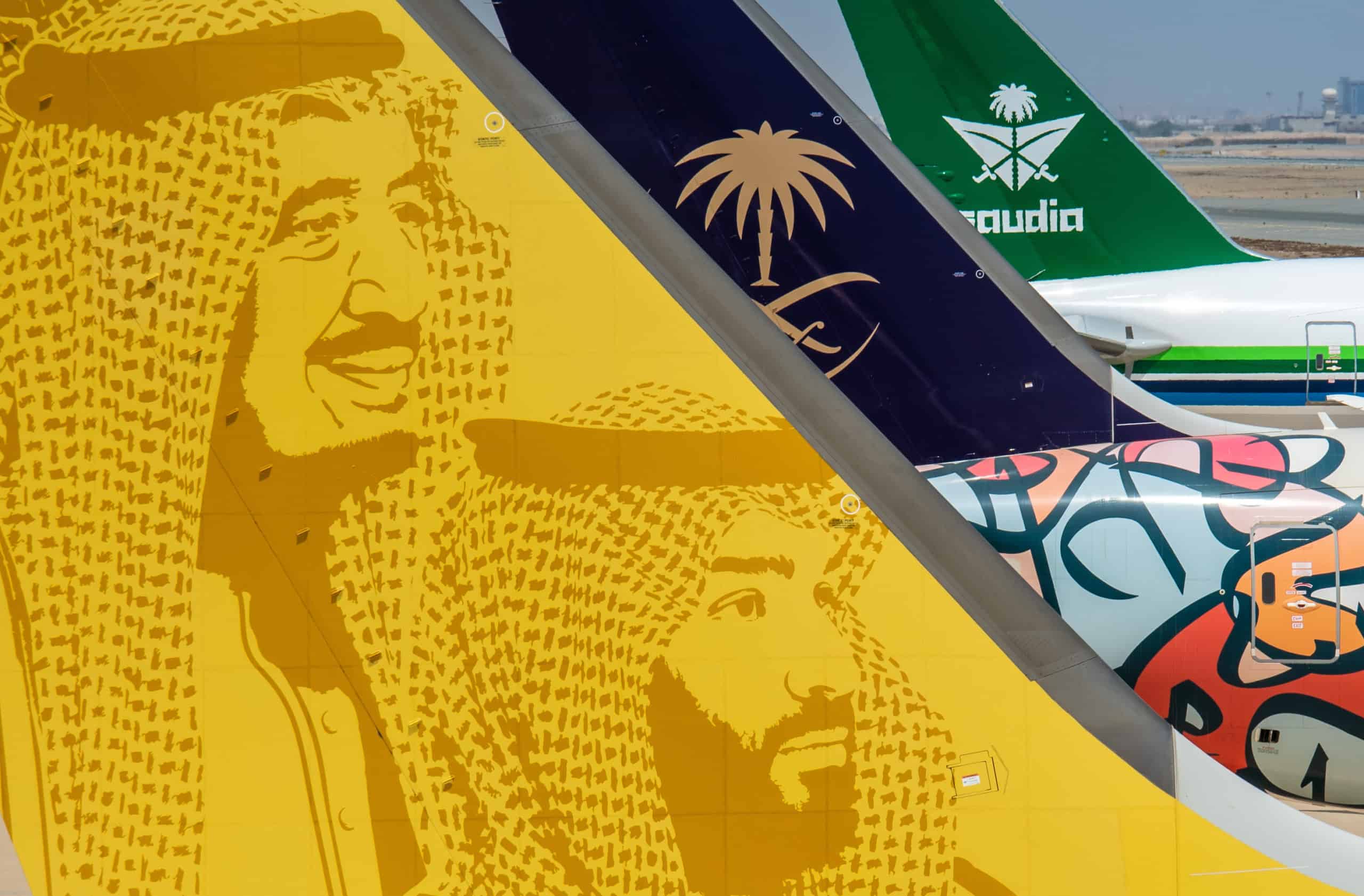
SAUDIA celebrates the 75th anniversary of operating the first flight to Cairo, and the group’s plan is based on expanding its international networks by adding new lines, providing the best air transport services internally and externally, and achieving the digital transformation plan. The group also intends to add 40 new aircraft to its fleet during the next 4 years.
SAUDIA owns one of the most modern fleets of aircraft in the world, operating flights to more than 100 global destinations, and has an integrated group of companies specialized in the aviation industry, air transport, and various services for the sector.
Saudi Arabian Airlines has witnessed great growth and development, starting with the Dikota plane in the 1940s, and reaching the Green Liner plane, where we got the five-star category globally according to the International Apex Organization.
The first flight of air traffic in the airspace of the Kingdom of Saudi Arabia was done by a single DC3 aircraft on May 27, 1945 AD. It was the aircraft that was gifted to King Abdulaziz bin Abdul Rahman Al Saud, may God rest his soul, by US President Franklin Roosevelt. It began to transport passengers between Riyadh, Jeddah, and Dhahran.
The first international flights took off to Lod Airport in Palestine on October 28 of the same year to transport pilgrims through the Lebanese capital, Beirut. In the following year (1947 AD), the first scheduled domestic flights were operated between Jeddah, Riyadh, Hofuf, and Dhahran, in addition to international flights to Amman, Beirut, Cairo, and Damascus, using DC-3 aircraft.
In 1948, five (DC-4) aircraft and five other Bristol (170) aircraft were purchased to support the international flight network.
In 1952 and 1953, the number of Saudia’s fleet reached (20) aircraft, including (10) DC-3 aircraft, five Bristol aircraft (170), and five (DC-4) Skymaster aircraft. The international flight network was extended to Oman, Bahrain, Kuwait, Basra, Asmara, Karachi, and Istanbul.
In 1954, SAUDIA inaugurated new domestic stations in Madinah, Buraidah, Khamis Mushait, Jizan, and Najran, and a new international station, Port Sudan.
In 1956, the international network expanded to cover the Qatari capital, Doha, in the east, from Basra to Baghdad, from Medina to Amman, and from Damascus in the north, and from Jazan to Hodeidah in the south.
As for the internal network, it extended to connect between Jeddah and each: Medina, Al-Wajh, Tabuk, Turaif, Badna, Yanbu, Sakaka, Al-Qurayyat, and between Riyadh and Zulfi, Al-Majma`ah, Turbah, and Bisha.
The year 1961 AD was the date for Saudi Arabia to enter the era of jet aviation, and to become the first airline in the Middle East to own jet aircraft, by joining two Boeing (720) aircraft to its fleet, each with a capacity of (119) passengers. In 1962, Boeing 720s began scheduled flights to Beirut, Amman, and Cairo.
On February 19, 1963 AD, Royal Decree No. (45) was issued according to which SAUDIA became an independent institution under the name “The General Organization of Saudi Airlines”.
In 1967 AD, “Saudi Arabia” joined the International Air Transport Association (IATA), and in the same year, three (DC-9) jet aircraft joined the fleet to support the international flight network that included Tripoli, Tunisia, and Rabat in North Africa, and Frankfurt, Geneva, and London in Europe.
In 1971, new computers of the type (707) were also used. IBM-360\20) for planning and day-to-day operations.
In 1972, the Corporation adopted the term “Saudi Arabia” as its official name, and the colors of its fleet changed from green and black separated by a thin golden ribbon to green and blue in their light and dark shades to modernize the mental image of the national carrier among its customers.
In 1973 AD, “Saudia” transported for the first time in its history one million passengers in one year on its flights, and the percentage of air freight transported on “Saudia” flights increased to (53%), and “Saudia” added two more Boeing (737) planes.
In the same year, Saudia’s international flights began from Tabuk to Istanbul, Beirut, Damascus, Amman, and Cairo.
In 1976, eleven new aircraft joined the fleet, including three Tristar aircraft. Flights to Casablanca were doubled, and Saudia operated a direct flight between Riyadh and London, and other flights between Jeddah and Geneva, and Jeddah and Tunisia.
The number of passengers continues to increase year after year, reaching 6.5 million passengers in 1978, and three new Boeing (737) aircraft join the fleet.
In 1979 AD, Saudia transported for the first time in its history (8) million passengers, and the quantities of air freight transported amounted to (61) million kilograms, and a direct flight was operated between Dhahran and New York.
In 1980, the number of passengers increased to (9) million passengers and the quantities of air freight to (72) million kilograms, and four Tristar planes joined the fleet, and due to the increasing demand of travelers on Saudia’s domestic and international flights, and keeping pace with comprehensive development plans in all regions.
At the international level, attention was paid to expanding the international network to reach Saudia flights to Athens, Kano, Stockholm, Mogadishu, Nairobi, and Bangkok.
In 1981 AD, King Abdulaziz International Airport in Jeddah was officially opened, and “Saudi Arabia” continued its launch, expanding its international network to New Delhi, Islamabad, Dhaka, and Colombo in Asia, Seoul, Jakarta, Singapore, and Manila in the Far East, Madrid and Nice in Europe, and Sharjah in the Arabian Gulf region.
As a result of the massive expansion in the size of the fleet and the air network, “Saudi Arabia” achieved 1983 a new record in the number of passengers carried on its flights, which amounted to more than (11) million passengers.
In 1984, (11) Airbus (A-300) aircraft joined the “Saudia” fleet to start its flights on domestic and regional lines, and Colombo station was added to the network of international stations.
In 1985 AD, SAUDIA received the first five Boeing (747-300) aircraft, which had signed a contract to purchase ten of them, which are distinguished by the spaciousness of their cabins and accommodate (424) passengers.
In 1988, Washington and Bangkok stations were added to the international flight network, and a hub for air cargo collection was created in Taipei to cover the Far East, along with Milan and Brussels to cover Europe.
In the field of air freight, Saudia services extended to London, Paris, Frankfurt, and Amsterdam with Boeing (747) aircraft, and from Jeddah to Zurich and Paris with (DC-8) aircraft.
In 1993, “Saudi Arabia” began implementing its plan aimed at obtaining boarding passes for pilgrims and Umrah pilgrims (24) hours before the departure time, and an automated search system for luggage was introduced in (38) domestic and international stations.
The year 1999 witnessed the operation of new flights to Athens via the Riyadh-Jeddah-Athens-Milan itinerary and vice versa, and the Dhahran-Riyadh-Athens-Milan route and vice versa.
Today, Saudia owns (142) aircraft from the latest production of aircraft factories in the world. Its fleet consists of Boeing B787-9 Dreamliner, B777-268, B777-300ER, Airbus A320-200, and A321, in addition to A330-300.