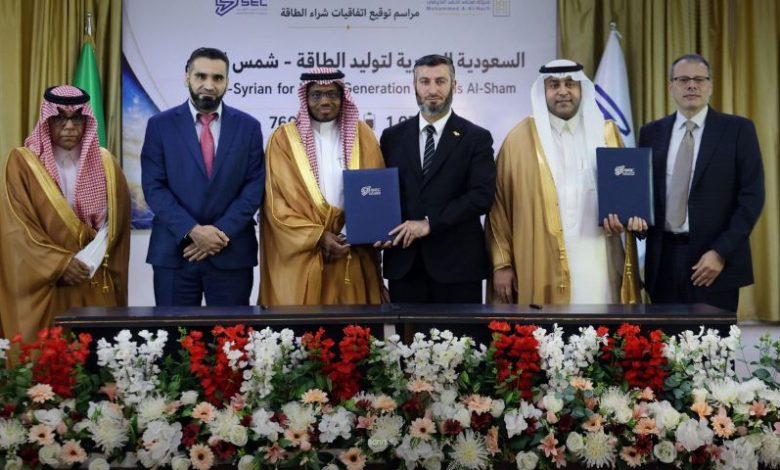
The big picture: Saudi Arabia and Syria sealed five new energy agreements in Damascus on Wednesday, marking a fresh milestone in the Kingdom’s rapid push to rebuild the war-torn country’s power sector.
Why it matters: The deals extend a broader Saudi investment wave that already tops $28 billion in memoranda of understanding since mid-2025, a scale unmatched by any other single bilateral partner in Syria’s reconstruction. Renewable energy, in particular, has become one of the fastest-moving fronts in that campaign.
Syria’s Ministry of Energy supervised the signing ceremony, which brought together Saudi Arabia’s Mohammed Ahmed Al-Harfi Contracting Company, the Syrian Electricity Company (SEC), Saudi Electricity’s Project Development Company (PDC) and Germany’s Siemens Energy.
By the numbers:
- 760 MW — combined solar capacity across the three Wadiyan al-Rabi plants
- 1,077 MWh — paired battery storage capacity
- 20-25 years — length of the power purchase agreements
- 3 cents/kWh — starting electricity tariff
- $1B — approximate value of the five agreements
- 3-5 years — targeted construction timeline
- A $1 billion solar push in Rural Damascus
Al-Harfi signed three power purchase agreements (PPAs) with SEC to develop solar plants in the Wadiyan al-Rabi area of Rural Damascus. Together, the projects will generate 760 megawatts of solar power and pair it with battery storage systems that hold a combined capacity of 1,077 megawatt-hours.
The PPAs run for 20 to 25 years. Electricity tariffs will start at a competitive 3 US cents per kilowatt-hour, undercutting many regional benchmarks.
Saudi Arabia’s deputy energy minister for renewable energy, Faisal al-Duaij, said the agreements are worth close to $1 billion. He added that construction will take four to five years, though teams aim to finish within three.
Alongside the PPAs, Al-Harfi signed two technical cooperation agreements. The first, with PDC, will deliver specialized consulting and engineering services to support project management. The second, with Siemens Energy, will transfer technical expertise in substations, power generation and storage systems.
Fuad Mosa, an adviser to Saudi Arabia’s energy minister, said the projects will supply Damascus and its densely populated countryside first, then extend to Aleppo in a second phase.
Part of a Bigger Reconstruction Bet
These solar projects highlight Saudi Arabia’s commitment to deepen economic ties with Syria while driving sustainable reconstruction. However, solar generation forms just one pillar of Riyadh’s broader economic assistance strategy. In fact, Saudi entities actively target key foundational industries across the destroyed nation.
Saudi Telecom Company (STC) is separately investing roughly $800 million to lay more than 4,500 kilometers of fiber-optic cable across Syria. Meanwhile, a Saudi consortium led by Bin Dawood Investment Group is building a new Aleppo International Airport, worth about $2 billion, designed to handle 12 million passengers annually. A new joint airline, Nas Syria, will operate from Damascus.
Saudi Arabia has also pledged $100 million toward Al Jawhara Tower, a 32-story skyscraper planned for central Damascus, and ACWA Power is pursuing a joint development agreement for up to 2.5 gigawatts of combined solar and wind capacity.
By the numbers:
- $16 billion: Total value of Saudi investment commitments and agreements targeting Syrian reconstruction efforts.
- $6.4 billion: Value of 47 strategic deals signed during the Syrian-Saudi Investment Forum in Damascus.
- 11 billion SAR ($2.9 billion): Saudi capital targeting physical infrastructure, including three new cement manufacturing plants.
- 4 billion SAR ($1.07 billion): Direct investments by Saudi telecommunications companies to upgrade digital networks and cybersecurity.
- $5.3 billion: Comprehensive package signed in early 2026 covering water desalination, aviation projects, and the Silk Link data corridor.
- 50%: Targeted gas output increase under an operational deal between Syrian Petroleum Company and Saudi firm ADES.
- 4 million cubic meters: Expected daily natural gas production from central Homs gas fields to fuel local electric power generation stations.
Building a Long-Term Strategic Economic Partnership
Between the lines: Syria’s economy needs the capital. The World Bank estimates the country’s total reconstruction bill at $216 billion, against a GDP of roughly $21 billion. By comparison, Western and multilateral commitments, including the EU’s package for 2026-2027 and a World Bank electricity grant, total only around $766 million combined. Consequently, Gulf investment, with Saudi Arabia driving the pace, has become central to the country’s recovery since Washington fully lifted sanctions late last year.
For Riyadh, the strategy carries political as well as economic weight. Saudi Arabia has backed Syrian President Ahmed Al-Sharaa since he took power in December 2024, following the fall of Bashar al-Assad. As a result, energy infrastructure has emerged as one of the clearest signals of that support.
Syria’s Ministry of Energy framed Wednesday’s agreements as part of the kingdom’s approach to deepening bilateral cooperation frameworks and the economic and fraternal partnership between the two countries. In addition, officials said the projects will help Syria achieve its sustainable development goals.
What’s next: Implementation begins immediately, with Damascus prioritized first. If Al-Harfi’s team meets its three-year target, the Wadiyan al-Rabi plants could come online well ahead of many other Gulf-backed reconstruction projects still stuck in early planning stages.