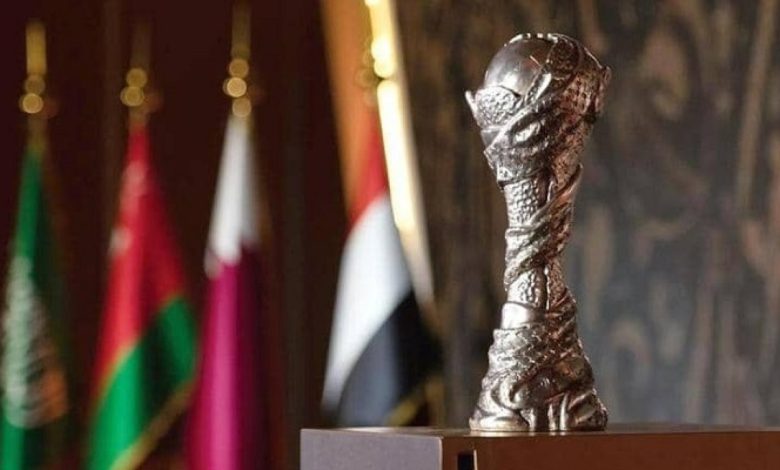
The big picture: Jeddah will make history this month as the first Saudi city on the Red Sea to host the Arabian Gulf Cup, with the region’s oldest football tournament kicking off on September 23 and runs until 6 October under the patronage of King Salman bin Abdulaziz Al Saud.
Why it matters: Khaleeji 27 is Saudi Arabia’s first Gulf Cup as host since 2014, and it doubles as the Kingdom’s final major dress rehearsal before it stages the 2027 Asian Cup. Consequently, local organizers plan an extraordinary tournament for regional football fans.
State of play: Eight national teams will compete across 14 action-packed days. Furthermore, the championship kicks off on Saudi National Day, September 23.
Five Decades of Gulf Football Heritage
Between the lines: Four founding nations, Bahrain, Kuwait, Saudi Arabia, and Qatar, launched the Arabian Gulf Cup in Bahrain in 1970. Prince Khalid Al-Faisal originally proposed the idea to foster regional brotherhood and sporting development. Subsequently, the championship expanded to incorporate four additional member nations. The United Arab Emirates joined in 1972, followed by Oman in 1974, Iraq in 1976, and Yemen in 2003.
Historically, the tournament has served as a powerful catalyst for infrastructure growth across the Arabian Peninsula. Modern stadiums, advanced media networks, and sports academies across the region owe their origins to Gulf Cup hosting efforts. In addition, the tournament established a fierce yet friendly sporting rivalry among neighboring Gulf countries.
The championship has endured political shifts and dramatic sporting moments over five decades. Consequently, winning the Gulf Cup trophy remains a crowning achievement for players and supporters alike across the Middle East.

All-Time Champions, Dynasties, and Legendary Goalscorers
State of play: Kuwait hold the record as the most successful nation in Gulf Cup history with 10 championships. Specifically, the Blue Waves dominated the early eras of the competition. Kuwait won six of the first eight editions between 1970 and 1986. Furthermore, Kuwait added titles in 1990, 1996, 1998, and 2010 to cement their historic supremacy.
Iraq rank second on the all-time tournament leaderboard with four regional crowns. The Lions of Mesopotamia captured trophies in 1979, 1984, 1988, and 2023. Remarkably, Iraq won the 25th edition on home soil in Basra in 2023 after a long hiatus from hosting.
Saudi Arabia and Qatar have each claimed three Gulf Cup championships. Meanwhile, Oman and the United Arab Emirates have captured two titles each. Bahrain enter Khaleeji 27 as defending champions. Bahrain captured their second historic title in January 2025 during Khaleeji 26 in Kuwait.
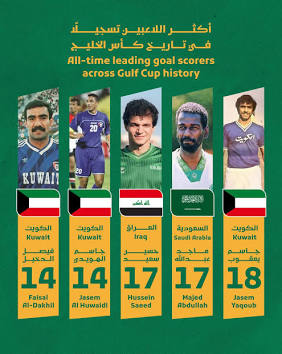
The record books: Gulf Cup history features extraordinary goalscoring achievements by iconic strikers.
Kuwaiti forward Jasem Yaqoub leads the all-time scoring chart with 18 goals. Specifically, Yaqoub scored nine goals during the fourth tournament in Doha in 1976. That remarkable record remains the highest individual tally in a single edition.
Saudi Arabia legend Majed Abdullah and Iraqi icon Hussain Saeed share second place with 17 goals each. Abdullah represented the Green Falcons across five consecutive tournaments from 1982 to 1988. In fact, Abdullah scored memorable goals against every regional opponent.
Kuwaiti legends Faisal Al-Dakhil and Jassem Al-Huwaidi share fourth place with 14 goals each. Meanwhile, Qatari forward Mansour Muftah and Emirati star Ali Mabkhout share sixth place with 13 goals each.
Kuwaiti icon Bader Al-Mutawa and Qatari forward Mahmoud Soufi scored 12 goals each during their international careers. Furthermore, Saudi legend Yasser Al-Qahtani scored 10 goals across five tournament appearances.
Saudi Arabia’s Tournament Legacy and Host Ambitions
Between the lines: Saudi Arabia have carved out a rich and proud legacy in the Arabian Gulf Cup. The Green Falcons won their maiden title in 1994 in the United Arab Emirates under coach Mohammed Al-Kharashy.
Saudi Arabia secured their second championship in 2002 on home soil in Riyadh. Subsequently, Saudi Arabia claimed their third crown during the 16th edition in Kuwait in 2003–04.
Beyond their three championships, Saudi Arabia finished as tournament runners-up on seven occasions. Specifically, the Green Falcons reached the final in 1972, 1974, 1998, 2009, 2010, 2014, and 2019. Consequently, Saudi Arabia remain one of the most consistent performers in competition history.
Iconic players have written golden chapters in Saudi football history through the Gulf Cup. Legends such as Fouad Anwar, Sami Al-Jaber, Mohammad Al-Shalhoub, and Yasser Al-Qahtani delivered historic performances. Now, a new generation of Saudi talent target a fourth regional crown on home soil.
The bigger picture: Saudi Arabia host Khaleeji 27 as part of a grander sports transformation strategy under Saudi Vision 2030. Consequently, hosting major international events reinforces Jeddah’s position as a premier sports hub.
By the numbers:
- SAR 6.2 million ($1.65 million): Organizers allocated SAR 6.2 million ($1.65 million) in total prize money for participating teams.
- SAR 3.75 million ($1 million): The tournament champion will receive a top cash prize of SAR 3.75 million ($1 million).
- SAR 2.25 million ($600,000): The tournament runner-up will earn SAR 2.25 million ($600,000).
- 10 titles: Kuwait dominate competition history with a record 10 championships.
- 4 titles: Iraq rank second in historical standings with four regional titles.
- 3 titles: Saudi Arabia and Qatar have each captured three Gulf Cup crowns.
- 18 goals: Kuwaiti striker Jasem Yaqoub holds the all-time tournament scoring record with 18 goals.
- 17 goals: Saudi legend Majed Abdullah and Iraqi star Hussain Saeed share second place with 17 goals each.
- 15 matches: Two state-of-the-art venues in Jeddah will host 15 matches over 14 competition days.
- 62,345 capacity: King Abdullah Sports City Stadium accommodates 62,345 spectators for marquee fixtures.
- 27,000 capacity: Prince Abdullah Al-Faisal Sports City Stadium provides seating for 27,000 passionate supporters.
- 100% operational readiness: Local organizing committees achieved 100% operational readiness across all logistics, media, and security sectors.
Operational Excellence and Group Stage Breakdown in Jeddah
What’s happening: The Local Organizing Committee (LOC) has finalized operational plans across Jeddah. Organizers will utilize two world-class stadiums for the tournament. King Abdullah Sports City Stadium and Prince Abdullah Al-Faisal Sports City Stadium offer modern facilities, advanced press centers, and VIP hospitality services.
In addition, transport authorities in Jeddah have introduced dedicated shuttle services for international fans. King Abdulaziz International Airport will operate specialized arrival channels for visiting delegations and supporters. Fan zones across the Jeddah Corniche will offer cultural exhibitions, interactive gaming, and live screenings throughout the 14-day tournament.
State of play: The official tournament draw in Jeddah placed eight competing nations into two balanced groups.
In Group A, host nation Saudi Arabia face fierce competition against Iraq, Oman, and Kuwait. Football analysts view Group A as the traditional group of death due to historical rivalries.
Group B features defending champions Bahrain alongside Qatar, the United Arab Emirates, and Yemen.
The top two teams from each group will advance to the semi-finals on October 3. Subsequently, the grand final will take place on October 6 at King Abdullah Sports City Stadium.
What they’re saying: Minister of Sport Prince Abdulaziz bin Turki Al-Faisal highlighted royal support for Khaleeji 27. “The patronage of King Salman bin Abdulaziz Al Saud reflects the true prestige of Khaleeji 27,” Prince Abdulaziz stated. “We welcome our brothers from across the Gulf to Jeddah for an unforgettable celebration of sportsmanship and unity.”
Additionally, Yasser Al-Mishal, President of the Saudi Arabian Football Federation (SAFF), praised technical readiness. “SAFF continue working tirelessly to deliver a historic edition on Saudi soil,” Al-Mishal affirmed. “Our infrastructure and operational teams stand ready to set a benchmark for regional tournament management.”
Ultimately, Khaleeji 27 honors five decades of Gulf football tradition while showcasing Saudi Arabia’s world-class sporting capabilities and future ambitions.
What’s next: Saudi Arabia is set to announce its final squad soon, then meets Kuwait in the 23 September opener. A win there sets up a winnable group alongside Iraq, Oman and Kuwait. If Donis’s side advances, it gets a real shot at ending that long-running drought in front of a home crowd, and at proving the federation’s faith in him was justified.