Lebanon celebrated the resumption of exports to Saudi Arabia, with the first cargo ship leaving Beirut for the Jeddah Islamic Port on Saturday, June 20.
The move marked the end of a nearly five-year ban on Lebanese imports into the Kingdom, following a directive from Saudi Crown Prince and Prime Minister Mohammed bin Salman.
Saudi-Lebanese Trade Resumes
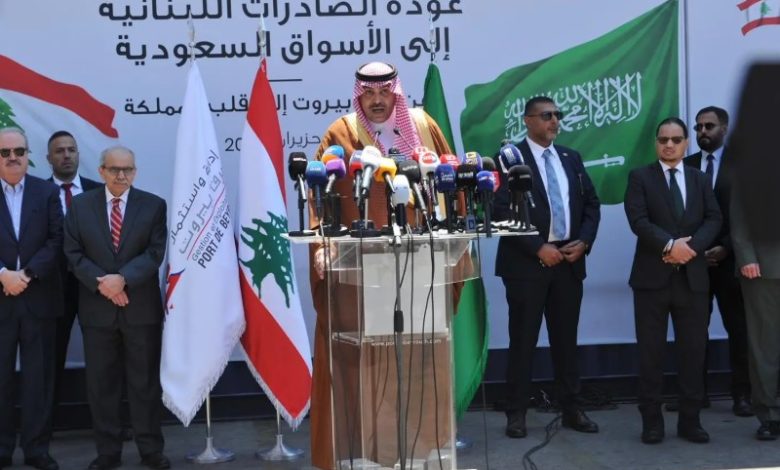
In a ceremony at the Port of Beirut, Saudi Ambassador to Lebanon Fahd Al-Dosari launched the resumption of Lebanese exports to Saudi Arabia, reported the Saudi Press Agency (SPA).
In his speech, Ambassador Al-Dosari announced the resumption of Lebanese exports to Saudi markets “following the positive steps taken by the Lebanese government toward rebuilding state institutions and the efforts undertaken by the competent authorities.”
Al-Dosari said that the first cargo ship of Lebanese exports left the Port of Beirut for the Jeddah Islamic Port, in a decision that underscores the fraternal ties between Saudi Arabia and Lebanon and the Kingdom’s commitment to supporting Lebanon’s stability, sovereignty, and the well-being of its people.
The ceremony featured several senior officials, including Lebanon’s Prime Minister Nawaf Salam, the ministers of finance, industry, agriculture, economy and trade, heads of relevant government agencies, in addition to a group of political, economic, and media figures and members of the Saudi Embassy.
Economic Lifeline
Saudi Crown Prince Mohammed bin Salman directed the resumption of Lebanese imports to the Kingdom, following a five-year ban, upon a request from Lebanon’s President Joseph Aoun and Prime Minister Salam.
The decision came in light of “the positive steps taken by the Lebanese government toward rebuilding state institutions, the progress achieved by the specialized teams over the past year, and the cooperation demonstrated by the Lebanese side, including the fulfillment of the required commitments,” the Saudi Foreign Ministry said at the time.
The resumption of Saudi trade offers a vital trade pipeline for Lebanon’s struggling agricultural and commercial sectors, further strained by the ongoing geopolitical tensions.
Major Economic Boost
Data from Lebanon’s Agriculture Ministry showed that the Gulf Cooperation Council (GCC) countries made up the main market for Lebanese agricultural exports before 2020, representing 45% of total exports worth $242 million.
Saudi Arabia accounted for 13% of these exports, receiving around 60,000 tons of vegetables, fruits and their products, valued at $42 million.
Following the Saudi ban, Lebanon’s annual fruit and vegetable exports to the Gulf declined from 200,000 tons to just 77,000 tons, negatively affecting agricultural production, farmers’ income, and the sustainability of sectoral value chains.
In his address, Salam thanked the Saudi Crown Prince for his generous decision. He praised the resumption of exports to the Kingdom, saying that the return to Saudi markets “means the return of hope” to thousands of farmers, factories and exporters across Lebanon.
He noted that the Saudi decision “sets an entire economic chain in motion” by creating jobs and ensuring the inflow of hard currency, helping Lebanon jumpstart its economy and boost the capabilities of its productive sectors.
The Lebanese Prime Minister also expressed hope that this move will be followed by further measures to strengthen cooperation and ease travel between the two countries.
Enhanced Security Measures
Salam highlighted the tightened security measures at Lebanese ports to ensure the country is not utilized as a staging ground to harm its neighbors.
He noted that authorities installed advanced scanning devices at the ports of Beirut and Tripoli, appointed a new, highly experienced and competent management for the ports and the Customs, tightened border control measures with Syria and stepped up the fight against smuggling in all its forms.
“I reiterate once more: we will never again allow Lebanon to be a launchpad for any harm against our Arab brothers; instead, it will be a partner in their security, stability, and prosperity,” Salam stressed.