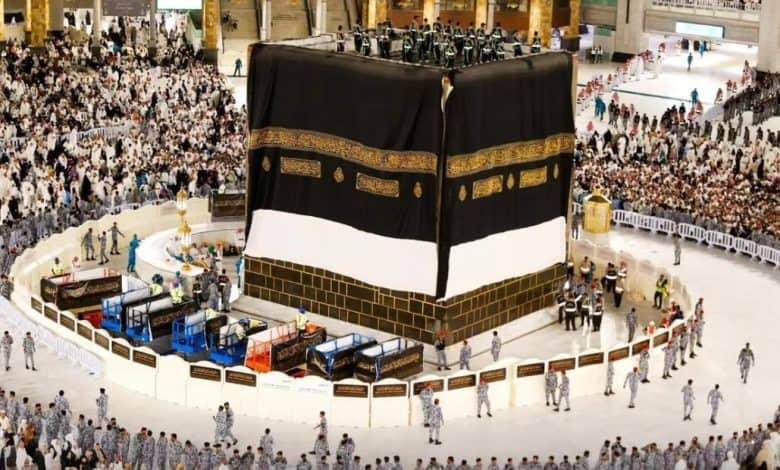
The Saudi General Authority for the Care of the Affairs of the Grand Mosque and the Prophet’s Mosque installed on Sunday a new Kiswa (cover) at the Holy Kaaba in Makkah, coinciding with the first day of the Islamic New Year.
A team of 159 skilled and trained Saudi craftsmen, from the King Abdulaziz Complex for Holy Kaaba Kiswa, embarked on dismantling the old Kiswa and installing the new one, reported the Saudi Press Agency (SPA).

A Meticulous Process
The new Kiswa, which weighs 1350 kilograms and is 14 meters high, consists of four separate sides and a door curtain. Each side is lifted separately to the top of the Kaaba in order to unfold it over the old cover.

After all sides are fixed to the top, the corners are sewed from the top of the Kiswa to the bottom. Then, the curtain is placed, a task that requires time and precision.
It needs an opening in the black fabric to match the size of the curtain, which is approximately 3.33 meters wide until the end of the covering and 6.35 meters long. After that, three openings are made in the black fabric to fix the curtain from underneath. Finally, the edges are sewed into the black fabric on the Kiswa.

Ornate Embroidery
The Kiswa of the Holy Kaaba consumes 1000 kilograms of raw silk, dyed in black, 120 kilograms of gold threads, and 100 kilograms of silver threads. Meanwhile, the Kiswa belt consists of 16 pieces, along with seven pieces below the belt.

Furthermore, the Kiswa consists of gold-embroidered pieces, including 16 for the belt area, 7 for under the belt, 4 corner pieces, 17 lanterns, and 5 pieces for the door curtain, Al-Rukn Al-Yamani, and the Black Stone outline.
Saudi Skilled Workers
The King Abdulaziz Complex for Holy Kaaba Kiswa employs around 200 trained, qualified, and specialized Saudi craftsmen and administrators.
The Complex consists of several departments, such as dyeing and automated weaving, hand weaving, printing, belt-making, gilding, sewing, and assembly of the Kiswa.

It also includes supporting departments such as the laboratory, administrative services, quality control, public relations, health services for workers, and occupational safety.
Women Participation
Eng. Ghazi Al-Shahrani, CEO at the General Authority for the Care of the Two Holy Mosques, highlighted the role of Saudi cadres in replacing the Kiswa. He told Al-Ekhbariya that Saudi trained and qualified craftsmen undertook the replacement of the Holy Kaaba Kiswa.
فيديو | الرئيس التنفيذي لهيئة العناية بشؤون الحرمين م. غازي الشهراني:
من يعمل على صناعة وتبديل #كسوة_الكعبة كفاءات سعودية مدربة#الإخبارية pic.twitter.com/BfR6xDglKA
— قناة الإخبارية (@alekhbariyatv) July 7, 2024
“A team of 150 Saudi craftsmen oversaw the work. They dismantled the old Kiswa and installed the new one. They were all trained and educated in a specialized factory,” he said.
For the first time this year, Saudi female employees of the General Authority for the Care of the Affairs of the Grand Mosque and the Prophet’s Mosque took part in replacing the Kiswa of the Holy Kaaba.