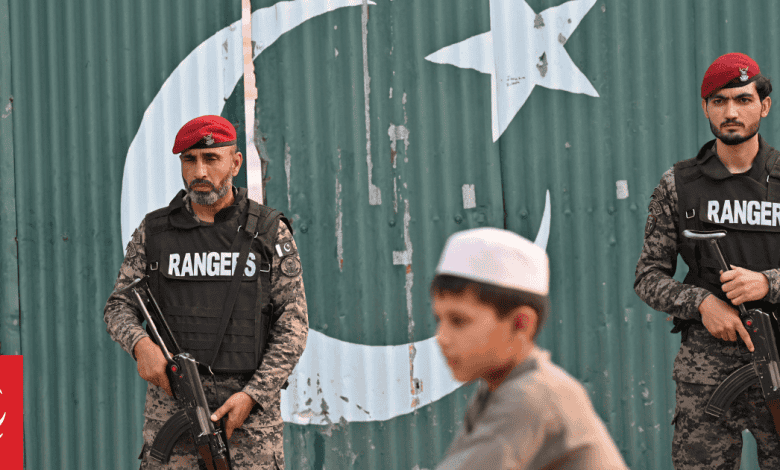
Pakistan has issued a stern warning that it will “avenge” the deaths caused by recent Indian air strikes that came in response to an attack in Kashmir, indicating a potential escalation in violence between the nuclear-armed neighbors. Reports confirm at least 43 fatalities, with Islamabad claiming 31 civilians died due to Indian strikes and border firing. Meanwhile, New Delhi reported at least 12 deaths from Pakistani shelling.
In a national address late Wednesday, Pakistani Prime Minister Shehbaz Sharif made a solemn pledge. He stated, “We make this pledge, that we will avenge each drop of the blood of these martyrs.” This declaration underscores the gravity of the situation and the commitment to retaliate against perceived injustices.
India’s army reported destroying nine “terrorist camps” in Pakistan early Wednesday morning. This military action followed New Delhi’s accusation that Islamabad supported an attack on tourists in Indian-administered Kashmir. Pakistan has categorically denied these allegations, asserting its innocence in the matter.
Claims of Downed Jets
Pakistan military spokesman Ahmed Sharif Chaudhry claimed that five Indian jets were downed across the border. However, an unnamed Indian senior security source stated that three fighter jets crashed within Indian territory. This conflicting information highlights the chaotic nature of the ongoing conflict.
Both nations have engaged in heavy artillery exchanges along the Line of Control, which divides Kashmir. This region remains a contentious area, with both countries claiming it entirely but administering it separately. The situation has escalated tensions significantly, raising concerns about further military confrontations.
India’s Justification for Strikes
India defended its military actions, claiming they were “focused, measured, and non-escalatory.” However, Pakistan’s Defence Minister Khawaja Muhammad Asif accused Indian Prime Minister Narendra Modi of launching strikes to boost his domestic popularity. He emphasized that Islamabad “won’t take long to settle the score.”
On Wednesday night, the Pakistani military spokesman confirmed that firing along the Line of Control was “ongoing.” He reiterated Pakistan’s right to respond in self-defense, stating that the armed forces had been “authorized” to take action. This declaration signals a readiness for further military engagement.
The largest Indian strike targeted an Islamic seminary near Bahawalpur, resulting in 13 fatalities, according to the Pakistan military. Additionally, a government health and education complex in Muridke was destroyed, along with a mosque in Muzaffarabad, killing its caretaker. Tragically, four children were among those killed in Wednesday’s attacks.
Pakistan also reported that India targeted a hydropower plant in Kashmir, damaging a dam structure. This incident occurred after India threatened to stop the flow of water on its side of the border. India’s Defence Minister Rajnath Singh stated that the operation was New Delhi’s “right to respond” following the attack on tourists in Pahalgam last month.
International Concerns and Diplomatic Pressure
The international community has expressed deep concern over the escalating conflict. Diplomats and world leaders have urged both countries to de-escalate tensions. The spokesman for UN chief Antonio Guterres emphasized, “The world cannot afford a military confrontation between India and Pakistan.”
On Wednesday, US President Donald Trump called for an immediate halt to the fighting. He added, “If I can do anything to help, I will be there.” This statement reflects the urgency of the situation and the need for diplomatic solutions.
Rebels in Indian-administered Kashmir have waged an insurgency since 1989, seeking independence or merger with Pakistan. India frequently accuses Pakistan of supporting armed groups fighting its forces in Kashmir, a charge that Islamabad vehemently denies. The cycle of violence continues, leaving civilians caught in the crossfire.