
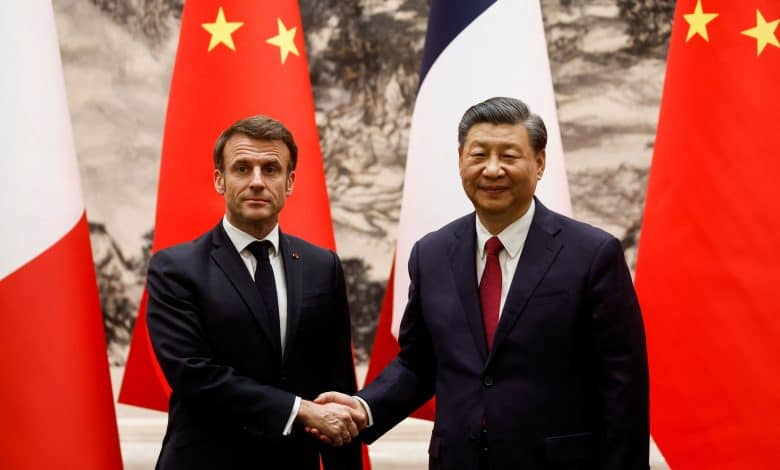
French President Emmanuel Macron kicks off a crucial three-day state visit to China on Wednesday, intending to strengthen dialogue on sensitive issues like the war in Ukraine, global trade imbalances, China’s growing Pacific influence, and human rights.
Macron deliberately attempts to convey a strong, unified European position on China, simultaneously working to avoid any diplomatic moves that might unnecessarily provoke Beijing’s leadership. Experts note China’s increasing international assertiveness currently strains crucial European trade, security, and diplomatic relationships worldwide.
Noah Barkin, an analyst from Rhodium Group, stressed Macron’s delicate balancing act, stating, “He must make clear to China’s leadership that Europe will respond to growing economic and security threats from Beijing, while preventing an escalation of tensions that leads to a full-blown trade war and diplomatic breakdown.” Barkin admitted this particular message “is not an easy message to deliver.”
The President will formally begin his agenda with a visit to Beijing’s historic Forbidden City before he meets President Xi Jinping twice: once on Thursday in the capital, and again on Friday in Chengdu, Sichuan province.
Significantly, this trip closely follows European Commission President Ursula von der Leyen’s tense July visit, where she declared that EU-China ties had reached a critical “inflection point.”
Trade Disputes and Geopolitical Tensions
Trade disagreements dominate the official agenda as low-cost Chinese exports increasingly impact European industries, particularly the domestic steel sector, following exclusion from the US market.
Furthermore, Europe actively monitors China’s rapid technological advancements in electric vehicles and its global monopoly on rare earths processing, which critically threaten essential European industrial supply chains.
France, whose domestic carmakers struggle to compete in the Chinese market, recently supported a European Commission proposal to increase tariffs on all imported Chinese electric cars.
Consequently, Beijing recently ended a year-long investigation into French brandy imports, a move widely interpreted as a clear sign of diplomatic de-escalation after the initial EV tariff dispute. Officials expect the two leaders will extensively discuss the contentious issues of Taiwan and the South China Sea.
State-run newspaper China Daily later quoted Cui Hongjian, a Chinese Europe specialist, who predicted that France and China “will come up with common understanding” during the visit. Cui insisted that this understanding “will not only help stabilize China-France ties and China-EU ties, but also help the parties focus on cooperation to tackle common challenges, instead of viewing each other as challenges.”
Finally, Human Rights Watch confirms widespread repression remains across China, mentioning mass detention of Uyghurs, forced labor, and significant restrictions in Tibet and Hong Kong.