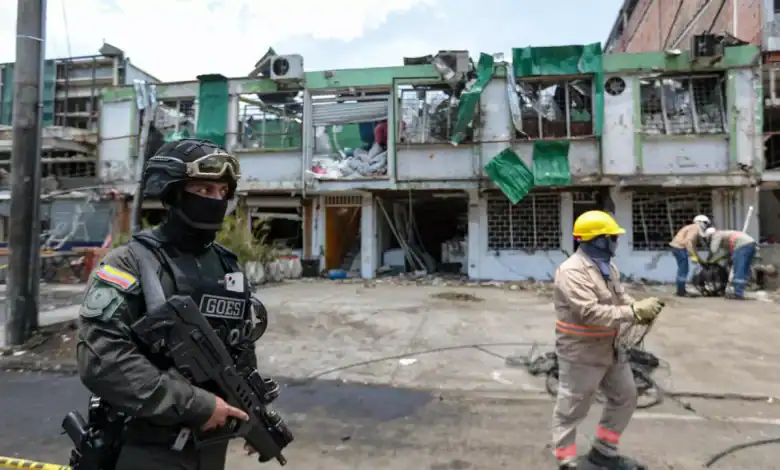
Colombia vowed on Friday to crush “desperate” armed groups following twin guerrilla attacks that killed 19 people and worsened the nation’s worst security crisis in decades. Defense Minister Pedro Sanchez urgently met top security officials in Cali after a horrific truck bomb exploded Thursday afternoon. The blast ripped through a busy street near a military aviation school in northern Cali. Shockingly, civilians suffered all casualties, with six dead and 60 wounded according to authorities. Residents described the terrifying violence as the explosion shredded building facades and injured innocent bystanders including children.
New Military Operation Launched
Sanchez announced “Operation Sultana” immediately after Friday’s high-level meeting in Cali which aims to neutralize the terrorist threat and protect Cali plus its surrounding area from further attacks. The minister provided limited operational details but confirmed strengthening the elite Search Bloc unit. Consequently, this 700-person force hunting high-value targets will gain more technology and intelligence capabilities. Authorities previously used such units to capture notorious drug lords like Pablo Escobar effectively. Furthermore, Cali Mayor Alejandro Eder revealed a second truck bomb failed to detonate nearby. Eder stressed that both bombs exploding would have created an infinitely worse catastrophe. Police have already arrested two suspects connected to the Cali attack.
Nationwide Crisis Deepens
Meanwhile, just hours before Cali’s bombing, another guerrilla group struck northwest Colombia. They used rifles and drones to shoot down a police helicopter, killing 13 officers instantly. Despite these devastating twin attacks, Sanchez insisted the military continues making significant progress against armed groups across multiple fronts. He argued that pressure on criminal organizations has driven them into a state of dangerous desperation. President Gustavo Petro‘s leftist government squarely blames both attacks on FARC dissident groups. These factions rejected the landmark 2016 peace accord and now operate as violent splinter cells.
Nevertheless, President Petro faces mounting criticism over perceived security failures and his controversial strategy. His approach favors engaging armed groups through dialogue rather than solely military action. Cali Mayor Eder directly called this an intelligence failure requiring urgent correction. Colombia’s 2016 peace deal initially brought relative tranquility after decades of brutal conflict killing hundreds of thousands. However, it also spawned numerous dissident guerrilla factions, paramilitaries, and cartels vying for territory and cocaine profits. Guerrillas now claim responsibility for dozens of recent attacks including a presidential candidate’s assassination.
Election Fears Fuel Uncertainty
Laura Bonilla, a Peace and Reconciliation Foundation analyst, stated dissident groups actively try to destabilize the country. She explained their clear goal: putting the government on the ropes and generating widespread fear linked directly to the 2026 elections. Next May, Colombia will elect a new president as Petro, leading the nation’s first leftist government, cannot seek re-election. Security concerns alongside critical economic issues will undoubtedly dominate the upcoming campaign. Consequently, the UN Office on Drugs and Crime reports Colombian cocaine production has reached record highs under Petro. This booming trade unfortunately funds many rebel operations fueling the current violence.