How Prince Faisal’s Visit to Beijing’s Forbidden City Reflects Growing Partnership with China
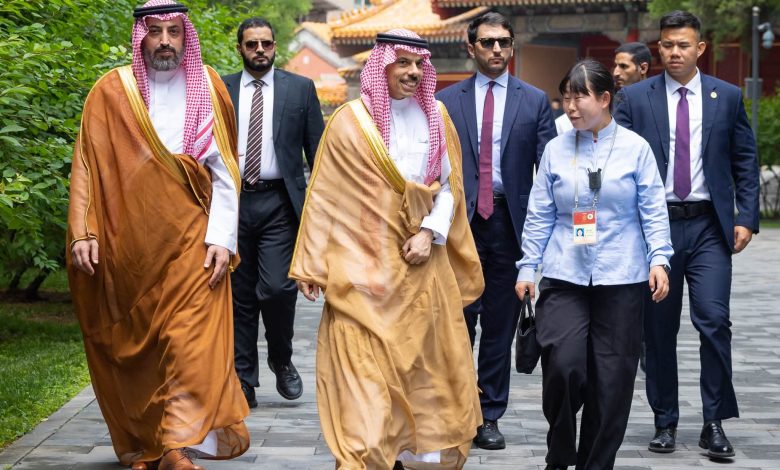
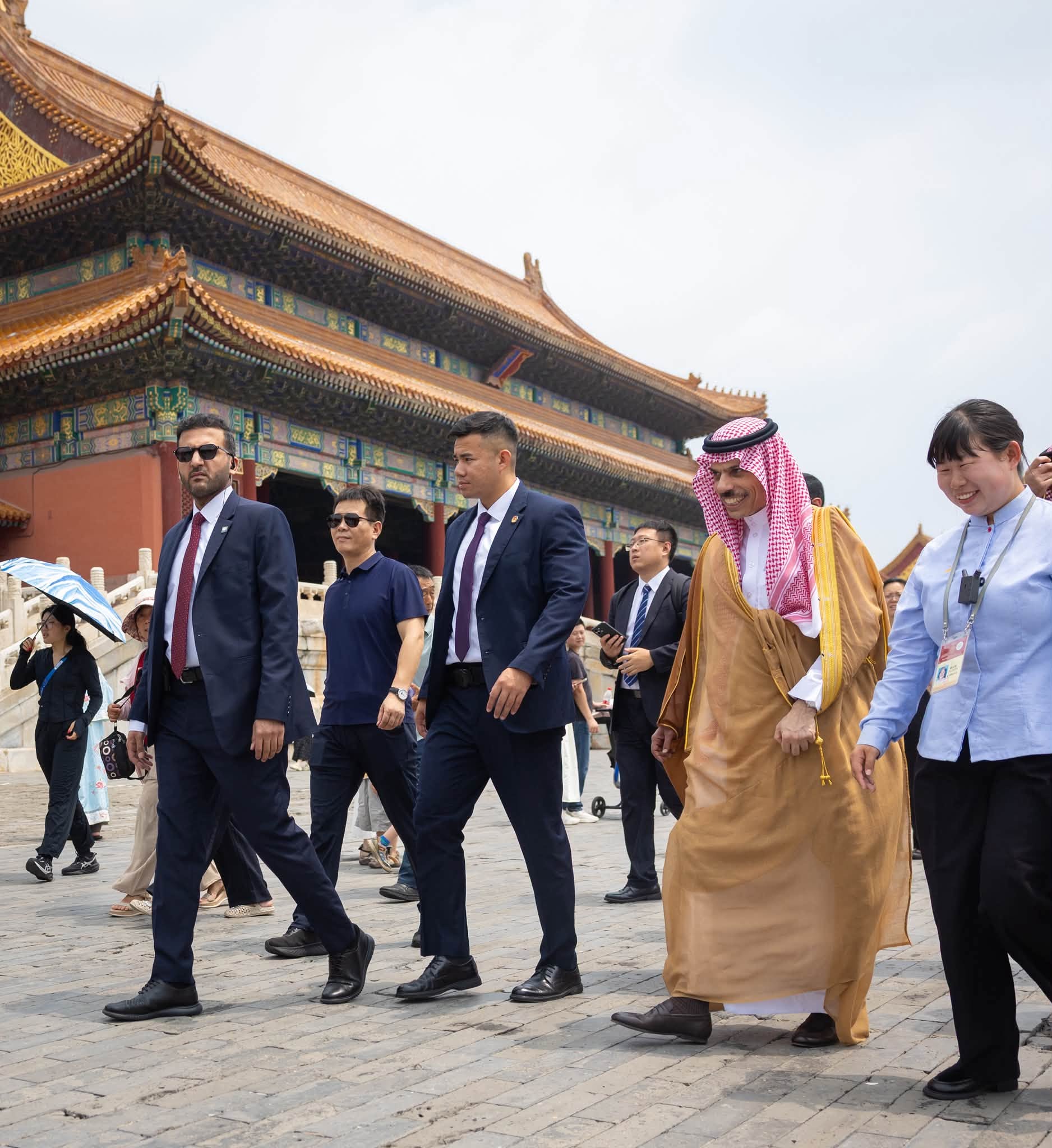
As part of his official visit to China, Saudi Arabia’s Foreign Minister, Prince Faisal bin Farhan, visited the Imperial Palace Museum, widely known as the Forbidden City, in Beijing, where he toured its most remarkable cultural and historical landmarks.
Walking through the museum’s majestic halls, Prince Faisal explored a series of centuries-old artifacts and carefully curated exhibitions that offer deep insights into the Chinese civilization.
The museum stop came on the heels of a series of high-level meetings that highlighted the strategic depth of Saudi Arabia’s partnership with China.
High-level Meetings
Prince Faisal arrived in Beijing on Tuesday and held significant talks with Chinese Vice President Han Zheng to discuss the expanding cooperation between Saudi Arabia and China.
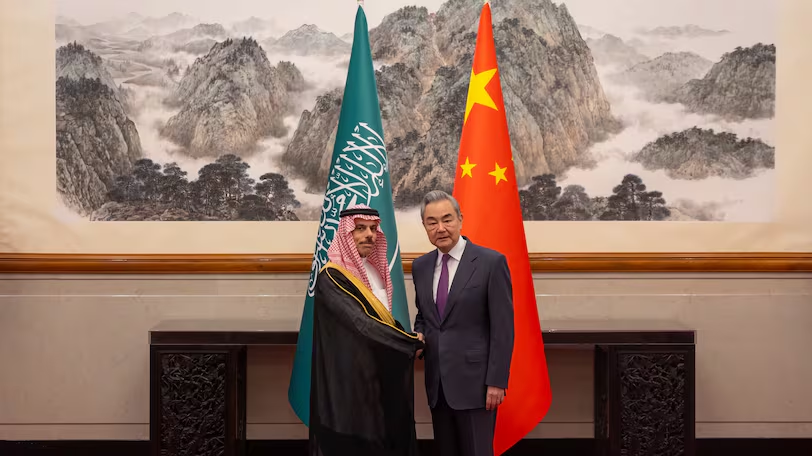
He also met with Chinese Foreign Minister Wang Yi, where the two diplomats emphasized the strength of the Saudi-Chinese strategic partnership and explored new avenues for strengthening coordination across a vast array of sectors.
Beyond Energy
What was once a relationship defined significantly by oil has emerged into one of the region’s most effective strategic partnerships.
Now, Riyadh and Beijing are unleashing new horizons for cooperation across a wide range of sectors, from investment and technology to infrastructure, clean energy, tourism, and cultural engagement.
China has established itself as Saudi Arabia’s largest trading partner, while the Kingdom has become one of Beijing’s leading economic partners in the Middle East.
The Defining Force of Saudi-Chinese Ties
The alignment of Saudi Vision 2030 with China’s Belt and Road Initiative have set the stage for unparalleled bilateral ties, transforming shred visions into actual joint efforts in infrastructure, advanced industries, digital transformation, and sustainable development.
This shared vision has given a prominent rise to billions of dollars in investments and collaborative ventures across emerging industries, including renewable energy, artificial intelligence, digital infrastructure as well as advanced manufacturing.
Culture as the New Language of Diplomacy
The Saudi Foreign Minister’s visit to Beijing’s Imperial Palace Museum was not just a stop on his official itinerary. Rather, it mirrored a growing recognition that culture has become a new language of modern diplomacy that complements both political dialogue and economic partnerships.
Under Saudi Vision 2030, the Kingdom has diversified its investment in preserving and celebrating historic landmarks, spotlighting its cultural identity, and promoting international cultural exchange.
Upon recognizing that impactful diplomacy is built not only on shared interests but also on shared understanding, Saudi Arabia has unfolded a new chapter with China, focusing on advancing cultural cooperation.
Saudi-Chinese Cultural Year
The Saudi-Chinese Cultural Year 2025 has emerged as one of the clearest expressions of the evolving partnership between Riyadh and Beijing. Set as a platform for cultural dialogue, the initiative launched a rich program of exhibitions, artistic collaborations, along with heritage events that celebrate the civilizational legacy of both nations.
The National Museum in Riyadh hosted “The Sound of Harmony: A Journey Through Ancient Chinese Music” Exhibition in September to further boost Saudi-Chinese cultural cooperation.
By displaying more than 100 rare musical artifacts, the “The Sound of Harmony” took visitors on a unique educational and artistic journey through the evolution of Chinese music across millennia.

Highlights featured ancient bone flutes, bronze bells, the traditional guqin, and the twelve lü pipes, each piece mirroring the deep connection between music, ritual practice, and cultural identity in China.
Beyond the musical collection, the exhibition showcased a curated selection of archaeological artifacts that offered deeper insight into the philosophical and spiritual significance of music in Chinese civilization.
Cinematic Dialogue
Recognizing cinema’s pivotal role as a bridge between the Kingdom and one of its most important international partners, Saudi Arabia’s Film Commission brought the third edition of Saudi Film Nights back to China.
Saudi Arabia offered Chinese audiences a window into the Kingdom’s evolving cinematic landscape by displaying four feature films: Hobal, My Driver and I, Slave, and Esaaf.
While Saudi Film Nights brought the Kingdom’s cinematic storytelling to audiences across China, Chinese Film Nights in Jeddah completed the cultural dialogue.
The Vox Cinema Red Sea in Jeddah hosted the “Chinese Film Nights” festival in December, showcasing six movies.

During a visit to China by Saudi Minister of Culture Prince Badr bin Abdullah bin Farhan, the Saudi Film Commission signed a memorandum of understanding (MoU) with the pioneering Chinese Film producer and distributor Bona Film Group to boost cinematic cooperation.
Therefore, Prince Faisal’s visit to the Imperial Palace Museum crystalized the true essence of Saudi-Chinese relations. In addition to expanding cooperation in trade, technology, and investment, both countries are investing in an essential dimension of diplomacy, cultural understanding.
Related Topics:
Saudi Arabia, China Champion US-Iran Peace, Deeper Economic Ties
China’s Xi Hold Talks with Belarusian Leader in Beijing
Saudi Arabia Advances Smart Mobility Partnerships at China’s Logistics Expo