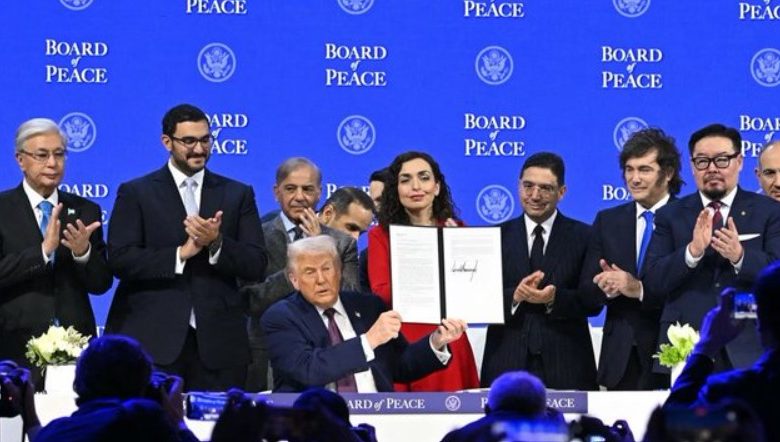
Dozens of world leaders have headed to Washington to attend the inaugural meeting of the Gaza Board of Peace, set to convene on Thursday, February 19, 2026.
Established as the centerpiece of his 20-point peace plan for Gaza, US President Donald Trump will preside over the Board’s meeting, where he will likely make major announcements regarding reconstruction funding and the deployment of the International Stabilization Force (ISF) in Gaza.
Inaugural Meeting
The Donald J. Trump US Institute of Peace in Washington will host the inaugural meeting of the Gaza Board of Peace on Thursday, with the participation of representatives from 47 countries and the European Union, reported Reuters.
Launched in Davos earlier this year, the Gaza Board of Peace includes a founding Executive Board, involving leaders with expertise in diplomacy, development, infrastructure, and economic strategy.
Moreover, the former UN envoy, Nickolay Mladenov, serves as the Board of Peace “High Representative” for Gaza, acting as the on-the-ground link between the Board of Peace and the National Committee for the Administration of Gaza (NCAG), chaired by Ali Shaath.
The Board also comprises an 11-member Gaza Executive Board to support the work of the NCAG. It includes US State Secretary Marco Rubio, US Envoys Steve Witkoff and Jared Kushner, former UK Prime Minister Tony Blair and Mladenov, in addition to representatives from Egypt, Qatar, Türkiye and the UAE.
Who Will Attend?
White House press secretary Karoline Leavitt confirmed on Wednesday the participation of more than 20 countries in the meeting.
Representatives from key Middle East powers, including Saudi Arabia, Egypt, Türkiye and Qatar will attend, in addition to other countries such as Indonesia, Kazakhstan, Argentina, Paraguay, Hungary, Belarus and Israel.
Speakers at the meeting include Trump, Rubio, Witkoff and Kushner, Tony Blair, Mladenov, and US ambassador to the UN Mike Waltz, among others.
Absent Allies
Most of the US’ traditional Western allies have declined to join the Board, citing concerns over its funding structure and political mandate.
These include the UK, Canada, Australia, and New Zealand (the Five Eyes), as well as Spain, France and Germany. Similarly, Russia and China – two UN Security Council permanent members – will not attend Thursday’s meeting. Meanwhile, Italy and Cyprus will participate only as observers.
The Vatican also declined an invitation to join the Board. “One concern is that at the international level it should above all be the [UN] that manages these crisis situations,” the Vatican’s top diplomat, Cardinal Pietro Parolin, said.
Leavitt called the Vatican’s decision “deeply unfortunate,” defending the Board of Peace’s legitimacy. “The president has a very bold and ambitious plan and vision to rebuild and reconstruct Gaza, which is well under way because of the Board of Peace. This is a legitimate organization where there are tens of member countries from around the world,” she said.
Key Announcements
During the meeting, Trump is expected to announce that participating nations have secured an initial $5 billion for the reconstruction fund – a significant down payment on a total recovery cost expected to reach the tens of billions.
This figure is expected to include $1.2 billion commitments each from the UAE and Kuwait, a US official told Reuters.
On Sunday, Trump said that members of the Gaza Board of Peace pledged $5 billion for reconstruction efforts, with formal announcement expected during the Board’s inaugural meeting.
Another major announcement expected during the meeting is related to the ISF deployment in Gaza. Trump will likely reveal the participating nations in the international force, which will work with Israel, Egypt and newly trained Palestinian police to help maintain security and demilitarize the Gaza Strip.
So far, Indonesia is the only country that has committed troops to the ISF, declaring that up to 8,000 of its troops will be ready by the end of June for a potential deployment to Gaza.
Sticking Points
The Board of Peace still faces some unresolved questions, most notably the disarmament of Hamas – a key demand of Israel and a cornerstone of the ceasefire agreement. The Palestinian group insists on its right to resistance as long as the Israeli occupation of Gaza persists.
“We are under no illusions on the challenges regarding demilitarization, but we have been encouraged by what the mediators have reported back,” a senior US official said.
Other challenges include maintaining security and the flow of aid. One Board member, speaking to Reuters on the condition of anonymity, admits the path forward is blocked by “formidable” hurdles.
Although security in Gaza is the linchpin for all other progress, the local police force remains under-trained and unready for deployment, the official noted.
He also pointed to a diplomatic deadlock regarding the negotiations with Hamas. While the Board could leverage the influence of Qatar and Türkiye, Israel remains deeply skeptical of both mediators.
Additionally, the official described the current flow of aid as “disastrous,” noting that a surge in aid is meaningless without a clear, functional authority to manage its distribution.