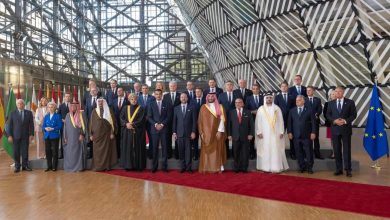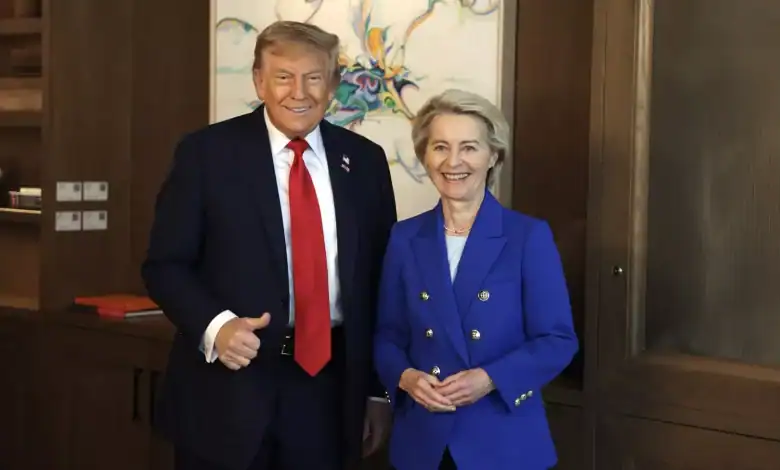
US President Donald Trump and European Commission President Ursula von der Leyen will meet in Scotland on Sunday, with the aim to resolve a prolonged transatlantic trade standoff that has persisted for months. Both leaders hope to establish a trade deal that benefits their respective economies.
In a bid to reduce the United States’ trade deficits, Trump has threatened to impose punitive tariffs on numerous countries, insisting that these tariffs will take effect if a trade agreement is not finalized by 1 August, as the EU faces a potential 30% levy, prompting them to negotiate vigorously with the Trump administration.
Announcement of the Meeting
Von der Leyen announced the meeting on X, stating, “Following a good call with POTUS, we have agreed to meet in Scotland on Sunday to discuss transatlantic trade relations,” in what could a critical step in maintaining strong economic ties between the US and the EU.
Trump arrived in the UK late Friday and confirmed his meeting with von der Leyen, expressing optimism about the discussions, stating, “I’ll be meeting with the EU on Sunday, and we’ll be working on a deal.” He praised von der Leyen, calling her “a highly respected woman,” and emphasized the importance of the upcoming negotiations.
The Stakes of the Meeting
Trump acknowledged the challenges ahead, noting that the chances of reaching a deal stand at “50-50,” mentioning that sticking points remain on “maybe 20 different things.” However, he remains hopeful, stating, “If we make it, that would be, actually, the biggest deal of them all.”
This high-level meeting follows extensive negotiations between top EU and US trade officials, with recent signals suggest that both sides are moving closer to an agreement. European diplomats indicate that the proposed deal may involve a baseline 15% US levy on EU goods, similar to the agreement reached with Japan earlier this week. Paula Pinho, von der Leyen’s spokesperson, confirmed that “intensive negotiations” have occurred at both technical and political levels leading up to the meeting, stating, “Leaders will now take stock and consider the scope for a balanced outcome that provides stability and predictability for businesses and consumers on both sides of the Atlantic.”
Impact of Tariffs on the EU
The EU has faced multiple waves of tariffs since Trump returned to the White House, with the EU currently endures a 25% levy on cars, a 50% tariff on steel and aluminum, and a 10% tariff on various goods as Trump threatens to increase this tariff to 30% if no deal is reached. The EU aims to avoid sweeping tariffs that could further harm its already sluggish economy. The trading relationship between the US and the EU is worth approximately 1.6 trillion euros ($1.9 trillion) annually. EU member states have authorized the European Commission to pursue a deal to prevent hefty US tariffs, with retaliation considered a last resort.
To maintain pressure during negotiations, EU states recently supported a package of retaliatory measures on $109 billion (93 billion euros) worth of US goods, which will begin in stages from 7 August if no agreement is reached. Most EU states prefer a deal over no deal, even if it involves undesirable levies of 15%.
Key Exemptions Under Discussion
Exemptions for specific sectors remain crucial in negotiations as diplomatic discussions include potential carve-outs for aircraft, steel, lumber, pharmaceuticals, and agricultural goods. Regarding steel, a compromise may allow a certain quota to enter the US, with amounts exceeding that subject to a 50% tax.
Since initiating its tariffs campaign, Trump’s administration has announced only five agreements, including those with Britain, Japan, and the Philippines. While EU hopes for a deal have risen, the looming 1 August deadline brings a sense of déjà vu. Earlier this month, EU officials believed they were close to an agreement before Trump escalated his tariff threats. An EU diplomat emphasized, “The final decision is in the hands of President Trump.”