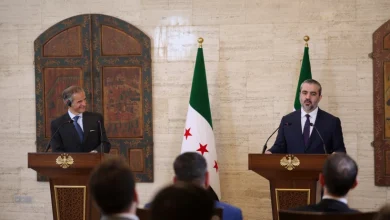
Saudi Arabia and Oman have reiterated the importance of protecting navigation through international waterways, particularly in the Strait of Hormuz.
The strategic maritime corridor has been the epicenter of tensions as the US and Iran traded heavy strikes in response to attacks on vessels transiting the Strait, putting their recently signed ceasefire on the brink.
Saudi-Omani Discussions
The Big Picture: Saudi Arabia’s Foreign Minister Prince Faisal bin Farhan and his Omani counterpart Badr Albusaidi held a phone call on Monday to review bilateral ties and discuss issues of mutual interest, the Saudi Foreign Ministry said in a statement.
What to Watch: Both ministers explored the latest regional developments, reaffirming the need to strengthen coordination and consultations, as well as advancing joint diplomatic efforts to safeguard the region’s security and stability. Their discussions focused on efforts to ensure freedom of navigation and maritime safety in the Strait of Hormuz.
Why It Matters: The Strait of Hormuz is a strategic waterway linking the Arabian Gulf with the Gulf of Oman and the Arabian Sea, through which around a fifth of daily global oil and LNG supplies pass. Oman, alongside Iran, overlooks the Strait.
The Hormuz Standoff
Flashback: Since the eruption of the US-Iran war in late February 2026, Iran has partially closed the Strait, illegally blocking transit without its permission. This has disrupted the flow of goods, essential commodities and energy and aid supplies. While a preliminary deal between the US and Iran on June 18 lifted the blockade, sporadic clashes erupted around the waterway, with Tehran claiming the right to total control over the critical maritime corridor. As a result, US President Donald Trump declared the ceasefire over, ordering waves of military strikes against Iranian targets and reinstating the naval blockade on Iran. Tehran, for its part, retaliated with attacks targeting US bases and facilities across the region.
State of Play: Following reports of an imminent escalation, the US paused attacks for two consecutive days after two weeks of tit-for-tat attacks, reportedly to give diplomacy a chance, according to the US Ambassador to the UN, Mike Waltz.
Oman-Iran Talks Underway
Driving the News: Iran touted progress in talks with Oman on the management of the Strait of Hormuz. Iranian Foreign Ministry’s Spokesperson Esmaeil Baghaei said that Iran and Oman’s Deputy Foreign Ministers held “useful” talks in Tehran over Friday and Saturday to discuss “common principles and operational mechanisms” to ensure the safe passage of shipping through Hormuz while respecting the sovereign rights of the two states.
Backstory: The US-Iran preliminary deal stated that Iran and Oman would hold discussions with other Gulf littoral countries to “define the future administration and maritime services in the Strait of Hormuz.” In light of this, Muscat and Tehran formed a joint committee to discuss the future administration of the Strait and the relevant services. However, Oman said that it had no plans to impose any transit fees on ships transiting the waterway.
Between the Lines: Oman has repeatedly underscored its commitment to continuing transparent and neutral cooperation with all parties to restore freedom of navigation in the Strait, in full compliance with international law and in line with its obligations as a State Party to the UN Convention on the Law of the Sea.
Saudi-Omani Coordination
The Context: As two members of the Gulf Cooperation Council (GCC), Saudi Arabia and Oman have closely coordinated, aligning their positions to navigate crises and maintain regional stability and peace. In response to Houthi attacks on shipping in the Red Sea, Muscat said it was closely coordinating with Riyadh, Yemeni Parties, and the UN Special Envoy for Yemen to resume the political process and implement the roadmap in a manner that will achieve security and stability in the region. It reiterated the need to avoid escalation and any threats that could further endanger freedom of navigation.
Catch Up Quick: Earlier in July, Prince Faisal bin Farhan visited Muscat to meet Albusaidi. The two ministers reaffirmed the importance of safeguarding waterway security, ensuring freedom of navigation, and supporting peaceful dialogue to resolve disputes and enhance regional stability. They also reviewed joint strategic initiatives, transportation networks, and logistics connectivity to support regional integration.
The Anchor: The two countries’ partnership is driven by the Saudi-Omani Coordination Council, established in 2021 to leverage each country’s comparative advantages and align the shared goals of Saudi Vision 2030 and Oman Vision 2040. One of the key projects under this framework is the Saudi-Oman Highway – a strategic land link connecting the two Gulf countries aimed at scaling up bilateral trade and tourism.