Sudan’s paramilitary Rapid Support Forces (RSF) claimed on Monday it had seized Heglig oilfield, the country’s largest oil field bordering South Sudan.
The seizure came as the RSF tries to expand its outreach to the east and south of the Darfur region, over which it had taken full control after capturing the city of El-Fasher in late October.
Capturing Heglig Oilfield
After news reports of the paramilitary’s seizure of the Heglig oilfields, the RSF confirmed it had taken control of the strategic oil field in the South Kordofan state. In a statement, the paramilitary group claimed it had “liberated” the strategic area of Heglig after the army forces fled.
“The liberation of the Heglig oil area marks a pivotal point in the path toward liberating the entire country, given the region’s economic importance as a key source of funding for the Port Sudan clique, which has used it to finance the war, expand its scope, and prolong its duration,” the RSF said.
The paramilitary group also said it would secure oil facilities, protect technical teams, and commit to their self-declared humanitarian truce.
SAF’s Withdrawal
A military source confirmed to AFP that the Sudanese Armed Forces (SAF) troops withdrew from the area. He said the reason behind the withdrawal was to “protect the oil facilities and prevent damage.”
Video footages have shown RSF fighters inside the Sudanese army’s 90th Infantry Brigade headquarters and standing beside abandoned military equipment.
Meanwhile, hundreds of SAF soldiers fled to South Sudan’s Unity State after leaving their positions in Heglig, Sudan Post reported.
“They entered our territory seeking safety. They arrived with their weapons. For their own security and of South Sudan, we have put their weapons and vehicles away. They are being held in a secure location while their status is assessed,” a security official said.
Heglig Strategic Importance
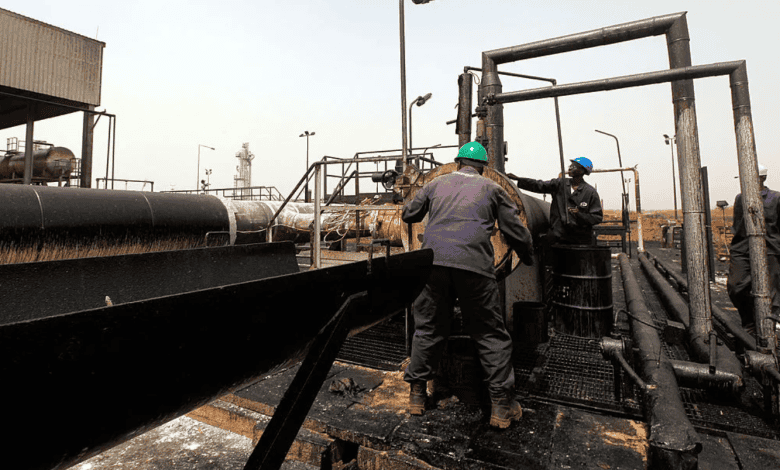
The Heglig oil field is the largest in Sudan, located in one of the country’s two main oil-rich regions. It has a significant economic importance for both Khartoum and Juba. The oil field represents a vital source of revenue for Sudan, which endures dire economic conditions due to the war.
Moreover, the strategic energy hub houses the main processing facility for South Sudan, which can only export oil through Sudan’s territory due to lack of other pipelines. It handles 130,000 barrels per day (bpd) of crude oil from South Sudan to Port Sudan for export.
Operations at the field shut down and technical teams were evacuated to South Sudan, reported Sudan Tribune, citing sources.
Sudan’s Energy Sector
The RSF’s takeover of Heglig further threatens Sudan’s ailing energy sector. Sudan’s second largest oil field, Balila field (Block 6), is located in the West Kordofan state and has been operated by China since the 1990s.
However, the China National Petroleum Corporation (CNPC) requested the early termination of its operations in Sudan, citing “force majeure,” after the RSF seized the field.
In the light of this, the Sudanese former oil minister, Gadein Ali Obeid, said that the loss of the country’s two main oil-producing regions represents a “disaster” for Sudan.
“All of Sudan’s oil production originates from both of them… Even oil from Block 6 was processed at Heglig, which used to handle between 80,000 and 100,000 barrels per day for Sudan and South Sudan,” he told AFP.
War in Sudan
Since April 2023, the SAF and RSF have been engaged in fierce fighting, triggering what the UN called “the world’s largest humanitarian and displacement crisis.” The war has killed tens of thousands of people, displacing over 12 million inside Sudan and to neighboring countries, and pushed parts of the country into famine amid cholera outbreaks.
Meanwhile, the conflict has driven Sudan into effective partition, with the SAF controlling the center, north and east, while the RSF holds the entire Darfur region and parts of Kordofan in the south, with each side declaring a government.
Fighting has intensified over the Kordofan region, which provides a strategic route to the capital, Khartoum, and links central Sudan to Darfur. Moreover, the region, including North, South, and West Kordofan, has an abundancy of resources.