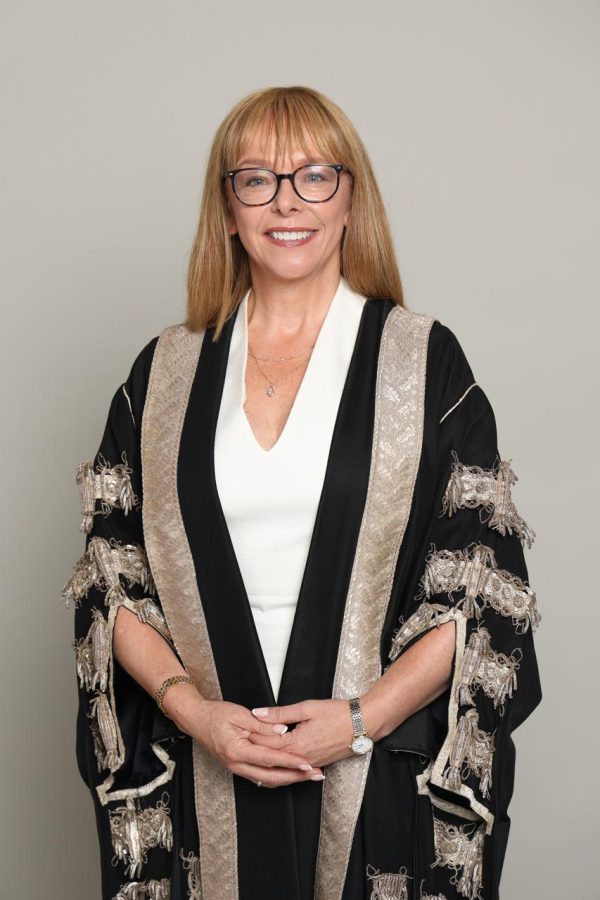
Heriot-Watt University has welcomed Professor Nola Hewitt-Dundas as Principal and Vice-Chancellor this week, marking an important transition in leadership at the University.
Professor Hewitt-Dundas joins from Queen’s University Belfast, where she served as Pro-Vice-Chancellor, and is an internationally recognised academic in innovation and science policy.
Her appointment comes as Heriot-Watt prepares to launch Strategy 2035 in October, the institutional strategy that will set the University’s direction and ambition for the next decade.
Bruce Pritchard, Chair of Court at Heriot-Watt University, said: “Professor Hewitt-Dundas brings a distinguished record in research and a deep understanding of how universities turn ideas into real benefit for communities and society.
“It is a privilege to welcome someone of her calibre, and a historic milestone for us, with Professor Hewitt-Dundas becoming the first woman to hold the post in our history.
“With Strategy 2035, we have a clear sense of direction and ambition, and in Professor Hewitt-Dundas we have the leader to deliver it.”
Professor Hewitt-Dundas brings extensive experience in senior university leadership, global engagement, governance, innovation and research.
Professor Hewitt-Dundas said: “This is a remarkable university where for over 200 years Heriot-Watt has responded to the needs of industry and society through world-class education, pioneering research and real-world impact.
“Heriot-Watt has always believed that education should be practical, useful, and open to anyone with the drive to use it. Our new strategy builds on that legacy, setting our direction for the next decade.
“This is an institution where we push the frontiers in disciplinary and interdisciplinary research. But what makes this distinctive is the strong ethos of innovation and entrepreneurship. And that’s evident in our graduate start-ups, our academic spin-outs, and our technology transfer with our partners.
“Together with colleagues, students, our alumni and partners we have an extraordinary opportunity to build on our strengths, to broaden our impact and to shape the next chapter of Heriot-Watt’s story.”
Professor Hewitt-Dundas succeeds Professor Richard A. Williams, who steps down at the end of September after eleven years leading Heriot-Watt, during which the University strengthened its global presence and its international reputation for research and innovation.
Founded in Edinburgh, Heriot-Watt University is an internationally recognised university with campuses across Scotland, including Edinburgh, the Scottish Borders and Orkney, as well as in Dubai and Malaysia. It is renowned for its industry-focused education, research excellence and real-world impact across science, engineering, business and the built environment.
About Heriot-Watt University
Heriot-Watt University is a global research-led university based in the UK, with five campuses in Edinburgh, the Scottish Borders, Orkney, Dubai and Malaysia.
More than 25,000 students from 154 countries are currently studying with us. We have more than 173,000 alumni in 190 countries.
We are specialists in business, engineering, design and the physical, social, sports, environmental and life sciences subjects which make a real impact on the world and society.
Heriot-Watt was founded in Edinburgh in 1821 as the world’s first mechanics institute. In 1966, it became a university by Royal Charter. The university is named after 18th century Scottish engineer and inventor James Watt and 16th century Scottish philanthropist and goldsmith George Heriot.
86.8% of Heriot-Watt’s research is classed as world-leading and internationally excellent in the Research Excellence Framework 2021 – the UK’s system for assessing the excellence of research in UK higher education providers.
The university runs 113 undergraduate programmes and 170 postgraduate programmes across six academic schools and Edinburgh Business School.
Website: https://www.hw.ac.uk/
Contact:
If you would like more information or have any interview requests, please get in touch with Aisha Shaikh at: a.shaikh@hw.ac.uk