Saudi Arabia is putting a lot of effort to increase its self-sufficiency and achieve food security in line with its transformative Vision 2030.
For this purpose, the Saudi Ministry of Environment, Water and Agriculture announced 5 new investments in the agriculture sector in Al-Baha region, as part of the Kingdom’s endeavors to bolster self-sufficiency in agriculture.
New Investments
The Ministry of Environment announced these investment opportunities through its FURAS platform. These projects involve cultivating fruit, coffee, and palm trees, in addition to flowers and wild plants.
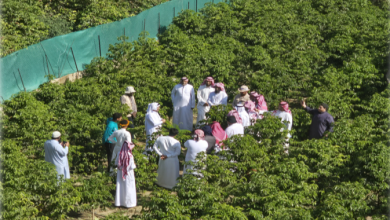
The new investment opportunities feature a coffee city project to cultivate more than 150,000 trees over an area of 2.29 million square meters, with a production capacity exceeding 15,000 tons, reported the Saudi Press Agency (SPA).
The second opportunity is Al-Ennab Village project near Al-Janabeen Dam. It focuses on cultivating palm and fruit trees across an area of over 4.6 million square meters.
Meanwhile, the third project is the Lavender Fields, which aims to plant more than 2,500 lavender seedlings annually and set up a fence and shades made of agricultural mesh, mother fields, and irrigation networks in an area exceeding 11,710 square meters.
Moreover, the Ministry announced a fruit nursery project in Qilwah, with the aim of cultivating 100,000 seedlings annually for all types of fruits, covering an area of 33,370 square meters.
Additionally, there is a flower nursery project in the same district to produce 500,000 seedlings annually for various flowers and wild trees over an area of 34,790 square meters.
Boosting Agriculture
Despite 90% of its territory being desert, Saudi Arabia is driving an agricultural boom to enhance domestic crop production and reduce dependence on imported food, according to Arab News.
Earlier this month, the Ministry of Environment, Water and Agriculture launched the first Saudi AgriFood Tech Alliance. The project founding partners include: the Research, Development, and Innovation Authority, King Abdullah University of Science and Technology, and Topian, NEOM’s food company.
The alliance aims to provide a platform for all stakeholders in the agriculture and food sector, harnessing the deployment of AgriFood technological solutions on a national scale.
Saudi Self-sufficiency
Saudi Arabia has embarked on a number of initiatives, investments and technological innovations to achieve food self-sufficiency in many products. In September 2023, figures from the General Authority for Statistics’ Agricultural Statistics Publication showed that the Kingdom has achieved complete self-sufficiency in the production of dates, fresh dairy products and table eggs.
Moreover, the figures indicated that Saudi Arabia has the capacity to export these items, as the Kingdom’s production exceeded its local demand, with a production rate of 124, 118 and 117 percent, for these items respectively.
Additionally, the Kingdom met 80% of local demand on potato, while domestic poultry comprises 68%, tomatoes 67%, red meat 60%, carrots 50%, fish 48%, and onions 44%.
Overcoming Challenges
Saudi Arabia has to tackle two main challenges to improve its food self-sufficiency. These obstacles are climate change, that has caused new record temperatures and soil degradation; and water scarcity, resulting from limited rainfall and natural freshwater reserves.
The CEO and vice chairman of the Red Sea Farms Cooperative, or Tamala, Jamal Al-Saadoun, told Arab News that Saudi Arabia has realized these levels of food self-sufficiency by “planning over a long period.” He noted that the Kingdom started working towards achieving self-sufficiency in the 1980s.
Al-Saadoun added that modern technology and the presence of many technological companies in the Kingdom have helped Saudi agri-business and investors to enhance quality and yields.
Furthermore, the Saudi government has heavily invested in modern desalination technologies and advanced irrigation techniques. These investments allow it to harness its water reserves and reduce water wastage. Saudi Arabia has built desalination plants along its coastlines to convert seawater into freshwater to use it in irrigation and other agricultural purposes.
The Kingdom is also considering the adoption of localized vertical-farming techniques and hydroponics, that is the science of cultivating plants without soil and with limited amounts of water.
Funding Farmers
The Saudi Agricultural Development Fund is playing a pivotal role in achieving food self-sufficiency by providing support for local farmers. The Fund has approved substantial loans for small farmers in greenhouse vegetable production, fish and shrimp farming, and poultry breeding.
In addition, the Kingdom has introduced several initiatives, including the Sustainable Agricultural Rural Development Program, that boost self-sufficiency in sectors such as fruit and coffee production.